
How to choose erosion control matting and rolls
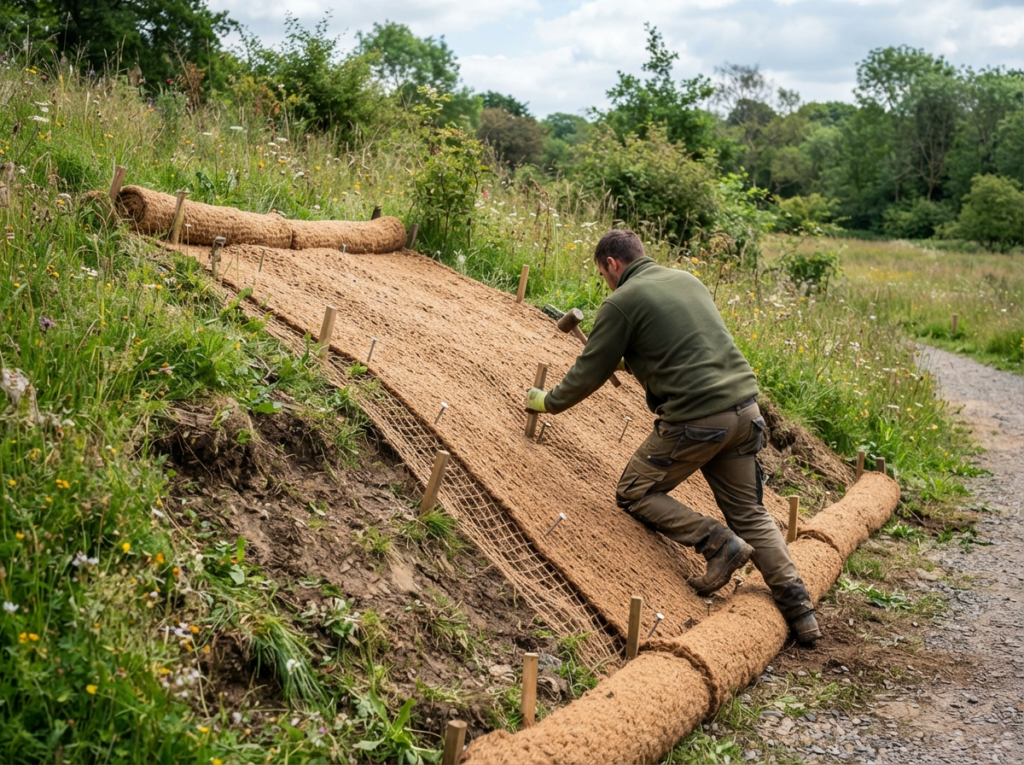
Work out where the erosion is happening before you order anything. A slope losing topsoil to wind and rain needs a different product to a bank being cut back by moving water, and once you know which one you have, the weight, format and fibre mostly choose themselves.
Slope face or water’s edge?
If a bank or slope is losing soil while grass or wildflower seed gets going, you want full-area cover: netting or a blanket laid flat across the whole surface. That’s Jute Netting, Geocoir Erosion Control Mesh, and Eromat C-100-J Coir Erosion Control Blanket.
If the problem is a linear edge instead, a riverbank, pond margin or ditch line being eaten away by flowing water or wave action, netting on its own won’t do much. You need mass or a physical barrier sitting at the toe: Rock Rolls, Brushwood Faggots, or Willow Spiling & Brush Mattress if you want a living structure rather than an inert one.
And if you want a wetland margin or attenuation pond edge to look established from day one, rather than bare fibre you plant into later, Coir Rolls and Coir Pallets arrive pre-planted with native UK wetland species already rooted in.
How much force is the ground dealing with?
Within the slope-face group, weight and cost roughly track exposure. Jute Netting is the cheapest and most widely used option for ordinary embankments and cuttings. It’s fully biodegradable and holds seed and topsoil in place while a sward establishes, though synthetic mats can outperform it once erosion forces get severe or vegetation is genuinely hard to establish. Geocoir Mesh comes in three weights, 400g/m2 up to 900g/m2, so you can match weight to how exposed the site is; the heaviest grade is aimed at the most demanding sites Phoenix supplies. It gives around five years of surface stability while roots take hold, a lot longer than jute.
Eromat’s blanket is a different shape again, a single coir mat rather than an open mesh, rated for gradients up to 1:1 and short-term flows up to 4.26 metres per second. It’s unseeded, so you sow grass or wildflower underneath it yourself, and it’s only rated for around 12 months: shorter-lived than Geocoir, but built to sit somewhere water crosses the slope, not just wind and rain.
At the water’s edge the force involved steps up again. Rock Rolls, dense stone packed inside a geogrid sleeve, are the toughest of the three: they dissipate wave energy and resist scour on rivers, lakes and coastal banks, and stay permeable so water passes through instead of building up behind them. Brushwood Faggots do a similar toe-support job with bundled native brushwood (ash, hazel or willow) instead of stone. They blunt the force of moving water and trap silt, and they’ll rot down naturally once the bank has re-vegetated around them. Willow Spiling & Brush Mattress is the slow-build option: live willow stakes driven into the bank grow into a root structure over time, so it ends up the most self-sustaining of the three once established, but it takes a season or more and it’s a bioengineering job rather than something you unroll and walk away from.
Wetland margins, and the fixings you’ll still need
Coir Rolls and Coir Pallets both arrive pre-planted with native wetland species rather than bare fibre, so you skip the weeks where a fresh planting is just mud. Rolls come in the cylindrical form you’d use along a bank or channel edge; Pallets are flat mats, better suited to a pond margin or SuDS area you’re covering rather than lining.
Nearly everything above needs pinning down, which is where Stakes & Pegs come in. GreenStake’s biodegradable stakes anchor matting, mulch mats and netting into hard ground, hold for over 18 months, and break down completely afterwards, so nobody has to go back and dig them out.
Worth flagging honestly: Ground Cover sits in this category online, but it isn’t erosion control. It’s a weed-suppression membrane for patios, block paving and driveways. If that’s genuinely what you need, it’s the right product, just not for a bank or slope.
Most of the products above for river, pond and wetland edges are quoted individually rather than listed at a fixed price, because the right size and grade depends on the bank, flow and gradient in front of you. If you’re not sure which of these fits your site, use the enquiry form on the product page or speak to the team directly before you order.
Frequently asked questions
Do I need to remove erosion matting once the grass has grown through?
No. Jute Netting, Geocoir Mesh and Eromat blanket are all biodegradable and designed to break down naturally once roots have taken over, so there is nothing to dig out afterwards.
Why do some of these products not show a price?
Rock Rolls, Willow Spiling & Brush Mattress, Brushwood Faggots, Ground Cover, Coir Rolls and Coir Pallets are quoted individually because sizing depends on the site: bank length, flow, gradient and, for the wetland products, which native species mix you want. Use the enquiry form on the product page for a specification and price.
Can I combine more than one erosion control product on the same site?
Yes, this is normal practice. A common approach on a riverbank is Rock Rolls or Brushwood Faggots at the toe to take the direct force of the water, with a coir blanket or mesh further up the bank face where seed is establishing, pinned down with Stakes & Pegs.