
How to choose wildflower seed
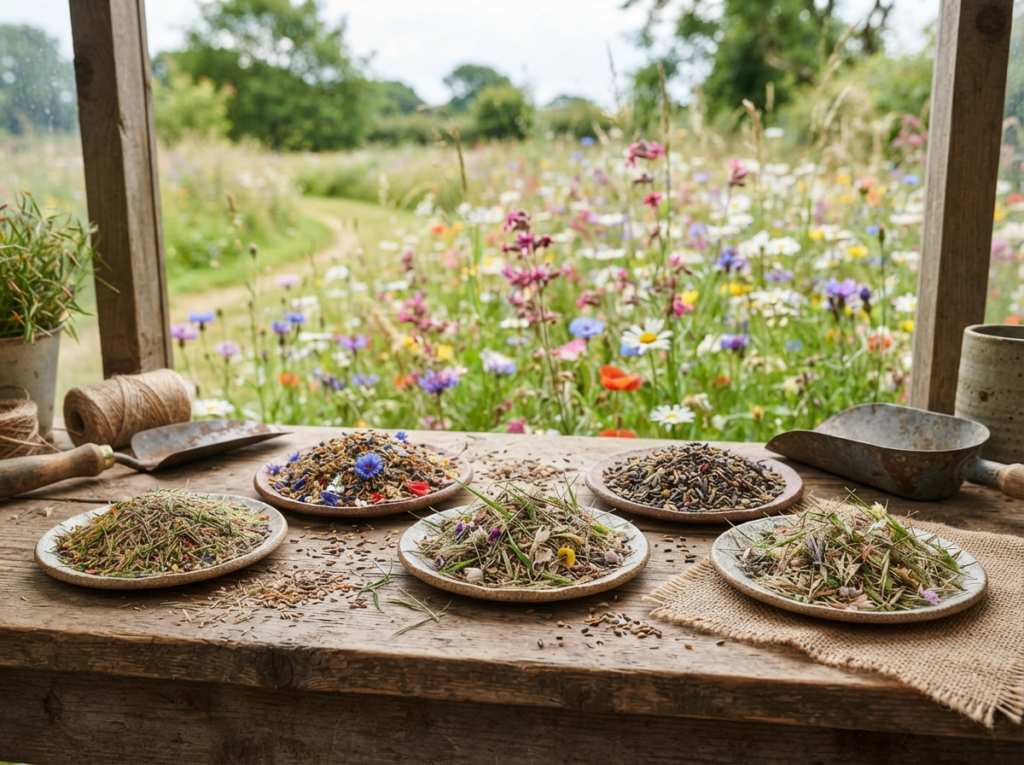
Two decisions settle most wildflower orders: whether you want 100% flowers or a grass and flower meadow mix, and whether the mix is matched to your actual soil rather than a generic ‘wildflower’ label. Get those right and the display that shows up in year two looks like the one on the packet.
100% wildflower, or wildflower and grass together?
Phoenix runs matching pairs through the BFS range: a 100% wildflower version, marked with an (F), and a wildflower and grass version of the same habitat type. BFS1(F) Traditional Hay Meadow is pure flower, sown at 1 to 2g/m². Its sibling, BFS 1 Traditional Hay Meadow, is 20% wildflower and 80% grass, sown heavier at 5g/m² because most of what you are sowing is grass, not flower.
The 100% mix gives a denser, more colourful first few years and suits a garden, a show border or anywhere the display itself is the point. The grass and flower version is closer to a real meadow: the grass carries the sward through winter, keeps weeds down while the wildflowers establish more slowly, and needs the traditional once or twice a year cut rather than constant attention. If the brief is genuinely ecological restoration or a low-input amenity meadow, the grass and flower version is usually the honest recommendation, even though the 100% version photographs better in the first summer.
Match the mix to the soil, not the aspiration
Wildflowers are far fussier about soil than lawn grass, and a mix chosen for the wrong ground simply fails to establish, whatever the label says. Heavy clay that waterlogs in winter and cracks in summer needs BFS4(F) Heavy Clay Soil. Chalk or limestone, dry and low in fertility, needs BFS7(F) Calcareous Grassland. A shallow, dry, low-fertility green roof needs BFS12(F) Greenroof, which drops in drought-tolerant stonecrops that a standard meadow mix does not carry. If you are not sure what your soil is, dig a spade’s depth and look at it before you order: a mix bred for free-draining chalk will sit and sulk on waterlogged clay, and no amount of aftercare fixes that mismatch.
Native meadow or ornamental colour scheme?
Not every wildflower project is aiming for a UK native, NVC-matched meadow. The Urban Non-Native range exists for beds, verges and amenity schemes where a colour theme matters more than habitat authenticity. UM1 Blue Harbour runs blue and white through summer, UM9 Nice & Easy gives an easy perennial display in yellow, white and purple, and UM7 Hardy Annuals copes with cooler sites and light shade that most annual mixes would struggle with. For remembrance planting or a one-off red and blue display, 100% Poppy & Cornflower Mix or pure Common Poppy Seed do the job without pretending to be a native meadow. None of this is wrong, but it is a different brief, and worth being honest about before you order a native BFS mix for a job that actually wants garden colour.
Which product for which job
Garden or small amenity meadow, colour-first: a 100% BFS(F) mix matched to your soil, such as BFS10(F) Species Rich on ordinary soil.
Restoration meadow or low-input amenity grassland: the equivalent grass and flower mix, for example BFS 10 Species Rich Wildflower Meadow Seed Mix.
Ornamental beds, verges or a themed display: an Urban Non-Native mix such as UM1 Blue Harbour.
Something more specific than the standard range covers: the Create Your Own Seed Mix service will formulate a bespoke wildflower, grass, or combined mix to your site’s soil and brief, and can label mixes for trade orders.
If your site does not obviously fit one of these types, or you are working to an NVC target community for a planning condition, it is worth phoning the sales team with the soil type and site history before ordering. A wildflower mix is a multi-year commitment, and the wrong one only shows up as a failure in year two.
Frequently asked questions
How long does it take a wildflower meadow to flower properly?
Most native meadow mixes need two to three full growing seasons to reach their proper flowering display, since perennial wildflowers put their first year into root and leaf growth rather than flowers. Annual and Urban Non-Native mixes flower in their first summer, but that display does not persist without re-sowing or tilling the ground again the following autumn.
Do I need to cut a wildflower meadow, and when?
Yes, and timing matters more than most people expect. A traditional hay meadow mix is normally cut once in late summer, after seed has set and dropped, and the cuttings are removed rather than left to rot down and add fertility the wildflowers do not want. Tussocky grassland mixes may only need cutting every other year. Check the individual product page, since the right regime differs by habitat type.
Can I sow a wildflower mix on top of an existing lawn?
Not successfully as a rule. Wildflowers need bare, disturbed soil to germinate and cannot compete with an established grass sward for light and nutrients. The ground needs to be cleared back to soil, whether by turf stripping, cultivation or a stale seedbed, before sowing. This is a genuine limitation, not a sales point either way, so it is worth planning the groundwork before the seed arrives.