
How to choose tree protection for a newly planted tree
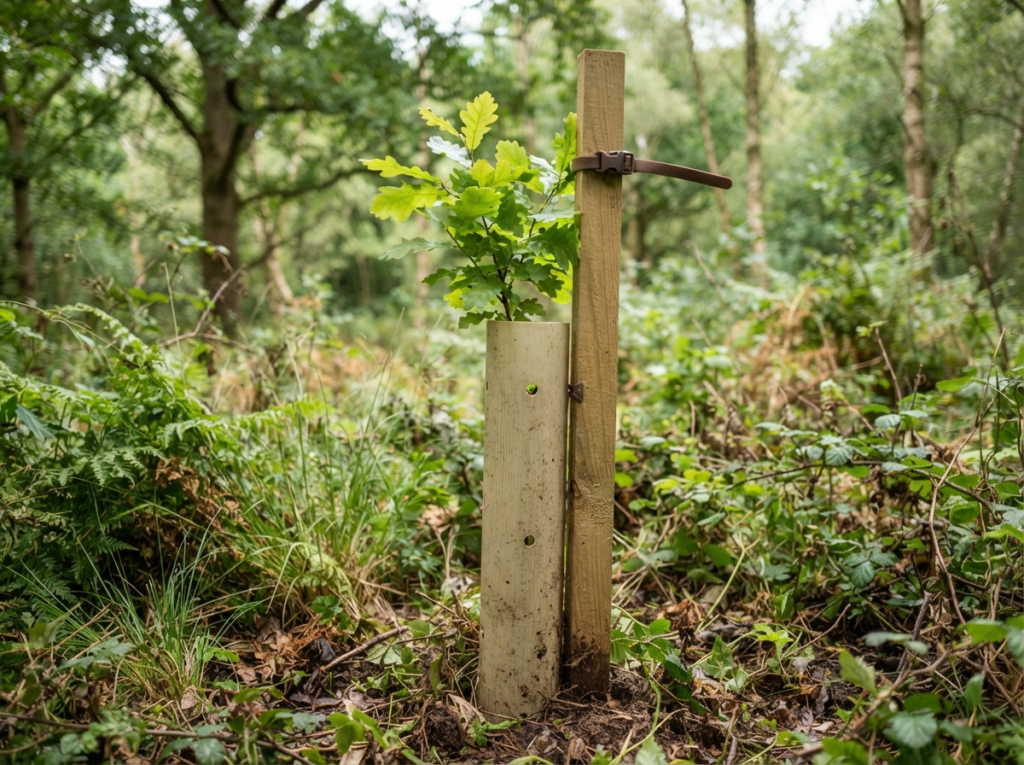
Protecting a newly planted tree usually means three decisions, not one: what shape of guard the plant needs, whether it needs a separate stake to hold that guard upright, and whether you want the whole thing collected and recycled afterwards or left to biodegrade in the ground.
What’s actually threatening the tree
Rabbits and voles are the baseline risk on most sites. Hares, sheep and deer raise the height the guard needs to reach, and on roadside or amenity planting, strimmer damage and herbicide drift matter as much as browsing does. A site with light rabbit pressure and careful maintenance staff can often get away with a lightweight spiral guard. A site with deer, or one that gets contract-mowed by whoever’s cheapest that month, needs a taller, sturdier shelter. Work out which of these applies before choosing a guard shape.
Guard shape: tube, shrub shelter, spiral or hedge wrap
For a single-stemmed whip, the Vigilis Standard Tree Shelter is a rigid tube that also traps warmth around the stem, which helps it establish faster, on top of the physical browsing protection. It comes in five heights from 0.6m, which covers rabbits, up to 1.8m for red and sika deer, so size to the tallest threat on site rather than the average one.
Bushy, multi-stemmed shrubs and hedgerow species such as hawthorn and blackthorn need width more than height. The Vigilis Shrub Shelter has a shorter, wider profile in Standard and XL diameters, built for exactly that growth habit.
The Spiral Tree Guard is the lightweight, lower cost option: it protects against rodents, rabbits, sheep and deer, comes in four heights and four diameters, and suits sites where the browsing pressure doesn’t justify a full tube shelter and its microclimate benefit.
For slim hedging whips where you’d rather not drive a stake in at all, the Vigilis Hedge Wrap opens to fit around the stem, needs no stake, and expands as the plant thickens.
Supporting the guard: stakes, ties and spacers
A tube or shrub shelter needs a Tree Shelter Stake alongside it, in square or machine-rounded profiles sized to the guard’s height, driven in next to the whip rather than through the rootball. A spiral guard is generally supported on a bamboo cane instead, a simpler and cheaper option that suits its lighter build.
For larger standards being staked without a tube guard, or bare-root trees on exposed sites needing extra support while roots establish, Tree Stakes & Cross Bars give a double-stake fixing that a single stake won’t match on bigger trees. Secure the trunk to the stake with Buckle & Soft Tree Ties, which come with a spacer already fitted, or with Tree Belting cut to length plus Spacer Sleeves and Blocks to keep the stake off the bark on bulk planting schemes.
Standard or biodegradable
Vigilis shelters, shrub shelters and hedge wraps all come in a standard, recyclable version and a soil-biodegradable Bio version made from a patented plant-based material. Choose standard where someone will realistically return to collect guards; choose Bio, such as the Vigilis Bio Tree Shelter or Vigilis Bio Shrub Shelter, for remote sites, rewilding schemes or Countryside Stewardship agreements where biodegradable guards are often preferred; check your scheme’s specific conditions with your adviser.
Most planting schemes end up ordering across two or three of these categories rather than one, and that’s normal: a mixed hedgerow and standard tree planting job might need hedge wraps, tube shelters, shelter stakes and ties all in the same delivery. If you’re not sure how a specific site should be specified, contact the team with your planting plan and browsing pressure and they’ll help you put the right combination together.
Frequently asked questions
Do I always need a stake with a tree guard?
Tube shelters and shrub shelters need a stake alongside them. Spiral guards are usually supported on a bamboo cane instead. Hedge wraps are the exception: they stand on their own without a stake, though you can add a cane for support on exposed sites.
How tall a guard do I need if I have deer as well as rabbits on site?
Size to the tallest threat present, not the average one. Rabbits need 0.6m, hares 0.75m, roe deer and muntjac 1.2m, fallow deer 1.5m, and red or sika deer need 1.8m. A site with several species should be guarded to the height of the most demanding one.
What's the advantage of a biodegradable guard over a standard one?
A standard guard lasts six years or more and is fully recyclable once collected, which suits sites where someone will return to remove it. A biodegradable Bio guard breaks down naturally in the soil once the tree is established, so there's nothing to collect, which matters on remote sites or grant-funded schemes where reducing plastic is part of the agreement.