
How to choose a tree or shrub guard
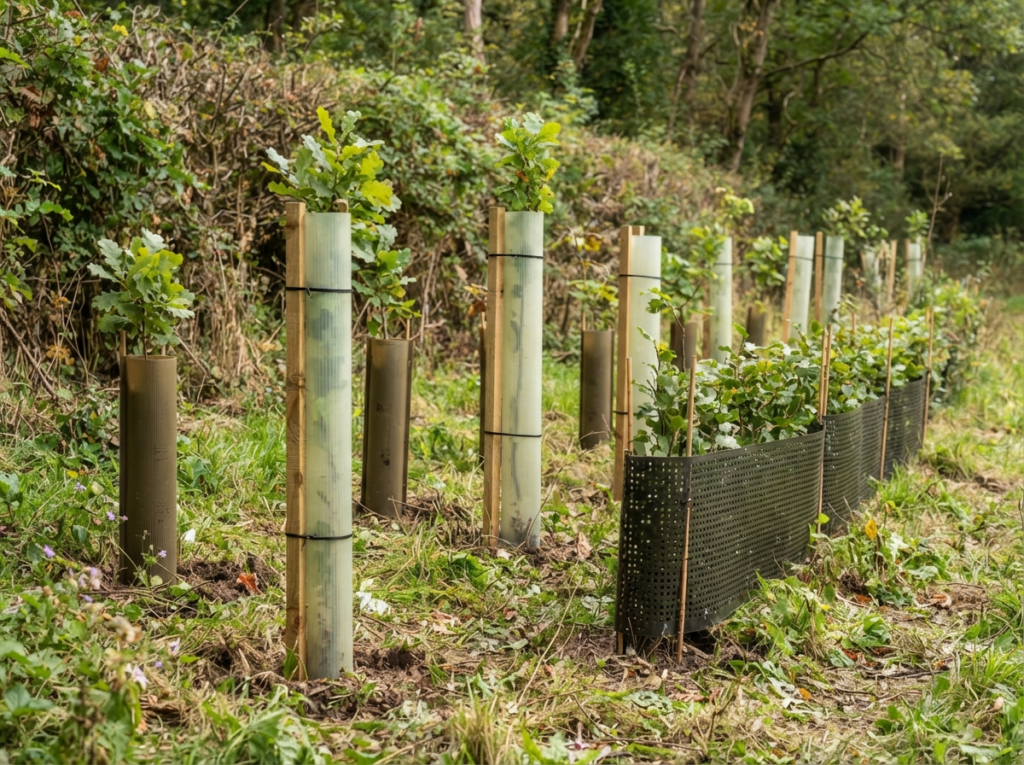
Three questions decide which Vigilis guard is right: what shape of plant you’re protecting, whether you want it recyclable or left to biodegrade in place, and how tall the guard needs to be for the browsing pressure on your site.
Tree, shrub or hedge: which shape guard
A single-stemmed whip growing straight up needs a tube. The Vigilis Standard Tree Shelter and its biodegradable counterpart, the Vigilis Bio Tree Shelter, are rigid twin-walled tubes that also trap warmth around the whip, which helps it establish faster.
Bushy, multi-stemmed native shrubs and hedgerow species such as hawthorn, blackthorn, hazel and field maple need more room than a narrow tube allows, or the tube ends up restricting the lateral growth that makes these species useful for hedgerows and habitat in the first place. The Vigilis Shrub Shelter and Vigilis Bio Shrub Shelter have a shorter, wider profile for exactly that, in Standard (130 to 160mm) and XL (160 to 200mm) diameters depending on how bushy the species gets.
For slim, single-stemmed hedging whips where you’d rather not drive a stake in at all, the Vigilis Hedge Wrap and Vigilis Bio Hedge Wrap open to fit around the stem, need no stake, and expand as the plant thickens so they never constrict it. That stake-free fitting is what makes them quick across high-volume hedgerow schemes.
Standard or Bio: recyclable plastic or soil-biodegradable
The standard range is UV-stabilised polypropylene with up to 30% recycled content, built to last six years or more and fully recyclable once the plant is established. That’s the right call where someone will realistically return to site to collect guards, and where a longer-lasting, slightly more robust tube suits the conditions.
The Bio range is a genuinely different material: a patented plant-based product derived from potato, wood and corn, soil-biodegradable to ISO 17556, developed with over £360,000 of Innovate UK funding and tested in the UK’s largest independent field trial for a biodegradable tree guard. It breaks down naturally in the soil once the tree is established, so nobody has to go back and collect guards from remote or hard-to-access sites. That’s worth the extra thought on Countryside Stewardship hedgerow agreements and similar schemes, where biodegradable guards are accepted and often preferred; check the specific conditions of your agreement with your scheme adviser, as data sheets are available on request.
Sizing for the browsing pressure on site
Height should match the most demanding animal actually present, not the average one. On tree shelters, 0.6m covers rabbits, 0.75m covers hares, 1.2m covers roe deer and muntjac, 1.5m covers fallow deer, and 1.8m is needed for red and sika deer. Where more than one species is present, size up to the tallest threat rather than splitting the difference. Hedge wraps run a shorter range, 0.40m and 0.60m for rabbits and 0.75m for hares, since they’re built for slimmer stems rather than deer-pressured sites.
Which product for which job
Woodland creation, reforestation and Biodiversity Net Gain planting where guards will be collected: Vigilis Standard Tree Shelter. The same job on a Countryside Stewardship or rewilding scheme where nobody wants to be retrieving plastic afterwards: Vigilis Bio Tree Shelter. Hedgerow creation and farm wildlife schemes with bushy, multi-stemmed planting: Vigilis Shrub Shelter or the biodegradable Vigilis Bio Shrub Shelter. High-volume hedgerow whip planting where a stake would slow things down: Vigilis Hedge Wrap or Vigilis Bio Hedge Wrap.
If you’re planting a mix of shrubs, whips and standards on the same site, it’s entirely normal to order across two or three of these rather than force one guard type to do every job. For advice on quantities and which sizes suit a specific planting plan, get in touch with the team.
Frequently asked questions
What's the difference between a standard Vigilis guard and a Bio one?
Standard guards are UV-stabilised polypropylene, built to last six years or more and fully recyclable once collected. Bio guards are made from a soil-biodegradable, plant-based material that breaks down naturally in the ground, so there's nothing to collect once the plant is established.
Will a Bio tree guard biodegrade before the tree is established?
It's designed to give protection through the establishment period, then break down in normal soil temperatures once the tree no longer needs it. If you're relying on it for a specific grant scheme's conditions, check the timescale against your agreement with your scheme adviser.
Do I need a stake with every Vigilis guard?
Tree shelters and shrub shelters are fixed to a stake with pre-fitted cable ties. The Vigilis Hedge Wrap and Bio Hedge Wrap are the exception: they stand on their own without a stake, though you can add a bamboo cane for support on exposed sites or taller plants.