
How to keep priority turf alive legally when a hosepipe ban comes into force
If you manage amenity ground, a sports surface, or any lawn that takes wear, a hosepipe ban notice from your water company tends to land at the worst possible moment: ground baked hard, sward stressed, fixtures still coming. The instinct is to start triaging immediately. Before you do, it is worth understanding exactly what the ban restricts, because the assumption that all outdoor watering stops is often wrong.
What a Temporary Use Ban actually covers
Water companies in England and Wales can issue Temporary Use Bans under section 76 of the Water Industry Act 1991. Standard TUB restrictions target domestic use: watering a private garden or lawn by hosepipe, washing a car by hosepipe, filling a paddling pool. A TUB issued under this section does not automatically prohibit commercial irrigation, local authority grounds maintenance, or sports club operations.
Drought Orders under the Drought Act 1976 are a different instrument. These require approval from the Secretary of State and can restrict commercial and industrial water use as well as domestic. If your water company has escalated from a TUB to a Drought Order, the legal position changes significantly. Read the specific order or notice in full, not just the press headline. The wording matters more than the label.
Exemptions and legal alternatives
Even under a Drought Order, certain uses remain lawful. Hand watering by can is almost never restricted: the legislation targets the hosepipe, not the act of watering itself. Water collected in a butt or harvested from a roof is generally exempt because it is not drawn from the mains supply. On many surfaces, these alternatives can bridge the critical first fortnight, particularly for newly seeded areas that cannot afford to wait for rain.
For sports clubs, bowling greens, cricket clubs, and grounds teams managing surfaces with clear community or economic value, some water companies accept formal exemption applications during Drought Orders. This is worth pursuing. Contact your water company before conditions deteriorate, not after, because the process takes time and there is no guarantee of approval. Put the application in writing and make the case clearly.
Deciding where the water goes
When allocation is tight, the priority question is where failure is irreversible. An established lawn under stress can enter dormancy and recover once rainfall returns. A cricket square that cracks badly, or a recently seeded area that dries out before establishment, is a different and more expensive problem.
Newly turfed or seeded areas top the priority list. After that, concentrate on high-wear surfaces where the sward is already thin: penalty areas, goal mouths, heavily trafficked grass paths. An established back lawn looks terrible in drought but comes back. A seedbed that fails needs reseeding from scratch.
Water at dawn where timing is in your control. Midday application loses a meaningful proportion to evaporation before it reaches the root zone. A soil wetting agent can help on hydrophobic or compacted surfaces where water tends to bead and run off rather than penetrate. When every litre is rationed, penetration matters.
Cutting regime during a ban
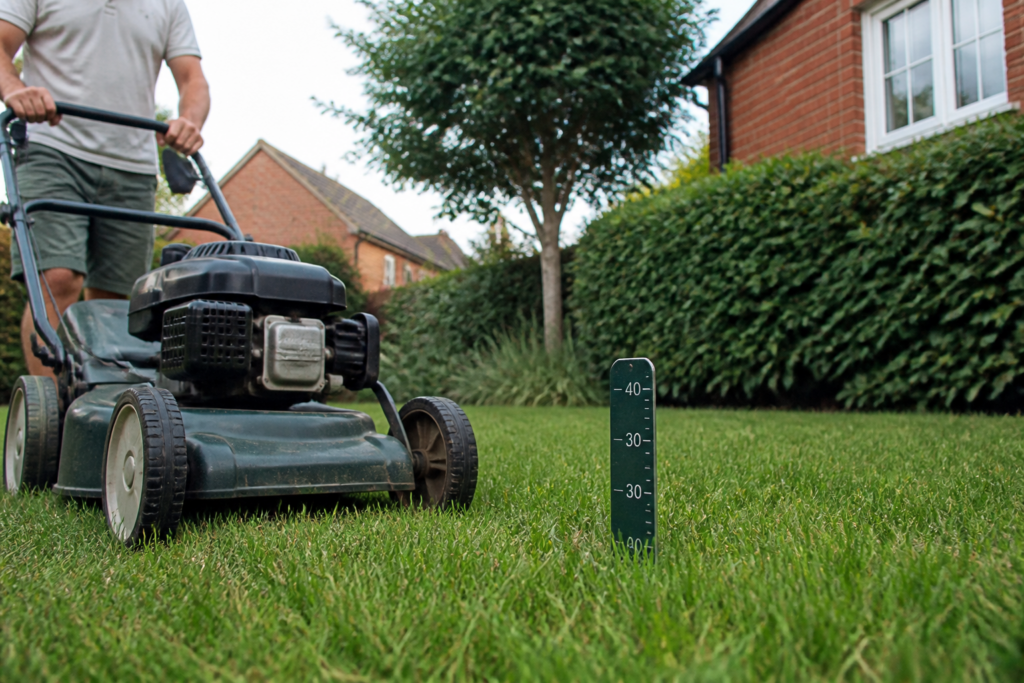
Raise the mowing height. Longer leaf blades shade the soil surface, lower the temperature at root level, and reduce evaporative loss from the sward. On a sports pitch, go as high as the fixture schedule allows. A surface that fails mid-season is harder to recover than one playing slightly long.
Hold off on nitrogen-heavy fertiliser applications. They drive leaf growth, which increases the plant’s water demand. If any nutrition is needed at all, a low-nitrogen biostimulant or seaweed-based product is a more appropriate choice during a dry period; it can support root health without pushing the top growth you cannot afford to sustain.
After the ban lifts
When restrictions end and rain returns, wait a few days before putting machinery back on. Compacted dry ground needs time to rehydrate before it will handle traffic without damage. Heavy renovation on stressed turf before it has recovered can cause more harm than the drought itself did.
Keep a record throughout any restricted period: dates, volumes used under any exemption, and correspondence with your water company. A clear log is easy to present if compliance is ever questioned, and good records also help you plan better for the next dry summer.
Frequently asked questions
Does a hosepipe ban apply to sports clubs and commercial grounds teams?
A standard Temporary Use Ban under the Water Industry Act 1991 primarily targets domestic use and does not automatically cover commercial or sports club operations. A Drought Order can restrict commercial use too. Check the specific notice issued by your water company to confirm what applies to your site.
Can I use a watering can during a hosepipe ban?
Yes. A hosepipe ban restricts use of a hosepipe connected to the mains supply; it does not restrict watering by hand with a can or bucket. Water from a rainwater butt is also generally exempt because it is not drawn from the mains.
What is the difference between a hosepipe ban and a Drought Order?
A hosepipe ban (Temporary Use Ban) under the Water Industry Act 1991 restricts specific domestic uses. A Drought Order, made under the Drought Act 1976, is more severe and can restrict commercial and industrial water use too. Drought Orders require approval from the Secretary of State.
How do I apply for a watering exemption during a Drought Order?
Contact your water company directly as soon as a restriction is announced. Some companies accept applications from sports clubs, bowling greens, cricket clubs and other sites with clear community or economic value. You may need to agree to a reduced allocation and provide supporting information about the site.
Should I let the lawn go dormant during a hosepipe ban or keep watering?
Established lawns often survive temporary dormancy and recover once rainfall returns. Priority for any limited water supply should go to newly seeded or turfed areas, cricket squares, bowling greens, and other surfaces where damage is slow and costly to reverse.