
How to choose reptile and amphibian fencing
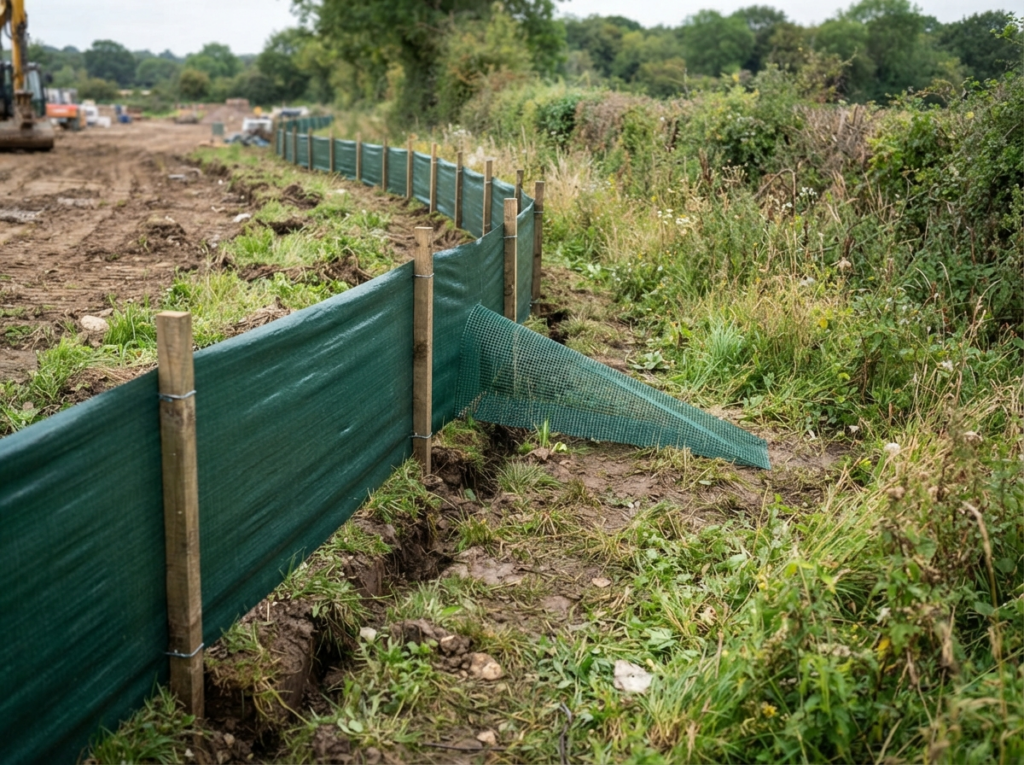
All six of Phoenix’s Herpetosure barriers keep protected species off a site during construction or land management, but the panel is tuned to the species named in the ecological survey or method statement. Work out which species that is, and whether the fence needs to work in one direction or both, and the right barrier is usually obvious.
Which species does the fence need to exclude?
Newt & Slow Worm Fencing is the standard ecological exclusion system: self-supporting green recycled polypropylene panels that need no stakes, resist fire and vandalism, and go up faster than timber or membrane fencing. Toad Fencing is made to the same specification. Few toad species carry the same legal protection as great crested newts, but they still migrate in large numbers to breeding ponds, and this fencing is commonly installed at road crossings to guide them safely through culverts underneath rather than across the road.
Snake Fencing stands taller, at an above-ground height of 900mm, supplied in three-metre panel lengths. It has been used at nuclear power stations, flood alleviation schemes and road and rail projects, and suits sites where vegetation along the fence line cannot be kept cut back, or where the extra height is needed to stop snakes getting through regardless.
Water Vole Fencing is a durable, cost-effective barrier used by developers, contractors and conservation bodies including the RSPB to stop water voles crossing a site boundary during development or conservation work.
Where a project needs to exclude reptiles generally rather than one named species, Reptile Fencing is the general-purpose option: a reusable, recyclable barrier that installs quickly and carries a 10-year UV guarantee. Its beige colour resists the expansion and contraction that direct sun causes in black fencing, so a long-running fence line stays taut through the seasons rather than sagging.
Does the barrier need to let animals leave, or keep them out both ways?
One-Way Fencing does a different job to the barriers above. Its panels are formed with two bends that hold the fence at a 45-degree angle once fitted, and a textured upper surface gives reptiles and amphibians enough grip to climb out and leave a site, while stopping them climbing back in. It is the right choice when a working area needs clearing of a protected population before construction starts, rather than kept permanently free of one, so it is often fitted alongside a standard exclusion barrier rather than instead of it.
How long does the fence need to stay up?
Newt & Slow Worm Fencing is built to go up fast, which suits a construction boundary with a defined programme. Reptile Fencing’s 10-year UV guarantee and sun-stable beige panels are worth asking about specifically where the fence needs to stay up for a medium to long-term ecological project rather than one phase of works.
Which product for which job
- Reptile Fencing: general reptile exclusion, long-running sites, 10-year UV guarantee.
- Newt & Slow Worm Fencing: standard ecological exclusion, fast to install, no stakes needed.
- Toad Fencing: same specification as newt and slow worm fencing, commonly used at road crossings to guide toads to culverts.
- Snake Fencing: 900mm above-ground height, for sites where vegetation cannot be kept clear or extra height is needed.
- Water Vole Fencing: excluding water voles from a development or conservation boundary.
- One-Way Fencing: clearing a working area of a protected population before works start, fitted alongside a standard barrier.
None of these are listed at a fixed price, since panel quantity and fitting depend on the length and shape of the boundary. Call Phoenix Amenity or use the enquiry form on the product page with the species named in your ecological method statement, and the team can confirm panel counts and lead time.
Frequently asked questions
Do I need a different fence for newts and for toads?
No, Toad Fencing is made to the same specification as Newt & Slow Worm Fencing. It is more about where the fence goes: toad fencing is typically installed at known road crossings to guide toads safely to a culvert.
Why is Snake Fencing taller than the others?
Snake Fencing stands at an above-ground height of 900mm, taller than the standard exclusion panel, because it is specified for sites where the fence line cannot be kept clear of vegetation, or where extra height is needed to stop snakes getting through.
Do I need One-Way Fencing as well as a standard exclusion barrier?
Only if the site needs clearing of an existing population before construction starts. One-Way Fencing lets animals leave but not return, so it is usually fitted alongside, not instead of, the species-specific exclusion fence around the rest of the boundary.