
How to choose a wildflower meadow seed mix
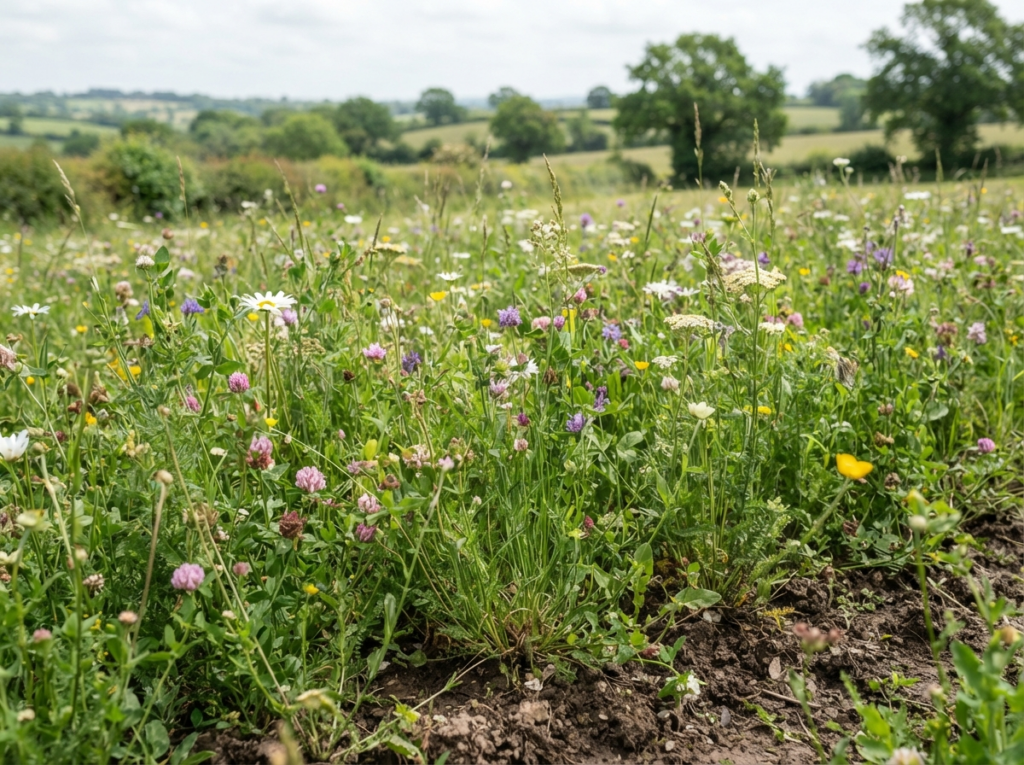
The soil under your feet decides which BFS mix will actually establish. The flowering result you want, colourful and quick or subtle and traditional, decides the ratio of wildflower to grass. Answer the soil question first; the rest follows from there.
What is your soil actually like?
Free-draining sand or wet peat, base-poor and low fertility: BFS 2 is built for acid grassland, matching NVC communities U1 to U5.
Heavy clay that waterlogs over winter and cracks in a dry summer needs species that can cope with both extremes: BFS 4 is formulated for exactly that ground.
Chalk or limestone, dry and base-rich: BFS 7 matches the calcareous grassland communities CG1 to CG7.
Permanently or seasonally wet ground, pond margins, stream banks and ditch sides: BFS 5 is built around wetland species such as yellow flag iris and ragged robin.
Seasonally flooded lowland grassland: BFS 3 matches the MG4, MG8 and MG9 floodplain meadow communities and is a common choice for biodiversity net gain and riparian schemes.
Coastal ground takes two forms. Salt-sprayed cliffs and shingle, low fertility and exposed: BFS 11 matches maritime cliff communities MC1 to MC12. Grazing marsh and floodplain closer to brackish water: BFS 11a matches MG11 and MG12 and keeps the short sward that breeding lapwings need.
Free-draining, post-industrial substrate on a brownfield site: BFS 14 is built to help re-establish Open Mosaic Habitat on Previously Developed Land, a habitat of principal importance for priority invertebrates.
Shade under hedgerows, woodland edges or established trees: BFS 6 is the only mix here bred for low light.
Green roof substrate: BFS 12 is 85% drought-tolerant flora with just three slow-growing grasses, developed for lightweight, low-fertility roof build-ups and BREEAM biodiversity credits.
How much flower do you want, and how fast will grass compete it out?
Most of the mixes above sow at 20% wildflower to 80% grass, which suits ordinary to low fertility ground. Richer soil is a different problem: grass grows fast enough on high-nutrient ground to crowd out an ordinary meadow mix within a season or two. BFS 8 answers that with 50% wildflower content and tall, scrambling species such as meadow vetchling that can hold their own against vigorous grass. Once a few years of cutting and removing arisings has brought fertility down, the site can move up to a higher-diversity mix such as BFS 1, the traditional MG5 hay meadow blend.
For a general-purpose meadow on ordinary soil, BFS 10 gives the widest species count across all soil types, while BFS 9 takes a more restrained, old-English approach with familiar native species rather than a showy display. Where the priority is low maintenance over colour, and the site suits coarse tussocky grasses such as cock’s-foot and tall fescue, BFS 13 needs only one cut a year and recreates the MG1 grassland type valued by small mammals and overwintering invertebrates.
Working to a brief that none of these quite match?
Site conditions and project briefs do not always line up with a standard list. The Create Your Own Seed Mix service builds a bespoke grass, wildflower or combined blend around your soil, aspect and brief, including trade labelling and branding for larger contracts.
Which mix for which job
Standard amenity meadow on decent soil: BFS 10 or BFS 9. Clay that waterlogs: BFS 4. Chalk downland restoration: BFS 7. Pond or ditch margin: BFS 5. Coastal cliff or verge: BFS 11. Brownfield or ex-industrial site with a BNG target: BFS 14. Rich soil where grass usually wins: BFS 8. Green roof: BFS 12. Anything else: talk to the team about a custom blend.
All the mixes are UK native seed, sown at the rate given on each product page. If your site does not fit neatly into any of the categories above, the fastest route to the right answer is a quick call describing the ground: what grows there now, whether it floods, and what the finished area needs to do.
Frequently asked questions
What sowing rate should I use?
Most BFS mixes sow at 5g per square metre, with two exceptions worth knowing: BFS 8 and BFS 14 sow at 3g per square metre because they carry a higher proportion of wildflower seed, and the green roof mix BFS 12 sows at 2g per square metre. Check the individual product page before ordering, since rate depends on the specific mix.
When should I sow a wildflower meadow mix?
Spring, from March to May, and late summer to early autumn, from August to October, are both workable UK windows, provided the ground is not frozen or in drought. Autumn sowing generally has an easier ride, since the soil is still warm and rainfall is increasing, while spring sowing needs the seedbed kept moist through any dry spell.
Will every species listed actually be in my bag?
All the BFS mixes carry a species availability note: exact proportions can shift between orders depending on what is in seed stock at the time. The habitat type and NVC match stay consistent; a handful of individual species may vary. If a specific species is essential to your brief, for a biodiversity net gain assessment for example, check with the team before ordering.