Trade customer? Open an account for volume pricing & POA on bulk orders. Apply now →
No products in the cart.

Account
HomeStoreSeed & PlantsWildflower SeedBFS 3 – Floodplain Meadow Grassland Seed Mix

BFS 3 – Floodplain Meadow Grassland Seed Mix

In stock

BFS 3 – Floodplain Meadow Seed Mix: A floodplain meadow seed mix for lowland grassland that floods seasonally and has low to moderate fertility, matching the MG4, MG8 and MG9 NVC communities. Blends 24 native wildflowers, including meadowsweet, great burnet and yellow rattle, with 8 native grasses such as creeping bent, for a resilient wet grassland habitat.

Suitable NVC Communities: MG4; MG8; MG9
Sowing Rate: 5g/m²
Contains: Wildflowers 20% (24 species) Grasses 80% (8 species)

N.B: All seeds specified in this mixture are subject to availability at the time of purchase.

Price range: £31.62 through £120.96 inc VAT Price range: £26.35 through £100.80 ex VAT
Delivery Nationwide, to site or yard
Dispatch Next working day, in stock
Bulk & pallet Volume pricing, any size
Talk to a specialist 01684 212 020

About BFS 3 - Floodplain Meadow Grassland Seed Mix

About BFS 3 floodplain meadow grassland seed mix

BFS 3 is a floodplain meadow grassland seed mix for creating and restoring UK floodplain meadows in the MG4, MG8 and MG9 National Vegetation Classification (NVC) communities. It is suited to lowland grassland that floods seasonally and has low to moderate fertility.

This matches the priority habitat type “Lowland Meadows”. Floodplain meadows are traditionally managed as hay meadows: left ungrazed from spring, cut for hay by mid July to remove fertility, then grazed for the rest of the year. Variation in field topography, such as ridge and furrow, lets a wider range of species establish across different wetness levels. These meadows are a valuable flower-rich resource for pollinators such as the common carder bee, orange tip and small copper butterflies, and for ground-nesting birds such as snipe and skylark.

The mix contains 24 native UK wildflower species and 8 native grass species, listed below.

Wildflowers, 20% of the mix (24 species)

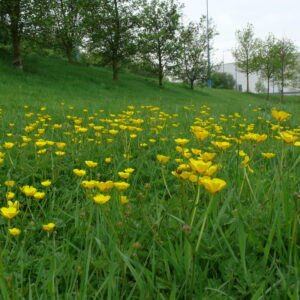
  • 8% Meadow Buttercup (Ranunculus acris), a bright yellow flower common in damp, fertile grassland.
  • 8% Ribwort Plantain (Plantago lanceolata), a tough, familiar meadow plant that supports foraging insects.
  • 7% Ox-eye Daisy (Leucanthemum vulgare), white daisy flowers that draw a wide range of pollinators.
  • 7% Selfheal (Prunella vulgaris), a low-growing purple flower and useful ground cover for bees.
  • 6% Black Knapweed (Centaurea nigra), a thistle-like purple flower and a strong nectar source in damp meadows.
  • 6% Red Clover (Trifolium pratense), a nitrogen-fixing legume that improves soil fertility and feeds bees.
  • 5% Common Bird’s-foot Trefoil (Lotus corniculatus), a yellow flower sometimes called “eggs and bacon”, and a food plant for several butterfly larvae.
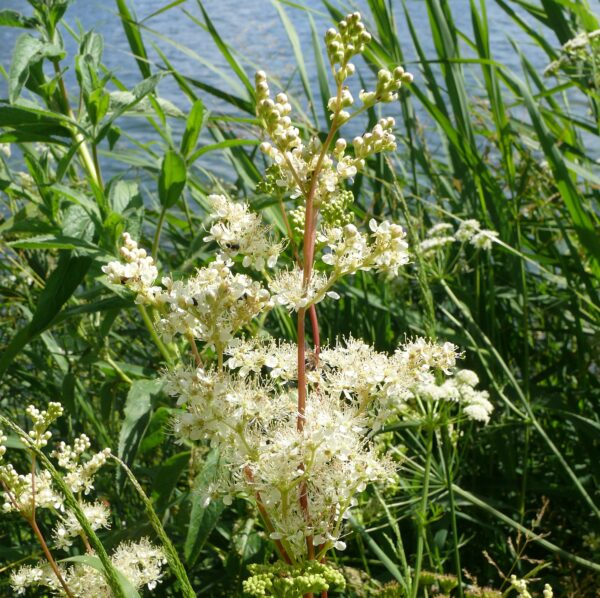
  • 5% Meadowsweet (Filipendula ulmaria), a fragrant, creamy flower typical of damp grassland.
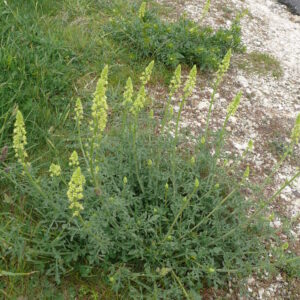
  • 5% Yellow Rattle (Rhinanthus minor), a hemi-parasitic annual that weakens grasses and gives other wildflowers room to establish.
  • 4% Autumn Hawkbit (Leontodon autumnalis), a yellow flower that extends the forage season into late summer.
  • 4% Common Sorrel (Rumex acetosa), reddish flower spikes that add colour to the sward from early summer.
  • 4% Greater Bird’s-foot Trefoil (Lotus pedunculatus), similar to common bird’s-foot trefoil but prefers wetter ground.
  • 4% Great Burnet (Sanguisorba officianlis), deep red flower heads and a marker species of species-rich floodplain meadow.
  • 3% Betony (Stachys officianlis), purple flower spikes that bees visit readily.
  • 3% Common Cat’s-ear (Hypochaeris radicata), a dandelion-like yellow flower that adds to meadow colour through summer.
  • 3% Meadow Vetchling (Lathyrus pratensis), a climbing, pea-like flower that adds structure to the sward.
  • 3% Square-stemmed St John’s-wort (Hypericum tetrapterum), a yellow flower found in damp or wet ground.
  • 3% Yarrow (Achillea millefolium), flat white flower heads, hardy and good for beneficial insects.
  • 3% Devil’s-bit Scabious (Succisa pratensis), a late-flowering purple-blue bloom and a key food plant for the marsh fritillary butterfly.
  • 2% Pepper Saxifrage (Silaum silaus), a fine yellow-green flower typical of old, unimproved meadow.
  • 2% Ragged Robin (Lychnis flos-cuculi), a pink, ragged-petalled flower found in damp meadows.
  • 2% Tufted Vetch (Vicia cracca), a climbing purple vetch that fixes nitrogen and adds floral diversity.
  • 2% Cowslip (Primula veris), an early-spring yellow flower and a familiar sight in traditional British meadows.
  • 1% Marsh Bedstraw (Galium palustre), a delicate white-flowered species that forms low mats in wet ground.

Grasses, 80% of the mix (8 species)

  • 45% Red Fescue (Festuca rubra ssp. rubra) and 35% Crested Dog’s-tail (Cynosurus cristatus) form the main body of the sward and tolerate a range of moisture levels.
  • 3% Creeping Bent (Agrostis stolonifera), which spreads readily in damp ground and helps consolidate the sward.
  • 2% Marsh Foxtail (Alopecurus geniculatus) and 3% Meadow Foxtail (Alopecurus pratensis), wetland grasses that tolerate seasonal waterlogging.
  • 5% Yorkshire Fog (Holcus lanatus), a common, adaptable grass found in most traditional meadows.
  • 3% Tufted Hair Grass (Deschampsia cespitosa), which forms tussocks on wet or heavy clay soils and adds structure to the sward.
  • 4% Sweet Vernal Grass (Anthoxanthum odoratum), which gives cut hay its characteristic sweet scent.

Where this mix works

This mix is designed to recreate historic MG4, MG8 and MG9 floodplain meadow habitat, so it is well suited to biodiversity net gain (BNG) and ecological compensation schemes. It gives pollinators, birds and small mammals a source of nectar, shelter and breeding cover across the flowering season. The grasses and wildflowers are chosen for their tolerance of seasonal flooding and heavy, wet soils. Once established, these meadows generally need only a single hay cut a year and light aftercare. All species in the mix are UK native.

Suggested uses

  • Floodplain meadow creation and restoration
  • Riverbank and riparian zone enhancement
  • Sustainable drainage systems (SuDS) with flood attenuation
  • Wet grassland habitat restoration
  • Biodiversity net gain (BNG) projects
  • Ecological mitigation and offsetting
  • Traditional hay meadow establishment

Sowing rates

For new establishment, sow at approximately 3-5g per square metre onto a fine, firm seedbed. For overseeding existing grassland, sow at approximately 1-3g per square metre once the sward has been opened up to give good seed-to-soil contact.

Suitable NVC communities: MG4, MG8, MG9. Contains wildflowers 20% (24 species) and grasses 80% (8 species). Please note: all species in this mix are subject to availability at the time your order is placed.

Grown for us by British partner nurseries
Expert product advice
Trade accounts welcome
Secure online checkout

Specification

Sowing rate (new)3–5 g/m²
Pack Size250g, 500g, 1kg, 2kg
Sowing rate (overseeding)1–3 g/m²