
Rhinanthus minor L.
Common Yellow Rattle
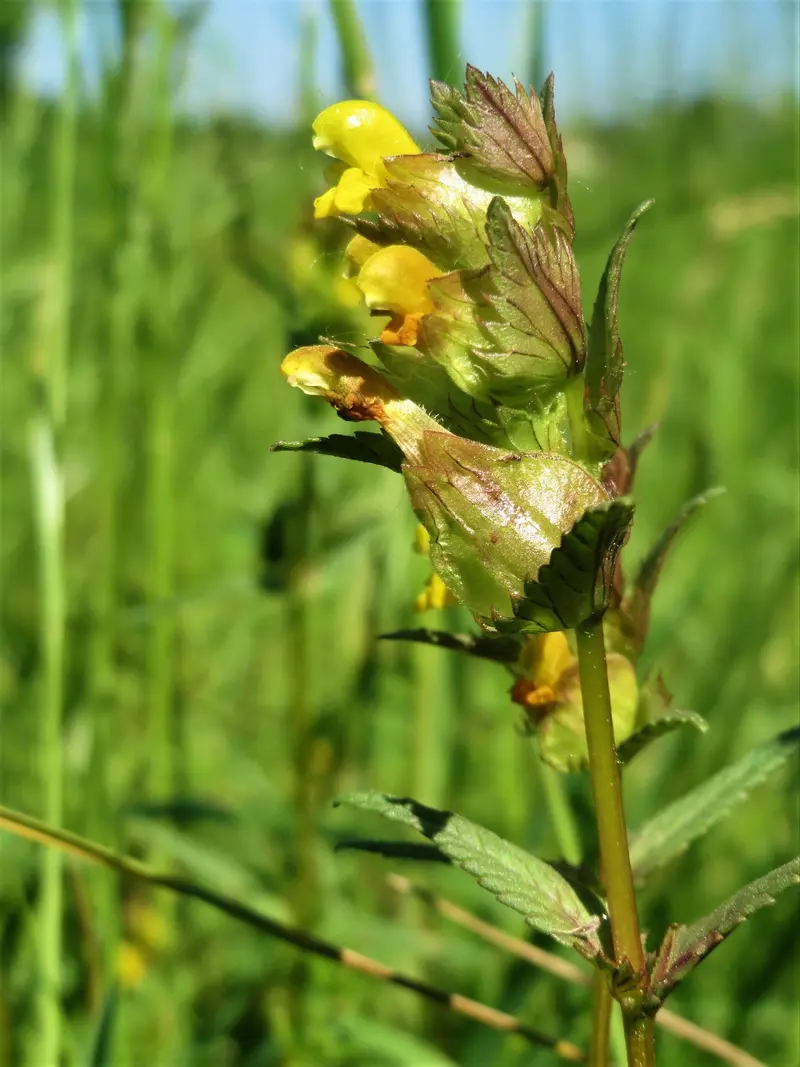
Yellow rattle is a slender native annual of grasslands, and one of the most useful plants for anyone managing a wildflower meadow. It grows upright stems with paired, toothed leaves and clusters of yellow, two-lipped flowers held in flattened, leafy bracts through early and mid summer.
About
Yellow rattle is a slender native annual of grasslands, and one of the most useful plants for anyone managing a wildflower meadow. It grows upright stems with paired, toothed leaves and clusters of yellow, two-lipped flowers held in flattened, leafy bracts through early and mid summer. As the seed capsules ripen, the loose seeds rattle inside the inflated, papery calyx, giving the plant its name.
It is semi-parasitic, drawing some of its nourishment from the roots of nearby grasses, which weakens their vigour and opens up the sward for other wildflowers to establish. This makes it a key tool for increasing diversity in meadows and grassland restoration. It thrives in open, sunny grassland on a range of soils and needs grass to grow alongside. The flowers are favoured by bumblebees, and sowing yellow rattle into existing turf is a well-known first step in converting rank grass into a flower-rich meadow.
Also known as
Hay Rattle · Little Yellow Rattle · Narrow-leaved Yellow Rattle · Rattlebox · Yellow Rattle · Yellow-Rattle
Synonyms
Alectorolophus crista-galli stenophyllus · Alectorolophus glaber · Alectorolophus phallax hispanicus · Alectorolophus serotinus · Rhinanthus balticus · Rhinanthus glaber minor · Rhinanthus minor elatior · Rhinanthus minor stenophyllus · Rhinanthus spadiceus · Rhinanthus stenophyllus
In our seed mixes
- BFS 1 – Traditional Hay Meadow Wildflower Mix
- BFS 10 – Species Rich Wildflower Meadow Seed Mix
- BFS 3 – Floodplain Meadow Grassland Seed Mix
- BFS 4 – Heavy Clay Soil Wildflower Seed Mix
- BFS 5 – Wetland & Pond Edge Wildflower Seed Mix
- BFS 8 – High Nutrient Initial Establishment Wildflower Grassland Mix – 50% Flora
- BFS1(F) – Traditional Hay Meadow 100% Wildflower
- BFS10(F) – Species Rich 100% Wildflower Meadow Mix
- BFS3(F)-Floodplain 100% Meadow Grassland Mix
- BFS4(F) – Heavy Clay Soil 100% Wildflower Seed Mix
- BFS5(F)-Wetland & Pond Edge 100% Wildflower Seed Mix
- BFS8(F) – High Nutrient Initial Establishment 100% Wildflower Mix
Beta — under active development. This catalogue is still being built and accuracy-checked. The information here (including plant identifications, British native status, soil and sun/shade preferences) is provided in good faith for general guidance only and may contain errors or omissions. It must not be relied upon on its own — please confirm details with us before making planting, specification, foraging or purchasing decisions, and never eat or medicinally use any plant based on this catalogue alone, as some species are toxic. To the extent permitted by law, Phoenix Amenity Supplies accepts no liability for any loss arising from use of this information.