
Centaurea nigra L.
Black Knapweed
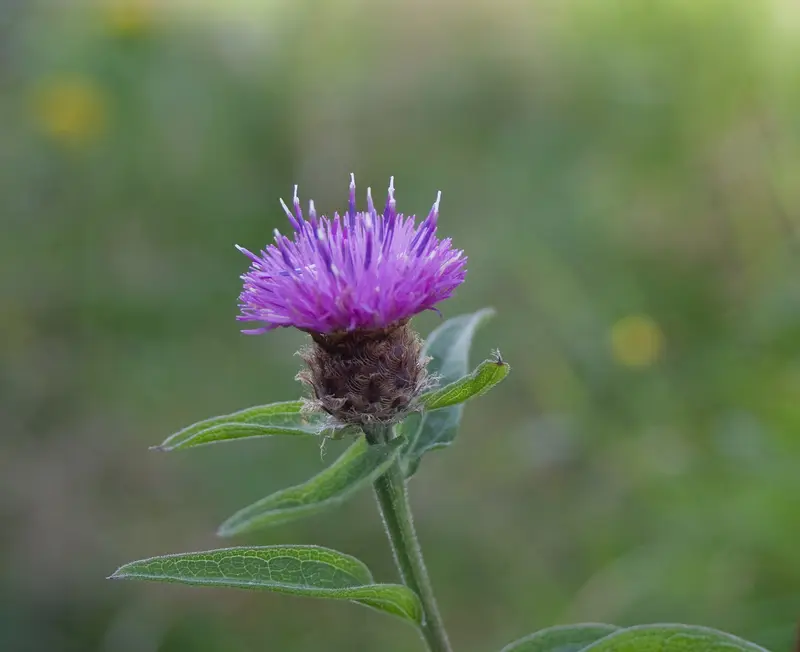
Common knapweed, also called lesser or black knapweed, is a tough, upright perennial of the daisy family, recognised by its thistle-like, reddish-purple flowerheads sitting on hard, rounded buds wrapped in dark brown bracts, which give it the country name hardheads. The stems are wiry and branching, carrying narrow, slightly toothed leaves, and the plant dies back to a sturdy rootstock each winter.
About
Common knapweed, also called lesser or black knapweed, is a tough, upright perennial of the daisy family, recognised by its thistle-like, reddish-purple flowerheads sitting on hard, rounded buds wrapped in dark brown bracts, which give it the country name hardheads. The stems are wiry and branching, carrying narrow, slightly toothed leaves, and the plant dies back to a sturdy rootstock each winter.
A genuine British native, it is one of the most reliable and widespread wildflowers of grassland, thriving in meadows, pastures, road verges, hedgebanks and rough ground on a wide range of soils in full sun. It flowers from early summer into autumn and is among the very best nectar plants for wildlife, heavily worked by bees, butterflies and hoverflies, while finches feed on its seed. Long-lived and adaptable, it is a backbone species in native meadow and grassland seed mixes.
Also known as
Black Starthistle · Common Knapweed · Hardheads · Lesser Knapweed · Spanish buttons · Spanish-buttons
Synonyms
Centaurea austriaca · Centaurea austriaca austriaca · Centaurea dubia nigra · Centaurea nigra mairei · Centaurea nigra nigra · Centaurea pectinata fuscata · Centaurea phrygia · Centaurea phrygia phrygia · Jacea nigra
In our seed mixes
- BFS 1 – Traditional Hay Meadow Wildflower Mix
- BFS 10 – Species Rich Wildflower Meadow Seed Mix
- BFS 120 – Wildlife Wildflower Seed Mix for Bees, Birds and Butterflies- 100% Flora
- BFS 13 – Tussocky Grassland Wildflower Meadow Mix
- BFS 14 – Brownfield Site Wildflower Mix (Open Mosaic Habitat on Previously Developed Land) – 80% Flora
- BFS 140 – Bat Friendly Wildflower Seed Mix – 100% Flora
- BFS 2 – Acid Grassland Wildflower Seed Mix for Sandy or Peaty Soils
- BFS 3 – Floodplain Meadow Grassland Seed Mix
- BFS 4 – Heavy Clay Soil Wildflower Seed Mix
- BFS 6 – Hedgerow & Shade Wildflower Seed Mix
- BFS 8 – High Nutrient Initial Establishment Wildflower Grassland Mix – 50% Flora
- BFS1(F) – Traditional Hay Meadow 100% Wildflower
- BFS10(F) – Species Rich 100% Wildflower Meadow Mix
- BFS13(F) – Tussocky Grassland 100% Wildflower Meadow Mix
- BFS14(F) – Brownfield Site 100% Wildflower Mix
- BFS2(F)- Acid Grassland 100% Wildflowers for Sandy/Peaty Soils
- BFS3(F)-Floodplain 100% Meadow Grassland Mix
- BFS4(F) – Heavy Clay Soil 100% Wildflower Seed Mix
- BFS6(F)- Hedgerow & Shade 100% Wildflower Seed Mix
- BFS7(F)- Calcareous Grassland 100% Wildflower Seed Mix
- BFS8(F) – High Nutrient Initial Establishment 100% Wildflower Mix
- BFS9(F)- Country Meadow 100% Wildflower Seed Mix
- UM11 – Patchwork Wildflower Mix
- UM13 – Treasure Trove Wildflower Mix
Beta — under active development. This catalogue is still being built and accuracy-checked. The information here (including plant identifications, British native status, soil and sun/shade preferences) is provided in good faith for general guidance only and may contain errors or omissions. It must not be relied upon on its own — please confirm details with us before making planting, specification, foraging or purchasing decisions, and never eat or medicinally use any plant based on this catalogue alone, as some species are toxic. To the extent permitted by law, Phoenix Amenity Supplies accepts no liability for any loss arising from use of this information.