
How to choose tree and shrub planting products
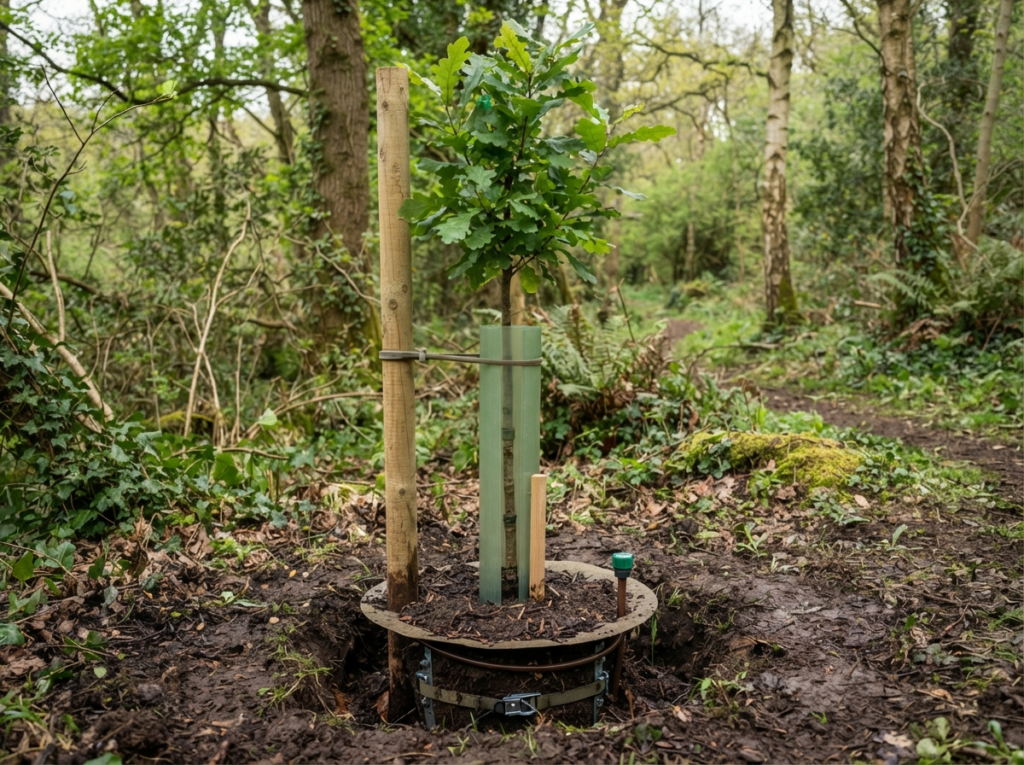
Most planting failures come down to one of three things: something ate it, something snapped it in the wind, or it dried out before the roots caught up. Work out which risk applies to your site and how long the stock needs cover, and the rest of the choice mostly falls into place.
What are you protecting it from, and for how long?
Rabbits and hares are the default threat on most UK sites, and a Spiral Tree Guard handles both on whips and young trees, in four heights from 20cm to 75cm. It is quick to fit and cheap, but it will not stop deer, and it needs a cane to hold it up (more on that below).
Where deer are on site, or the planting is forestry scale, step up to a full tree shelter. The Vigilis Standard Tree Shelter is rigid, twin walled and built to last six years or more, in five heights from 0.6m to 1.8m so it can be matched to whip or standard stock. If you would rather not collect the tubes once the tree is established, the Vigilis Bio Tree Shelter gives the same minimum three years of protection, then breaks down in the soil over a further three years or so.
Shrubs and hedgerow planting want a shorter, wider guard that leaves room for bushy growth rather than a narrow tube. The Vigilis Shrub Shelter and its biodegradable equivalent, the Vigilis Bio Shrub Shelter, both come in standard and XL diameters. For hedging whips specifically, a Vigilis Hedge Wrap or Vigilis Bio Hedge Wrap is a spiral guard that expands as the plant grows and needs no stake at all.
How will you support it in the wind?
A guard on its own does not hold a tree upright; that is a separate job. Light guards on whips just need a Bamboo Cane pushed in alongside. Heavier tree shelters need a proper Tree Shelter Stake sized to the guard, or for larger standards a Tree Stake with a cross bar for extra rigidity against wind rock while roots establish.
If the stock is semi-mature, rootballed or containerised, staking above ground is not always practical or tidy. The Platipus Tree Anchoring System anchors below ground instead, in four standard sizes, with no guy wires to trip over or vandalise. Where a stake is used, fit a spacer sleeve or block and a buckle or soft tree tie so the trunk cannot rub against the stake as it moves.
What goes in and around the planting hole
Get the roots off to the best start before worrying about mulch. Rootgrow Professional Mycorrhizal Fungi is sprinkled onto roots or used as a dip at planting, and one treatment lasts the plant’s lifetime. It is not suitable for ericaceous species such as rhododendrons and heathers.
For weed control around the base, coir and jute products break down naturally so nobody has to lift them later. Coir Mulch Discs fit around a single stem, Coir Mulch Mats suit wider planting, and Jute and Hybrid Jute is available pre-cut or by the roll for bigger schemes. On sloping ground, where loose bark mulch tends to wash away, Phoenix Ecotex Mulchmat stays put and breaks down fully over four to five years. Where roads or driveways run close to the roots, a Root Barrier deflects roots downward instead of sideways, and Bodcell spreads vehicle loading across the surface so the ground stays stable without compressing the soil beneath.
Which product for which job
New whips against rabbits, on a budget: Spiral Tree Guard with a bamboo cane.
Forestry or amenity planting where deer are present: Vigilis Standard Tree Shelter or Vigilis Bio Tree Shelter with a tree shelter stake.
Hedging runs: Vigilis Hedge Wrap, no stake needed.
Shrub and hedgerow beds: Vigilis Shrub Shelter or the bio version.
Semi-mature standards: Platipus Tree Anchoring System instead of visible staking.
A weed-free base with nothing to collect later: Coir Mulch Discs or Jute matting.
Buy for the fork that matches your site rather than by habit. A guard built for rabbits will not stop deer, and a shelter bought to last one season is a false economy on a forestry contract that runs for several. If you are planning a mixed-species scheme, or you are not sure which shelter height suits your stock, call the Phoenix Amenity team with the planting list and they can confirm sizes before the order goes out.
Frequently asked questions
Do tree shelters need to be collected once the tree is established?
Standard Vigilis shelters are recyclable but do need collecting once the tree no longer needs support, usually after several years. The bio range works differently: the Vigilis Bio Tree Shelter and Vigilis Bio Shrub Shelter both break down naturally in the soil after their protection period, so there is nothing to dig out or take away.
What height of tree shelter should I order?
The Vigilis Standard Tree Shelter and Vigilis Bio Tree Shelter both come in five heights, from 0.6m to 1.8m. As a rule, taller shelters suit sites with deer or heavy browsing pressure, and shorter shelters are enough where rabbits and hares are the main risk. Match the shelter to the tallest browsing animal on site, not just to the size of the whip.
Can mycorrhizal fungi be used on any tree or shrub?
Rootgrow Professional Mycorrhizal Fungi suits most trees and shrubs at planting time, but it is not suitable for ericaceous species such as rhododendrons and heathers, which form a different type of root association. Check the plant list before treating a mixed order.