
How to choose slope stabilisation matting
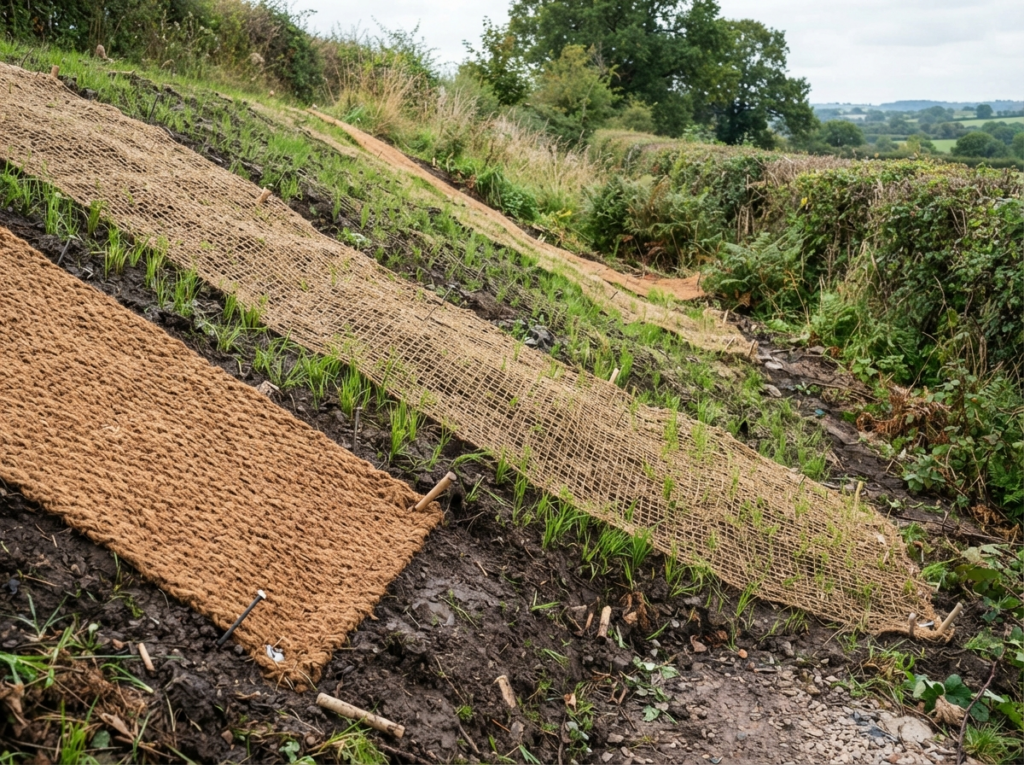
Slope stabilisation matting exists to buy time: it holds soil in place on a bank or cutting for long enough that grass or wildflower roots can take over the job permanently. The right product depends mostly on how long that establishment period needs to last, and whether you are protecting bare freshly-soiled ground or ground where vegetation is already growing through.
How long does the site need protecting
Geocoir Erosion Control Mesh is built for around 5 years of protection, stocked in three weights from 400g/m² for general slopes up to 900g/m² for the most exposed sites. Its open mesh structure lets grass and other species grow straight through it as they establish, so it suits slopes where you expect a longer window before vegetation is fully self-supporting.
Eromat C-100-J is a shorter-life option at around 12 months, rated for slopes up to 1:1. It is unseeded, jute-stitched over a 400g/m² coir mat, designed to sit over freshly soiled ground with your chosen seed mix sown underneath rather than built into the product.
Jute netting is the budget option: a 100% biodegradable, unbleached open weave that holds seed and topsoil in place and creates a sheltered microclimate that speeds up germination. It costs less than the coir products and breaks down naturally once the sward has taken, but it is generally the more practical choice on typical embankments and cuttings rather than the most demanding, high-energy sites, where a coir mesh or blanket will outlast it.
Bare soil or already vegetating ground
If the slope has just been re-profiled and re-soiled, Eromat’s unseeded blanket construction is designed for that stage: sow first, then cover, and the blanket protects the seed and soil surface while germination happens underneath. Where vegetation is already present or establishing and you want ongoing surface stability rather than a seed cover, Geocoir’s open mesh lets existing growth come straight through it.
Anchoring the matting
Whichever material you choose, it needs pinning down properly or it will not do its job. Stakes & Pegs includes GreenStake biodegradable stakes, which hold for over 18 months before breaking down completely and give around 45% greater holding power than an equivalent metal staple, plus wooden T-pegs as a standard alternative. Both installation guides call for roughly 3 pins per m² across the main slope, with tighter 150mm centres along trenched edges and overlaps.
Which product for which job
- Geocoir mesh: longer-life protection (around 5 years) where vegetation needs to grow through the mesh over time.
- Eromat C-100-J blanket: freshly soiled banks, seed sown underneath, shorter service life (around 12 months) while grass establishes.
- Jute netting: lower-cost, shorter-life cover for typical embankments and cuttings that are not under severe erosion pressure.
- Stakes & Pegs: needed alongside any of the above to hold the matting in contact with the ground.
Next step
For sites under serious or ongoing erosion pressure, such as riverbanks and lake shores, see Phoenix Amenity’s rock rolls, which do not depend on vegetation establishing at all. For typical slope and cutting work, use the enquiry form on any of the products above and the technical sales team will confirm the right weight and quantity for your bank profile.
Frequently asked questions
Do I need to sow seed before or after laying erosion matting?
It depends on the product. Eromat C-100-J is unseeded, so you sow your chosen mix and lay the blanket over it. Geocoir's open mesh works either way, since its structure lets grass and other species grow through it as it establishes.
How long does coir matting last before it breaks down?
Eromat C-100-J is rated for around 12 months, while Geocoir Erosion Control Mesh gives around 5 years of protection. Jute netting breaks down over a shorter period again, which is why it suits less demanding sites.
What do I use to pin the matting down?
Stakes & Pegs covers both options: GreenStake biodegradable stakes, which hold for over 18 months and outperform an equivalent metal staple, and standard wooden T-pegs. Both installation guides recommend around 3 pins per m² across the main slope.