
Cut little and often: how mowing frequency protects your sward at peak growth
June growth rates can genuinely catch teams off guard. After a few warm days and decent rainfall, grass that looked manageable on Tuesday needs cutting again by Friday. The instinct is to drop the mower height to buy more time between visits. That is usually the wrong call.
The right answer is to cut more often, not lower.
The one-third rule under June growth pressure
The basic principle in amenity turf management is the one-third rule: never remove more than a third of the leaf blade in a single cut. In June, perennial ryegrass and fescues can put on 25-30mm of growth in a week under warm, moist conditions. That pace makes a once-weekly mowing interval genuinely hard to hold without breaching the limit.
Consider a target height of 25mm. If the sward has reached 40mm in five days, cutting back to 25mm removes 15mm of leaf, which is 37.5% of the standing height. Already past the one-third limit. The fix is to cut before it gets that far, not to compensate by going lower.
What a peak-growth mowing regime looks like in practice
For higher-specification amenity turf and sports surfaces, twice-weekly mowing is often necessary through the June flush. Some fine turf situations need more than that. For general amenity grassland managed for appearance rather than heavy wear, once every five or six days is usually manageable, provided the cutting height is set appropriately for the species mix.
The practical challenge for many grounds teams is scheduling. If once-weekly is the hard operational limit, it is better to raise the cutting height slightly for the month than to take off too much in a single pass. A sward (the established grass surface) cut a little long stays healthier than one that has been scalped and then needs time to recover.
Why cutting too low causes problems
Taking off too much leaf at once weakens root reserves, because the plant draws down carbohydrates to regenerate leaf area quickly. In a wet June, that also opens the canopy to weed ingress: annual meadow grass will move into any gap. If conditions dry out sharply in late June or early July, a scalped sward shows drought stress much faster than one managed at a sensible height.
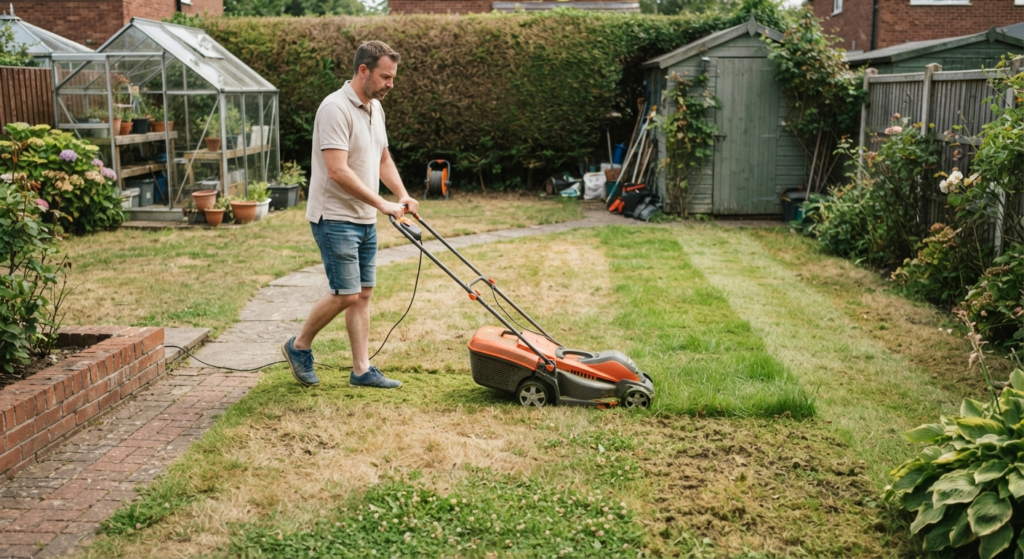
The tell-tale sign is colour. Yellow-brown patches where the cut was too aggressive, sitting alongside consistent green on the areas managed properly. Frequency, not a lower blade setting, is what keeps the sward looking right through peak growth.
Blade condition and ground checks for June
Blade sharpness matters more during peak growth than at any other point in the season. A blunt rotary blade tears the leaf rather than cutting it cleanly, and the ragged ends brown off within a day or two, creating entry points for fungal disease. Check and sharpen blades regularly during a high-frequency mowing programme. For reel mowers, make sure the bedknife is correctly set.
Mow in dry conditions where the site allows. June clippings are bulky, wet, and high in nitrogen. Left in clumps, they shade the turf beneath and can encourage fungal problems. Box clippings off on formal or sports turf, and on larger amenity areas make sure they are dispersed rather than left to mat down.
Check ground conditions before going out with heavy equipment after rain. Soft, wet ground and a heavy machine compact the soil and create ruts that take the rest of the season to sort out. If the site is soft, wait for it to firm up, or use lighter kit.
Frequently asked questions
How often should I mow grass in June?
On amenity lawns and sports surfaces, twice weekly is often needed at peak growth. For general amenity grassland, every five to six days is a practical target. Once-weekly intervals risk breaching the one-third rule when the sward is growing fast.
What cutting height should I use in June?
It depends on grass type and site use. Formal amenity and sports turf is typically maintained between 20mm and 40mm. General amenity grassland suits 40-75mm. Avoid dropping the height to compensate for a long interval; it causes more stress than it solves.
What is the one-third rule in mowing?
The one-third rule states you should not remove more than a third of the current leaf blade height in a single cut. It is standard in amenity and sports turf management to protect root reserves and canopy density. In June, staying within this rule means shortening the mowing interval, not lowering the blade.
Why does my grass go yellow or brown after mowing in summer?
Yellowing after a cut usually means too much leaf was removed in one pass. The plant draws on root reserves to regenerate quickly, and the stressed tissue shows as discolouration. Cutting more frequently at a consistent height prevents this.
Should I collect grass clippings when mowing in June?
On formal turf and sports surfaces, yes. June clippings are high in moisture and bulk; left in clumps they shade the turf and can contribute to fungal pressure. On larger amenity areas, fine dispersion is acceptable if blades are sharp and the grass is dry when cut.