
Overseeding thin shady lawns: why the September window closes faster than you think
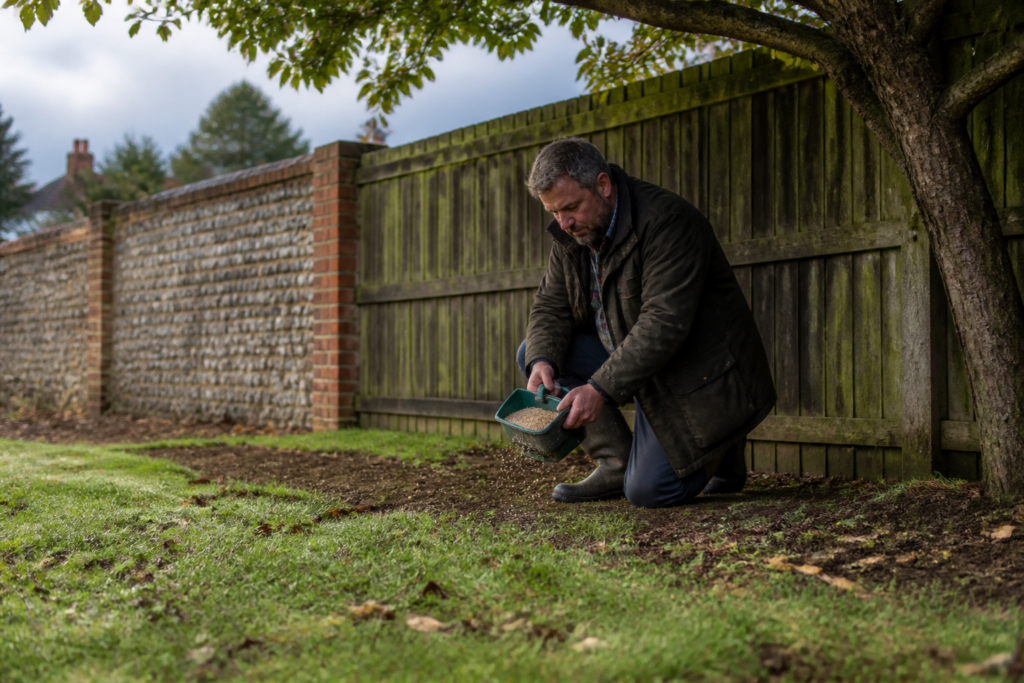
If you have thin or bare patches under trees, along fence lines or anywhere that sees fewer than four hours of direct sun a day, September is when you need to act. Shaded ground loses its summer warmth faster than open lawn. Once soil temperature drops below the point where germination is reliable, you have missed the season and you will be waiting until next year.
Why shaded ground cools faster than you expect
An open lawn is warmed directly by the sun throughout the day and holds that heat into the evening. Ground under a dense tree canopy gets far less of that solar input, and shaded soil in the same garden can run 2-4°C cooler than a nearby sunny patch, particularly on clear autumn nights when the ground radiates heat upward without cloud cover to hold it in.
Grass seed needs soil temperature above 8-10°C to germinate reliably. Below that, germination slows to almost nothing and seed sitting in cold wet soil tends to rot rather than establish. Under a mature deciduous tree in northern England or Scotland, that threshold can arrive in late September or early October. In sheltered southern gardens it may hold into October, but the margin is still much narrower than people expect.
A cheap soil thermometer, pushed to 5 cm depth first thing in the morning, gives you an honest reading. If you are seeing 10-12°C or above, the window is still open. Below 8°C on most mornings, it is effectively closed.
Seed choice matters more than timing
Most hardware store lawn seed is dominated by perennial ryegrass, which is excellent on open ground with good light. In a shaded spot it germinates, briefly looks promising, and then thins steadily through its first winter as the light fails to support it. Using a general-purpose mix in shade is how people convince themselves that overseeding does not work, when the seed was simply wrong for the site.
For shade, you need fine fescues: creeping red fescue (Festuca rubra) and chewings fescue (Festuca rubra subsp. commutata) are the two most reliable. Browntop bent (Agrostis capillaris) also tolerates lower light and wears reasonably well. Look for a seed mix where fine fescues make up at least 70% of the blend. Check the species listed on the back of the bag rather than relying on the name on the front.
Preparing the ground near tree roots
Soil under a mature tree is often compacted, dry and competing for moisture with the tree’s surface root system. Deep scarification or rotavating close to established trees is not appropriate: it damages roots the tree depends on and can destabilise older specimens.
A vigorous raking with a spring-tine rake to clear dead matter and scratch the surface is usually sufficient. If you cannot drive a hand fork to 5 cm easily, surface compaction is likely to limit germination regardless of how good your seed is. A hollow-tine aerator, used carefully within the root zone, or a garden fork pushed to 5-7 cm and rocked slightly, can improve things without causing serious root damage.
If the ground under the canopy is very dry (this is common: the leaf canopy intercepts rainfall before it reaches the soil), water it thoroughly one or two days before sowing. Germinating seed on bone-dry surface soil will die before roots can form.
Sowing, aftercare and honest expectations
Sow shade mixes at 35-50 g/m2 rather than the 25-35 g/m2 you might use on an open lawn. The less favourable conditions justify the higher rate to compensate for losses. Broadcast the seed evenly, then rake gently to get seed into contact with the soil rather than sitting on dead grass. Water after sowing and keep the surface from drying out completely for the first three to four weeks.
Once new grass reaches 6-7 cm, mow at a high setting: 50-60 mm rather than the 25-35 mm you might use on an open lawn. Shade grass needs more leaf area to photosynthesise in lower light and will not tolerate close cutting. It grows more slowly than ryegrass-dominated turf, so resist the urge to mow too soon.
One honest point: if a spot gets fewer than two hours of sun a day, even a well-sown fine fescue mix will be a holding exercise rather than a transformation. Heavy shade under dense evergreens is where grass eventually gives up. In those situations, ground cover planting (pachysandra, vinca, ivy) is a more realistic long-term answer than overseeding each autumn and being disappointed each spring.
Frequently asked questions
When is it too late to overseed a shady lawn in the UK?
Once soil temperature drops below 8°C consistently at 5 cm depth, germination becomes unreliable. In northern England and Scotland, that can happen in late September or early October. Further south, October may still be possible in mild years. Check soil temperature directly rather than relying on air temperature, which runs warmer.
Can any grass grow in deep shade?
In very heavy shade (under dense evergreens, or between buildings where direct sun never reaches), no grass cultivar performs reliably long term. Fine fescues cope well with partial shade, but even they thin out below around two hours of light per day. Ground cover plants are often the more practical alternative in those conditions.
Should I clear fallen leaves before overseeding in autumn?
Yes. A mat of leaves blocks light from seedlings and keeps the seedbed too wet. Clear them before sowing and continue clearing as they fall during the establishment period. A few scattered leaves will not cause a problem, but thick drifts will prevent germination and encourage rot.
How do I prepare ground for overseeding without damaging tree roots?
Avoid deep scarification, powered slitting or rotavating within the drip line of a tree. A spring-tine rake to clear surface debris and open the soil, combined with careful hollow-tine aeration or a hand fork pushed to 5-7 cm, gives reasonable seedbed preparation without major root damage.
Does overseeding a shady lawn actually work?
Yes, when conditions are realistic. Under light deciduous canopy with four or more hours of light, a shade-tolerant fine fescue mix can establish well and hold cover through winter. The sward needs managing differently from an open lawn (higher cut, no drought stress) but it can work. In deep permanent shade, results will always be limited.