
Protecting your winter sward: when to close a waterlogged sports pitch
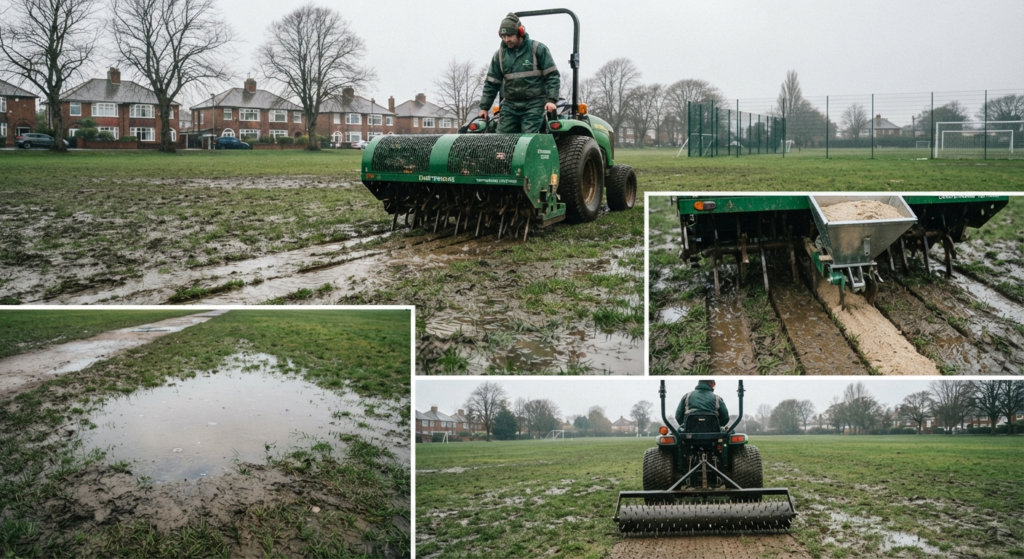
January is when the pressure builds. Coaches want pitch time, fixtures are stacking up after Christmas postponements, and the easiest path is to let play go ahead and deal with the consequences later. Closing a pitch costs goodwill. Opening it when you should not costs you the pitch itself, sometimes for months.
The decision should rest on surface saturation rather than rain in the forecast. Water in the sky is not the same as a sward that cannot bear load without tearing at the root.
What happens to the sward under stud load
When soil reaches field capacity and cannot drain further, the air-filled spaces between particles fill with water and the turf loses its anchorage. Under stud load, especially from heel strikes and turning movements, the plant does not compress cleanly. The leaf and stem shear away from the crown, and the crown from the root system below.
Surface softness on a well-draining pitch is manageable. Structural saturation below the surface is a different problem. Once the sward is torn and the rootzone exposed, the pitch faces compaction, moss invasion and bare patches that need renovation seed and weeks of exclusion to repair. A single afternoon’s play can set a pitch back further than the disruption of a postponement.
How to read the surface before play
Walk the pitch first. If the surface deflects noticeably more than 25mm underfoot at mid-stride, the turf is already under mechanical stress. That figure is a practical guide rather than a hard threshold, but you cross it clearly enough to know.
The screwdriver test gives you something more specific. Push a 150mm screwdriver vertically into the surface by hand. If it sinks past 100mm with minimal resistance, or if water wells up into the hole, the rootzone is fully saturated. Ponding in the hole means there is nowhere left for displacement to go. This is a reliable, low-tech check that most grounds staff carry out before a match decision.
Check goalmouth and corner areas separately. These zones take concentrated wear whatever the pitch condition and will deteriorate faster than centre field. A pitch that looks borderline across the main playing area may already be unsuitable in the areas where play is most concentrated.
What the pitch tells you after recent use
If the pitch was used recently, the evidence is in the surface. Stud holes that have not closed after 24 hours, deep impressions along the touchlines, and bare soil starting to show at turning points all point to a sward losing ground faster than it can recover.
Pull a small soil plug from a few centimetres down and press it between your fingers. If it ribbons rather than crumbles, the clay fraction is behaving plastically, which means load-bearing capacity is gone for now. On sandy rootzones the test is less diagnostic, but ponding is usually obvious enough on its own.
Making the decision and recording it
No universal rule covers every pitch type. A sand-dressed surface on a free-draining rootzone will bear more than a natural clay soil under the same rainfall. Shade, slope and prevailing wind all affect how quickly the surface shifts after a wet spell. Your call has to account for the specific surface you are managing.
Playing one session on a fully saturated pitch can set a pitch back further than a fortnight’s postponement. Overseeding into cold January soil establishes slowly. Force play through bad conditions for a few weeks and you can be fighting bare patches in April.
Keep a written record of the checks you carried out, what you found and the decision you made. For clubs, local authorities and schools, this record matters if the decision is later questioned. Most governing bodies, including the Football Association and Rugby Football Union, have their own pitch inspection procedures, and it is worth knowing what yours requires before the season reaches its wettest weeks.
Frequently asked questions
Can I use a fork or aerator to help drain a waterlogged pitch before a match?
Surface spiking can shift pooled water off a pitch but will not restore load-bearing capacity to a saturated rootzone. On clay soils, forking when fully saturated can worsen compaction because the tines displace soil sideways rather than opening stable channels. If the rootzone is structurally saturated, rest and drainage are the only reliable solution.
Is there a legal responsibility to close a waterlogged sports pitch?
There is no single UK law specifying when a pitch must close, but duty holders have a general obligation under the Health and Safety at Work Act 1974 to ensure a reasonably safe environment. Clubs and local authorities should hold a written record of inspection decisions. Governing body guidance from organisations such as the FA or RFU provides additional frameworks for affiliated facilities.
How long does a grass pitch take to recover after being played on when waterlogged?
Recovery time depends on soil type, drainage, temperature and the severity of wear. A clay-based pitch played on during saturation may need four to six weeks of rest and active renovation before it is ready again. Sandy rootzones drain and recover more quickly, but torn turf still needs time and often overseeding before it can safely take regular use.
What does the screwdriver test actually tell you about pitch playability?
Push a 150mm screwdriver vertically into the surface using hand pressure only. If it penetrates beyond 100mm with little resistance, or water wells up into the hole, the rootzone is fully saturated. It is a widely used practical check, not a formal national standard, but it gives a reliable indication of whether load-bearing capacity is compromised.
When should I contact the referee or governing body about a potential postponement?
Most governing bodies, including the Football Association and Rugby Football Union, have published postponement procedures. In affiliated leagues, a referee or official pitch inspector may need to inspect the surface formally. Notify officials as early as possible when conditions are deteriorating; late notification can cause unnecessary disruption to visiting teams and may carry a procedural penalty.