
How to fit sports turf renovation into a tight summer fixture gap
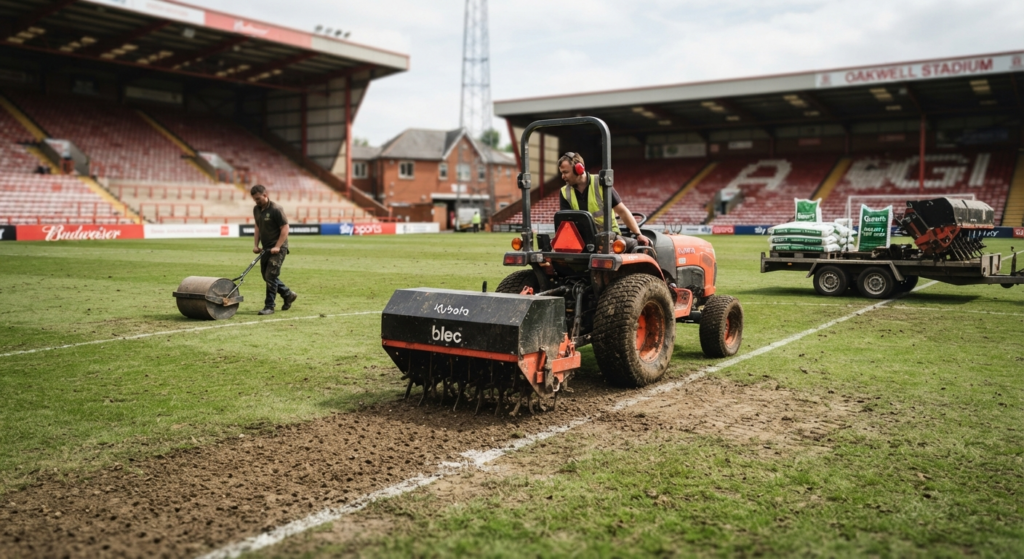
Most sports pitches get used harder in summer than their renovation schedule suggests is sensible. Match days compress, recovery time shrinks, and by the time a Wednesday evening fixture clears before Saturday’s game, you’re looking at roughly 72 hours. That’s not nothing.
Decompaction and overseeding, done in the right order, can make a real difference in a short window. The problem is that many grounds managers overseed into compacted soil and wonder why take-up is poor. Sort the compaction first, even briefly, and the result changes.
What the window realistically gives you
With 48 to 72 hours between fixtures, you can aerate, overseed and lightly top-dress, but full establishment isn’t coming before the next kick-off. What you’re doing is banking progress: getting viable seed into a more receptive seedbed so it germinates quickly once play eases. On a worn pitch in mid-June, even a single solid pass of aeration before overseeding will outperform broadcasting seed onto an impacted surface.
Decompaction first, seed second
Solid-tine aeration is the right choice when play resumes quickly. Hollow-tine creates surface disruption and the plugs need time to clear, which works well in autumn but not when a team is warming up in 48 hours. A solid-tine pass at 150 to 200 mm depth, ideally in two directions, breaks the compaction layer without creating loose debris on the surface.
If you have a sarel roller available, a pass with that immediately before overseeding also opens the surface without the mess. Either way, check soil temperature before you seed. Overseeding into soil below 10°C at 10 cm depth wastes time and seed; germination slows enough to make the exercise pointless. In late June and July across most of England and Wales you’ll usually be above that threshold, but it’s worth measuring if the pitch has been in heavy shade.
Matching the seed mix to the pitch
Match the mix to what’s already in the sward. On a predominantly ryegrass pitch, use a modern perennial ryegrass with good tiller density, the type that establishes reasonably well under summer warmth. On a football pitch with heavy centre-circle and penalty-area wear, target those zones specifically rather than broadcasting a full-pitch rate everywhere. The seed budget goes further and the improvement is more visible.
Overseeding rates into existing turf are typically 20 to 35 g/m2. Going heavier in a narrow time window won’t improve results when the existing canopy is competing for light.
Getting the most from the remaining time
After seeding, roll lightly if your machine allows it. Getting seed pressed into aeration holes and surface scratches improves contact more than most people expect. A light application of top-dressing sand helps where the surface is very uneven, but don’t apply it heavily when a match is two days away; it will displace under foot traffic.
Water if you can. A brief irrigation run the morning after seeding speeds germination considerably. Seed sitting dry on a warm summer surface can desiccate before it gets going, and you’ll have lost the window entirely. Mark the reseeded zones clearly, even just with canes and string; coaching staff and players will walk elsewhere if they know where fresh seed is sitting.
The pitch won’t look perfect for the next fixture. But the seed will be in better contact with the soil than if you’d done nothing, and it will establish faster when the workload eases. That’s a reasonable return on 72 hours.
Frequently asked questions
Can you overseed a sports pitch during the season?
Yes. A 48 to 72-hour gap between fixtures is enough for targeted solid-tine aeration and overseeding in the worst-worn zones. Full establishment takes longer than two days, but the seed will be in place and ready to grow when play eases.
Why is solid-tine aeration better than hollow-tine between fixtures?
Hollow-tine pulls cores out of the surface, which need removing before play resumes. Solid-tine pierces without extracting material, so the surface stays usable within hours. In summer when play is continuous, that makes it the more practical option.
What overseeding rate should I use on a worn sports pitch?
For overseeding into existing turf, 20 to 35 g/m2 is a standard working range. Using a higher rate when the existing canopy is competing for light rarely improves results and wastes seed.
Does soil temperature matter for summer overseeding?
Yes. Perennial ryegrass germinates poorly below 10°C at soil depth. Most UK pitches are above this in June and July, but shaded or north-facing areas can be cooler than expected. A quick soil temperature check before seeding is worth doing.
How long before a match can you overseed?
There is no firm minimum. Two full days gives the seed time to settle and allows at least one watering. Mark the seeded zones clearly so players avoid them where possible; limiting foot traffic over fresh seed improves contact and germination rate.