
Slitting, sarel rolling and surface channels: how to shift standing water from amenity turf
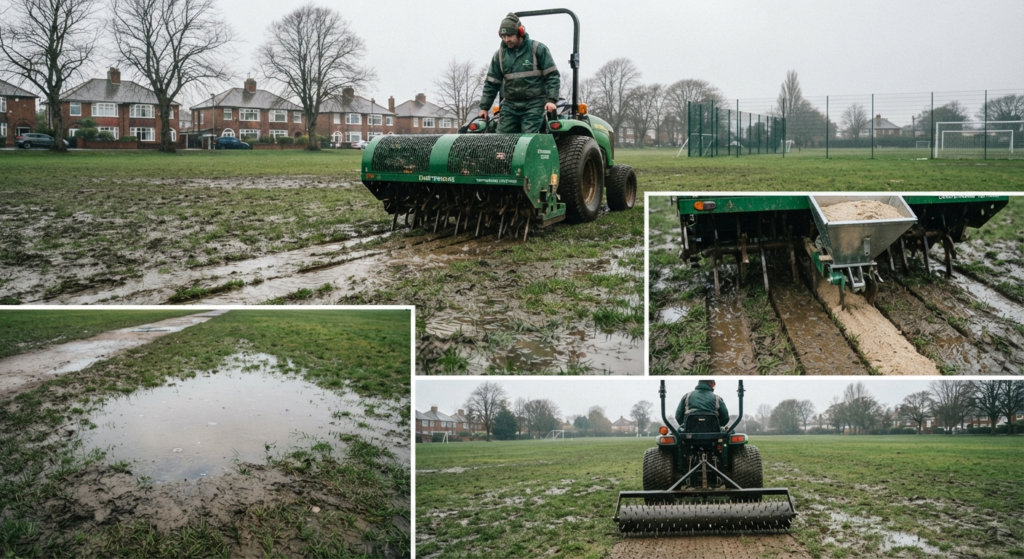
January is when the damage shows up. Saturated ground, puddles that persist for days, sward that squelches underfoot and stays that way. If you manage amenity grass on a council site, a sports ground or an estate, sitting it out until spring is an option. It is rarely a good one.
The common culprit is a surface cap: a layer of compacted or sealed soil in the top 50 to 100mm that water cannot penetrate quickly enough. Deeper subsoil drainage may be fine. The block is right at the surface. That distinction matters because it changes which operations are worth doing.
Slitting: direct relief for a compacted surface
A slitter machine cuts narrow vertical slots, typically 3 to 5mm wide and 80 to 150mm deep, through the surface cap and into the more permeable material beneath. Water that cannot penetrate the sealed surface finds these channels and drains away. On football pitches and amenity areas with heavy foot traffic, slitting is often used as a reactive measure after a prolonged wet spell, as well as during scheduled autumn maintenance.
Slot spacing makes a real difference. At 25 to 50mm centres you create a genuine drainage network across the surface; wider than that and the treatment is largely cosmetic. Backfilling with kiln-dried sharp sand keeps channels open under traffic. Without backfill, compaction closes the slit again within a few weeks.
The limit of slitting is what lies below it. If the subsoil is heavy clay with poor permeability throughout, slitting buys time but does not solve the problem. Water moves into the slots and sits there. If drainage is not clearing within a few hours of rain stopping, the issue is structural and probably needs a proper drainage survey before you do more work.
Sarel rolling: a lighter option when the ground is really soft
The sarel roller is a drum fitted with hardened star-shaped or cross-shaped discs that pierce the turf as the roller moves. Unlike hollow coring, it does not extract a plug; it simply opens the surface. The holes are small, typically 25 to 50mm deep, and the pattern is dense enough to give a useful improvement in infiltration without tearing the sward or requiring a cleanup pass.
The practical advantage in winter is that sarel rolling can be done on ground that is too soft for hollow coring. It is a lighter machine, causes less surface disturbance, and the turf is usable again much sooner. For amenity grass that is holding surface water but is not heavily compacted at depth, it is often enough. On golf outfields, park amenity areas and public open spaces, it is sometimes the realistic tool given ground conditions, budget and time pressure.
Check conditions 24 hours after rolling. If water is still sitting in the holes, the drainage below the rooting zone is the problem and rolling alone will not clear it.
Surface channels and perimeter drainage
Some standing water problems are not about soil permeability. They are about topography. Water sits because there is nowhere for it to run. A low point on an otherwise well-drained site will pond after moderate rain regardless of how open the surface is.
The simplest intervention is a cut channel, 150 to 200mm deep, running from the low point to an outlet with a consistent fall. Filled with pea gravel or a perforated pipe wrapped in filter fabric, it shifts water off the surface quickly. On small amenity areas this can be done with hand tools in a morning. For larger sites, a herringbone layout of slit drains connecting to a collector pipe gives much wider coverage.
Surface channels complement aeration rather than replacing it. Moving water off the surface faster reduces the time the sward spends saturated; improving surface permeability reduces ponding between drainage events. Where chronic waterlogging is the problem, both are usually worth doing.
Timing and machinery on wet ground
All three operations carry real risk if heavy equipment goes onto saturated soil. Compaction from a laden tractor undoes what you are trying to achieve. Before committing, walk the area: if your boot sinks more than 25mm under your own weight, the ground is probably too soft for anything heavier than a pedestrian machine.
Check the Met Office three-day forecast too. Opening a surface the day before 20mm of forecast rain may help if the drainage improvement is already working. It can make things worse if the profile is still closed and the new holes simply fill. Timing is unglamorous, but it matters as much as the choice of operation.
Standing water on amenity turf is almost always a surface structure problem. Fix the surface cap this winter and the grass is likely to cope better with whatever the rest of the season brings.
Frequently asked questions
Can you slit amenity turf in winter?
Yes, provided the ground is firm enough for machinery without causing ruts. Slitting works on dormant turf. Avoid operating on frozen ground or on soil so wet that the machine sinks. Pedestrian slitters are less damaging than tractor-mounted units in marginal conditions.
How deep should slitting go for drainage improvement?
For surface drainage, 80 to 150mm is the standard working depth. Deeper cutting can help connect to existing slit drains or a more permeable layer beneath, but only if there is something at that depth to receive the water. Going deeper into impermeable clay achieves little.
What is the difference between a sarel roller and a solid tine aerator?
A sarel roller uses star-shaped discs to pierce the surface continuously as it moves, producing a dense pattern of small holes with one pass. A solid tine is driven vertically to greater depth but at wider spacing. Sarel rolling is faster over large areas; solid tining gives deeper penetration where compaction extends further into the profile.
My amenity area always floods in winter. Do I need piped drainage?
It depends on the cause. If water clears within 24 hours of rain stopping, surface aeration and cut channels may be enough. If it sits for days regardless of weather, the problem is likely a clay subsoil or a high water table and piped drainage will give better long-term results than surface operations alone.
Can sarel rolling damage winter turf?
On dormant or slow-growing winter grass, sarel rolling causes minimal damage and the holes close quickly under normal foot traffic. Avoid rolling when the ground is frozen, as the discs can shatter frozen turf rather than pierce it cleanly.