
How to choose rock rolls for bank and shoreline protection
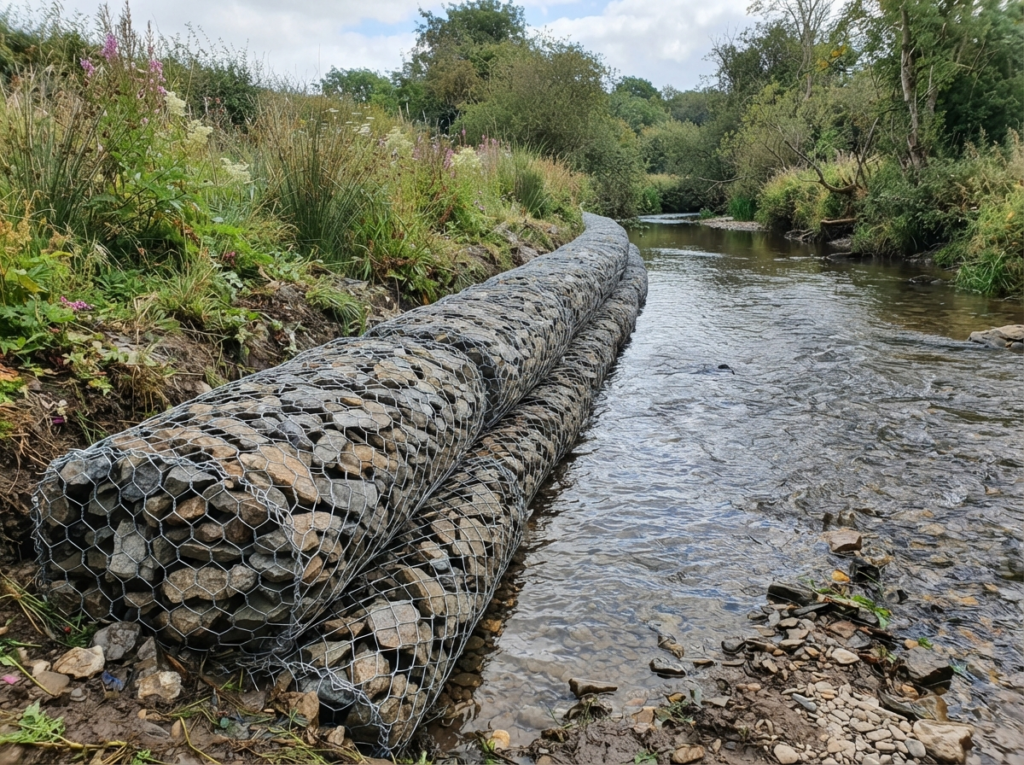
Rock rolls earn their place where water is doing the damage, not just weather or foot traffic. They are cylindrical geogrid or mesh sleeves packed with dense, angular rock aggregate, heavy enough to sit in place against wave action and current while still flexing to follow the shape of the bank underneath. If your problem is a soil bank being undercut by a river, lake or tide, that is the job a rock roll is built for.
Rock rolls or a coir blanket
The main fork is how much energy the water is throwing at the bank. Coir blankets such as Eromat C-100-J and jute netting protect soil while vegetation establishes on slopes and cuttings, but they biodegrade over months to years and rely on root growth taking over the job. Rock rolls do not depend on planting to hold. The rock fill and casing are non-biodegradable, so they carry on protecting the bank on their own, which matters directly at the waterline where scour is constant and vegetation may struggle to establish at all.
As a rule: use a coir or jute product above the waterline where grass or wildflower cover will take over, and use rock rolls at the waterline itself, on scour-prone bends, culvert outfalls and any edge where wave or current energy is ongoing rather than temporary.
Where rock rolls are specified
- Riverbank and estuary edge protection
- Lake and reservoir shoreline stabilisation
- Coastal erosion defence
- Scour protection around bridge abutments and piers
- Culvert outfall protection
- Ditch and channel lining
- Energy dissipation within SuDS schemes
The interlocking rolls conform to the bank rather than fighting its shape, and the open structure lets water pass through instead of building up hydrostatic pressure behind a solid barrier, which is what causes rigid revetments to fail or undermine over time. Over a longer service life, gaps in the rock fill can also give small niches for invertebrates and, on suitable banks, support some vegetation growing through.
Next step
Rock rolls are supplied against a project specification rather than off the shelf, since the right fill weight, roll length and quantity depend on the bank profile, flow velocity and the length of edge being protected. Use the enquiry form on the product page with your site details, or speak to Phoenix Amenity’s technical sales team, and they will work up a specification for the scheme.
Frequently asked questions
Are rock rolls better than a coir erosion blanket?
They do different jobs. Coir blankets and jute netting protect soil while vegetation establishes and then biodegrade; rock rolls carry the load themselves at the waterline, where current or wave energy is constant and grass cover may not take hold at all.
Do rock rolls need planting once installed?
No. The rock fill and casing are non-biodegradable and do not depend on vegetation to hold the bank. Some vegetation can establish in the gaps between the rock over time, but it is not required for the roll to work.
How do I get a price for rock rolls?
Rock rolls are quoted against your project: bank length, flow conditions and access all affect the specification. Submit your site details through the enquiry form on the product page and Phoenix Amenity's technical team will come back with a specification and quote.