
Instant wildflower cover on new schemes: how to lay and establish pre-grown turf
Late April is when the pressure on new landscaping schemes starts to build. Clients want to see something, handover dates are looming, and a recently graded area of bare earth does not look like progress. Seeding a wildflower meadow in this situation is a slow option: most mixes need a full growing season before they look convincing, and on high-visibility areas or slopes prone to wash-off, bare ground is not viable.
Pre-grown wildflower turf is the practical answer. It arrives as rolls of established meadow planting, typically containing native grasses and flowering plants grown for several months on a specialist farm before harvesting. You lay it much like grass turf and get immediate cover from day one. What takes care is making sure the turf actually knits into the ground below.
What the soil needs before you start
This is where wildflower turf schemes go wrong more often than anywhere else. The instinct on any landscaping job is to bring in good topsoil and get things growing. For wildflowers, that logic works against you.
High-fertility soil favours coarse grasses, which crowd out wildflower species quickly. The best substrate is low-fertility subsoil or a purpose-mixed sandy loam with minimal organic content. If rich topsoil has already gone down, check with your turf supplier before ordering; some mixes are formulated for higher-nutrient conditions, though species diversity may be lower in year one.
Cultivate the surface to about 50mm, firm it down to remove air pockets, and water it lightly before laying. Aim for a settled, slightly moist bed with no loose clods.
Laying the rolls
Wildflower turf is perishable in the same way as conventional grass turf. Stacked rolls heat up and the plants deteriorate fast, particularly as temperatures climb through May. Order enough to complete the job in one or two sessions and lay it the day it arrives if you can.
Butt the edges of each roll tightly together; gaps dry out quickly and the plants at those edges die back before they get a chance to root. On slopes, lay across the gradient rather than up and down, and peg the rolls where there is any risk of movement. Do not stretch them to cover gaps: they shrink back as they dry.
Once the turf is down, roll or tamp the surface firmly. Good contact between the turf backing and the soil below is what drives root penetration. If a roll is sitting proud on loose ground, that contact is broken and the knitting process stalls.
Watering and the first six weeks
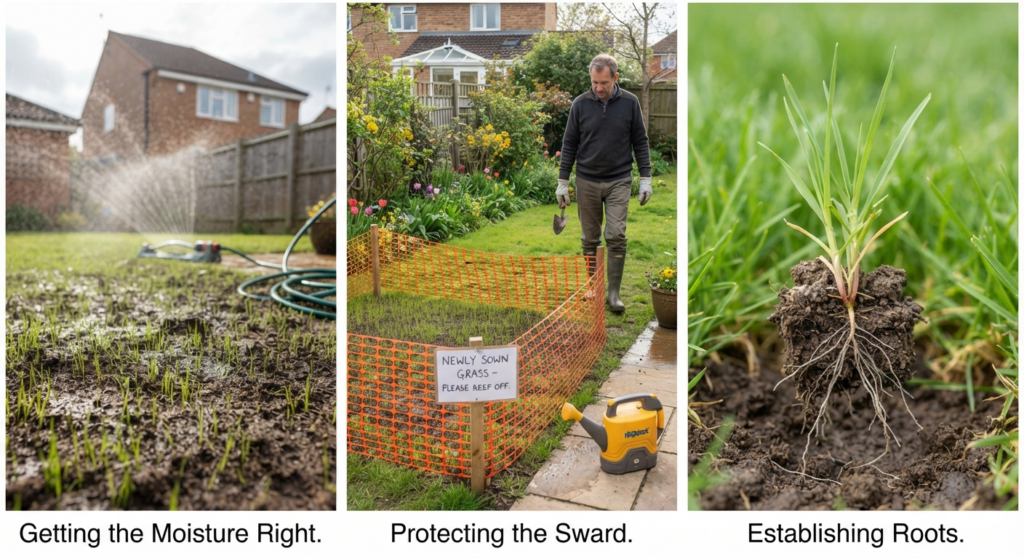
Water immediately after laying and keep the turf moist for the first four to six weeks. April and May can be drier than they look at ground level, particularly on free-draining soils. This is the window when the roots are growing through the backing and into the substrate. A dry spell here can stall establishment considerably.
Expect some yellowing and die-back in the early weeks. Plants put through harvesting, transport and laying are under stress, and it shows. What you want to see is new growth pushing through from the nodes, which tells you the roots are taking hold. Do not apply fertiliser if things look sparse; feeding at this stage pushes grass growth, not wildflowers.
Managing the cut in year one
Leave the turf uncut until the main flowering flush is over and the plants are setting seed. On most UK wildflower mixes, that means late June at the earliest, often into July. Cutting earlier removes the seed return the sward needs to thicken up over time.
At the end of the season, cut to around 70 to 100mm and rake off all the clippings. Taking the material away reduces soil fertility, which is what a wildflower site needs. Leave cuttings on and you build up the thatch and nutrients that encourage exactly the grasses you are trying to suppress. In most cases, the planting looks closer to its potential in year two than in year one.
Frequently asked questions
How long does wildflower turf take to establish?
Allow four to six weeks for the roots to knit into the soil below. The turf should be growing strongly after that, though the first full flowering display often comes in year two rather than year one.
Can wildflower turf be laid on existing topsoil?
It can, but results vary. Wildflowers prefer low-fertility substrates, and on nutrient-rich topsoil coarse grasses tend to dominate. Check with your supplier about mixes suited to higher-fertility conditions before ordering.
When is the best time to lay wildflower turf in the UK?
Spring (March to May) and early autumn (September to October) are both suitable. Avoid dry spells in summer and do not lay on frozen or waterlogged ground.
Can wildflower turf be used on slopes?
Yes, and it is often chosen for this reason. Lay rolls across the slope rather than up and down, peg them to prevent movement while the roots establish, and water well. Established wildflower turf helps stabilise moderate gradients.
How often should wildflower turf be watered after laying?
Water daily or every other day for the first four to six weeks in dry conditions. Once the roots have knitted into the soil the turf becomes more drought-tolerant and watering can be reduced.