
Choosing a grass seed mixture for heavy shade: the case for fine-leaved fescues
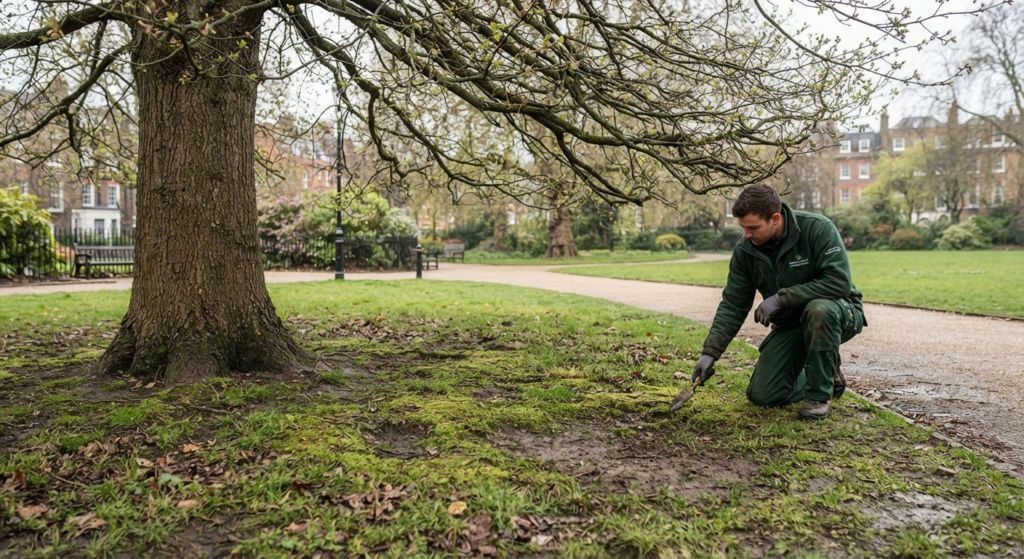
The turf under mature trees is one of the more stubborn problems in amenity grounds management. The usual fix is to overseed with whatever mix is on hand from the open areas, which tends to fail. Perennial ryegrass (Lolium perenne) requires roughly six hours of direct sunlight a day to establish well and maintain any real density. Under a closed canopy, that threshold is rarely met, and the result over a season or two is the familiar picture: thin sward, bare soil, and a creeping moss problem.
If you are assessing shaded areas this month while the deciduous canopy is still down, now is a good time to judge how much light genuinely reaches the ground. The difference between dappled shade and deep shade will change your species choice considerably.
Why ryegrass struggles in low light
Perennial ryegrass is bred for productivity and wear tolerance in open conditions. Its photosynthetic efficiency is optimised for high light. When available light drops below what it needs to sustain growth, the plant thins. The situation compounds: bare patches invite moss, tree root competition dries the upper soil faster than you might expect, and reduced airflow under canopy slows drying after rain, which raises disease pressure in what grass does remain.
Tall fescue (Festuca arundinacea) manages somewhat better in partial shade, but below four hours of direct sun daily it too becomes unreliable for amenity use. For positions with genuinely low light, the species list needs to shift to finer-leaved types.
The species worth including
Creeping red fescue (Festuca rubra subsp. rubra) is the starting point for any shade mixture. It tolerates low light better than almost any commonly sown broad-leaved grass, establishes at lower soil temperatures than ryegrass, and spreads slowly by rhizome to fill thin patches over time. Chewings fescue (Festuca rubra subsp. commutata) lacks the creeping habit but has a similarly fine leaf and reasonable shade tolerance; it gives a denser, more uniform surface where that is wanted. Hard fescue (Festuca brevipila) is worth considering specifically for dry shade conditions, which are common under canopy where tree roots compete for soil moisture through the summer.
In areas with genuine woodland-level shade, wood meadow-grass (Poa nemoralis) holds where even red fescue starts to thin. It is specifically adapted to very low light environments. Rough-stalked meadow-grass (Poa trivialis) suits moist, shaded positions rather than the drier conditions typical under mature tree canopy; use it for north-facing or riparian shade rather than as a general shade component.
How to specify the mixture
For most amenity shade situations, fine fescues should make up at least 80 per cent of the mixture. A typical formulation combines creeping red fescue with Chewings or hard fescue, depending on whether the soil is moist or dry. Where shade is very dense, replacing ten to twenty per cent of the fescue proportion with Poa nemoralis is sensible. Perennial ryegrass can appear at low rates, ten per cent or below, if the shaded area grades into a higher-wear transitional zone, but it should not anchor a mix intended for low-light ground.
Fine fescue mixes are typically sown at three to four grams per square metre for overseeding into an existing sward, or four to six grams on bare ground. Light surface scarification before sowing improves seed-to-soil contact, which matters under trees where the surface is often compacted or layered with leaf debris.
Planning from February
February is a sensible point to confirm the species specification and order seed for a spring application. Fine fescue mixes can be sown from March onwards once soil temperatures reach 5 to 8 degrees Celsius, though germination is slow at the lower end of that range. Autumn is the better establishment window for fine fescues, since soil temperatures are higher and the plants have time to root before winter. If that window was missed, late March to April is the realistic alternative.
It is also worth asking honestly whether permanent turf is the right solution at all. Under dense evergreen cover, or where surface roots leave little viable soil depth, even Poa nemoralis will thin. In those cases, bark mulch or a bound gravel surface is often the more practical choice, and worth factoring into the site plan now rather than after a third failed seeding.
Frequently asked questions
Can I overseed shaded areas with a standard lawn grass seed mix?
Not reliably. Most lawn mixes are dominated by perennial ryegrass, which needs around six hours of direct sunlight to stay dense. Under canopy, use a fine fescue-based mix instead.
What grass seed works best in dry shade, such as under mature trees?
Hard fescue (Festuca brevipila) is the most tolerant of dry shade conditions. Pair it with creeping red fescue for a practical mix; keep ryegrass out of it entirely if the position is genuinely dry and shaded.
When is the best time to sow grass seed in shaded areas?
August to October gives the best results: soil temperatures are still warm and the plants have time to establish before winter. If you missed that window, late March to April is the next realistic option once soil temperatures are above 5 degrees Celsius.
Why does grass under trees keep thinning even after reseeding?
Usually a combination of low light and root competition for water. Roots from mature trees can strip the top 20 to 30 centimetres of soil of moisture in a dry summer, stressing even tolerant species. If the same patch has failed twice, check whether the species selection is the problem or whether light levels and soil depth are simply too limiting for any grass to hold.
Is Poa nemoralis (wood meadow-grass) suitable for general amenity use?
Only in genuinely shaded positions. In open or semi-open areas it is outcompeted by more vigorous species, so including it in a general-purpose mix offers little benefit. Reserve it for dense shade where standard fine fescues struggle.