
How to tell grass seedlings from annual weeds in a new spring sowing
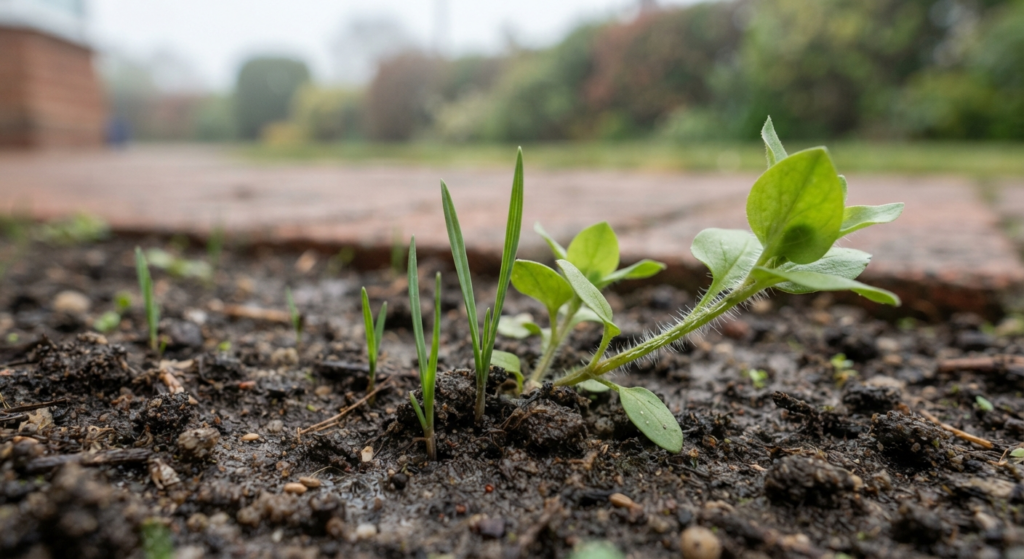
A newly sown area in spring gets busy very quickly, and not all of what emerges is the grass you paid for. Annual weeds and grass seedlings push through at similar times in warm, moist soil, and at a few millimetres tall they can look confusingly similar. Getting the identification right matters because the main tool for managing annual weed competition at this stage is the first cut, and its timing and height make a real difference.
What grass seedlings look like
Grass seedlings have narrow, strap-shaped leaves with parallel veins running along the blade. The leaf grows from the base of the plant, not the tip, which is what makes mowing non-lethal to them. A freshly germinated perennial ryegrass (Lolium perenne) seedling is essentially a single, slightly folded blade pushing straight up from the soil, with no rounded or oval seed leaves visible at ground level.
Grasses are monocots, meaning they produce one seed leaf when germinating. It looks nothing like the broad, paired seed leaves you would see from a broadleaf plant. Two rounded seed leaves lying flat near the soil surface is almost always a broadleaf weed.
Identifying the common annual weeds
Broadleaf annual weeds are dicots and produce two rounded seed leaves (cotyledons) first. After that, the true leaves develop into more recognisable shapes. Chickweed (Stellaria media) has paired oval leaves and a thin line of fine hairs along the stem. Groundsel (Senecio vulgaris) produces irregularly lobed leaves fairly quickly. Shepherd’s purse sits as a flat rosette of toothed leaves near the soil. Fat-hen has a slightly powdery, grey-green surface to its leaves.
Annual meadow grass (Poa annua) is the one that catches people out because it is a grass. It germinates faster than most sown species, produces softer and paler leaves, and the leaf blade often has a slightly boat-shaped tip. It can set seed within six to eight weeks of germinating. Worth identifying early: unlike broadleaf annual weeds, Poa annua can persist in the sward long after the other competition has cleared.
Using the first cut to weaken annual weeds
Annual broadleaf weeds grow from the tip. Cut them and you remove the growing point, which either kills them or sets them back significantly. Grass grows from the base of the leaf, from the meristematic tissue at the crown, so mowing affects it very differently. That difference in growth habit is what makes the first cut genuinely useful for weed management on a new sowing, not just a cosmetic tidy.
Time the first cut when the new grass is around 6 to 7 cm tall and the seedlings are clearly anchored in the soil. Set the mower blade to around 4 cm. Do not cut lower: the seedlings are still developing their root systems, and cutting too short can thin the establishment before the grass has competed properly. Mow on firm ground; wheel and foot traffic on soft, freshly-sown soil can dislodge seedlings, particularly on light or sandy soils.
Why selective herbicides are not the answer yet
New grass seedlings are sensitive enough that selective broadleaf herbicides can cause thinning or damage at establishment. Most product labels specify waiting until after three or four cuts before any selective treatment is applied. Read the product label before purchasing and follow it: applying a selective herbicide to a newly-germinated sward before the label permits is likely to thin the grass rather than protect it.
If the weed burden is heavy and annual weeds are getting ahead of the grass, the answer is to mow at the correct height and repeat. Annual broadleaf weeds weaken with each cut. As the grass canopy closes over and shades the soil surface, new weed seedling colonisation also slows. The sward usually wins, if you give it enough cuts early on.
Frequently asked questions
How can I tell if what is coming up is grass or a weed?
Grass seedlings have narrow, strap-like leaves and grow from the base of the plant. Broadleaf annual weeds such as chickweed, groundsel and shepherd's purse produce two rounded seed leaves first. Annual meadow grass is harder to distinguish because it is a grass, but it tends to be softer, paler and floppier than sown species.
When should I make the first cut on a new sowing?
When the grass seedlings are around 6 to 7 cm tall and clearly anchored in the soil. Set the mower blade to around 4 cm. Cutting shorter at this stage risks thinning the establishment before the grass has competed properly against the weeds.
Can I use weedkiller on a newly-sown area to clear annual weeds?
Not at this stage in most cases. Selective herbicides can damage young grass seedlings, and most product labels specify waiting until after three or four cuts. Check the label before purchasing. Repeated mowing at the correct height is the more appropriate approach during establishment.
My new sowing looks more weed than grass. Has something gone wrong?
Probably not. Annual weeds germinate fast in spring and typically outnumber grass seedlings in the first few weeks. Once the first and second cuts are done, broadleaf weeds weaken quickly. If the grass seedlings are present, the sward usually comes through as the competition reduces.
Will annual weeds come back after I cut them?
Broadleaf annual weeds weaken with each cut because mowing removes their growing point. As the grass sward thickens and shades the soil, there is less bare ground for new weed seedlings to colonise. Annual meadow grass is different and can persist in the sward long-term if it was present at establishment.