
Worm casts on autumn turf: cultural measures to keep your surface clean
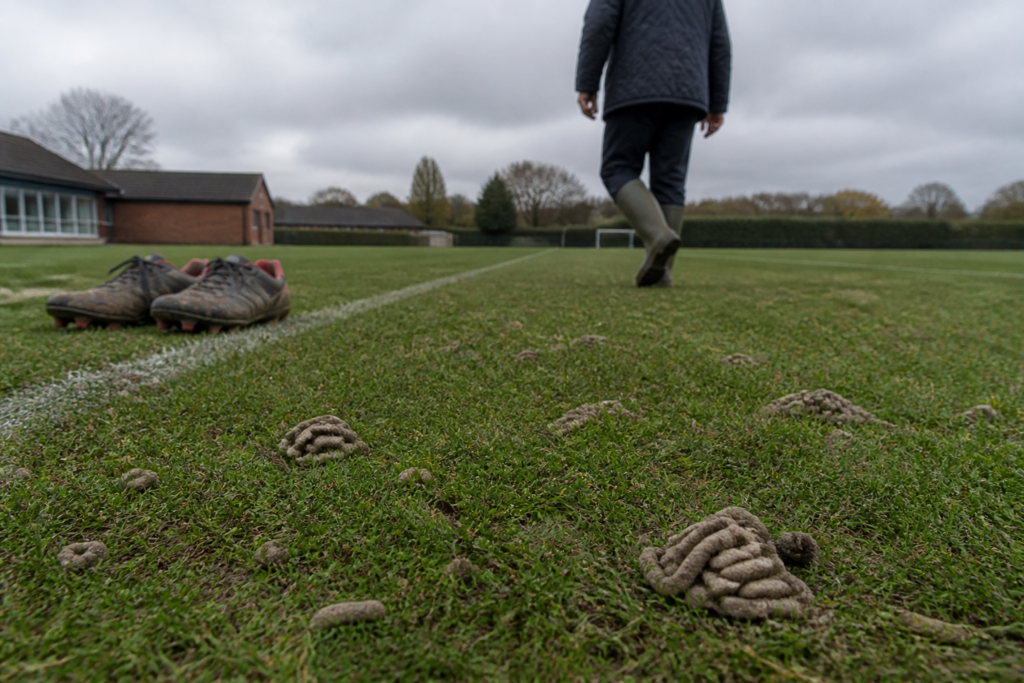
Once the first serious autumn rain arrives and soil temperatures drop towards 10°C, cast-producing earthworm species get active at the surface. On damp amenity grass you can expect fresh coils within a few days of the first proper wet spell. There are no approved pesticide options for worm control on UK amenity turf, so this is purely a cultural management question, and getting the timing of each measure right matters more than the number of things you do.
Why casts cause problems in autumn specifically
Fresh worm casts are not inherently damaging. They are mainly mineral soil, and if left to dry they add a small amount of fine material to the surface without causing real harm. The damage happens when they are smeared. Boots, mowers and ball traffic on a wet cast flatten it across the sward, creating bare, silty patches that drain slowly and give weed seedlings a head start. On a well-used pitch, a run of wet October days can undo several weeks of renovation work.
Casting is heaviest on moist, loamy or clay soils with a history of high nitrogen applications. The main surface-casting species on UK amenity turf are Aporrectodea longa and A. nocturna; these are deep-burrowing worms that pull organic material down and deposit mineral-rich soil at the surface as they go. Sites with heavier autumn feeding programmes tend to support larger populations of these species, which makes the casting season noticeably worse.
Work to dry conditions, every time
The single most effective cultural measure is also the most consistently ignored on busy grounds: brush or disperse casts when they are dry, not when they are wet. A stiff dragmat, a long-handled besom or a wire switch across dry casts breaks them down into fine particles that settle back into the turf without harm. Run the same equipment over wet casts and you smear them flat. That is how casts go from a normal biological process to a surface management problem.
On managed sites, this means scheduling brushing after dry spells rather than on a fixed day of the week. In a wet October that can mean waiting, which is frustrating. But the smearing damage around goal mouths, pathways or high-footfall areas compounds quickly if you rush it.
Autumn fertiliser and mowing height
Review what you are putting down in late September and October. High-nitrogen feeds at this time of year push soft, lush growth that earthworms feed on readily, which sustains larger populations through the autumn. If your programme includes an autumn application, a low-nitrogen product or one weighted toward potassium is a better choice on cast-prone sites. This will not eliminate casting but it does reduce the food supply that sustains heavier populations.
Keeping the cut slightly raised through autumn, towards the upper end of your site specification rather than the minimum, allows better air movement through the sward and faster drying between rainfall events. Casts are less likely to smear on a surface with some sward height. The gain is modest on its own, but it builds alongside the other measures.
Drainage work on persistently wet sites
If the same areas cast heavily every autumn, moisture retention is almost certainly the underlying factor. Hollow-tine aeration in September or October, followed by a sand-dominant topdressing worked into the channels, gradually shifts the soil profile towards better drainage. Cast-producing species prefer moist, heavy soils. A site that drains more freely will cast less, not because the worms disappear, but because the conditions suit them less well.
Soil acidification is sometimes suggested as a deterrent, on the basis that earthworms prefer neutral to slightly alkaline conditions. The pH reduction needed to genuinely affect casting, typically below 5.5, will degrade grass quality and suppress the beneficial soil biology that healthy turf depends on. It is not a realistic option for most amenity sites, and current practice as described by the Sports Turf Research Institute (STRI) focuses on drainage and surface management rather than soil chemistry.
A realistic view of what you can achieve
Cultural management will not stop casting entirely, and on a healthy site with good soil biology you would not want it to. The aim is to prevent smearing, maintain safe traction and stop casts accumulating as a structural surface problem. Get the brushing timing right, adjust the fertiliser programme, keep the cut sensible and address drainage on the worst areas. That is the complete toolkit, and it works when applied consistently.
Frequently asked questions
Can I use a pesticide to control earthworms on amenity turf?
No. There are no approved pesticide products for earthworm control on UK amenity grass. The last substance used for this purpose was withdrawn from authorisation and no replacement has been licensed. Cultural management is the only legal route available to UK grounds managers.
When is the best time to brush worm casts off the lawn?
Always brush, drag or switch casts when they are dry. Dry casts break down easily and the particles fall back into the turf without causing harm. Wet casts smear flat and create bare, compacted patches. If conditions are consistently wet, wait for a dry spell rather than brushing anyway.
Do worm casts actually damage the grass?
Not directly. The casts themselves are mineral-rich and do not injure grass plants. The harm comes from smearing: when wet casts are compressed by traffic or machinery they seal the surface, reduce drainage and create conditions that favour weed germination and reduce traction.
Why is worm casting worse in autumn than in summer?
The main casting species in UK turf are most active when soil is moist and temperatures are between roughly 5 and 15 degrees C. Autumn delivers both: ground that is still warm from summer but now thoroughly wet. Casting typically peaks in September and October and again in March and April.
Does sand topdressing help reduce worm casting over time?
Yes, over time. Regular sand topdressing following hollow-tine aeration shifts the surface profile away from the moist, heavy conditions that casting species prefer. It will not stop casting, but sites that have been sand-ameliorated over several seasons consistently cast less than comparable untreated areas.