
How to plant bare-root and root-balled standard trees properly this autumn
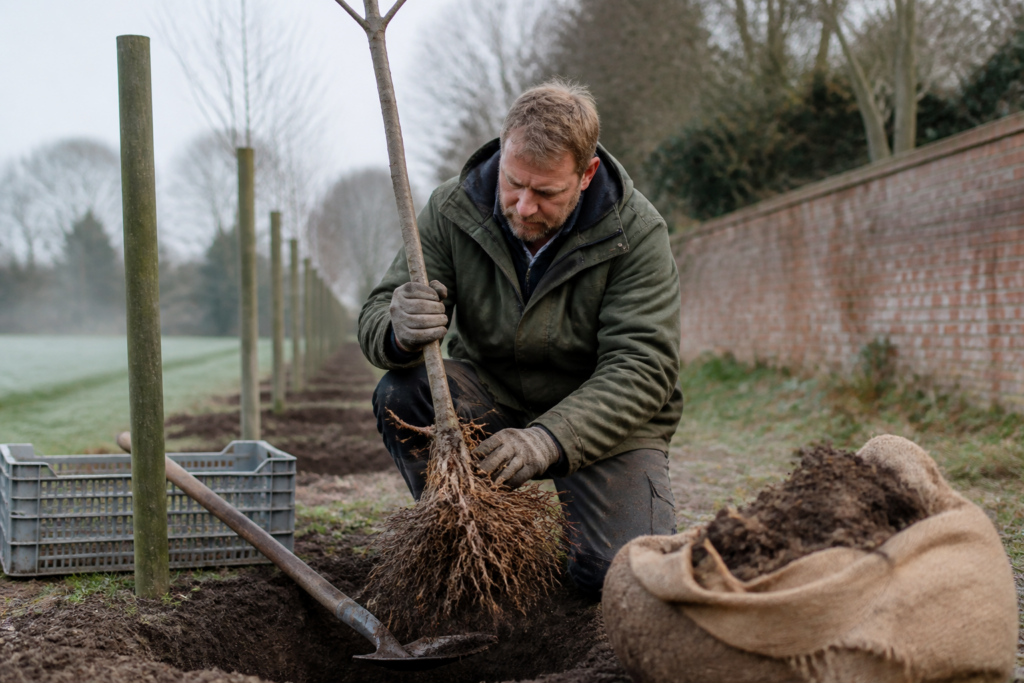
Mid-November is when the bare-root work starts. Deciduous trees have shed their leaves, growth has stopped, and the soil across most of the UK is still workable. If you are planning standard trees on an amenity site, a street scheme or an estate, this is the window. Opening the bare-root season for the right species at the right moment makes a genuine difference to how well those trees survive the first winter.
For most deciduous standards, bare-root is the better choice. It is cheaper than containerised stock and establishes well when handled correctly. Root-balled stock, where the rootball is kept intact in hessian and a wire cage, is the right call for evergreens, for species that dislike root disturbance such as Prunus, and for heavier standards where stripping the root system bare would be impractical.
What a standard tree actually means
A standard has a clear stem of 1.8 to 2.1 m from the base before the crown begins. Girth is measured at 1 m from the ground, and runs from 6 to 8 cm for a light standard up to 14 to 16 cm or beyond for a heavy standard. The girth tells you roughly how long that tree has been growing in the nursery field and how extensive the root system was when it came out. A 16 cm girth tree has been growing for years longer than a 6 cm one, and its root system is correspondingly more complex to protect in transit and at planting.
The gap between lift and pit is where most failures start
Fine root hairs, the fibrous structures that take up water and nutrients, can begin to desiccate in under 30 minutes if exposed to wind or sun. This is the part of the process that gets overlooked on busy sites. Trees arrive on the lorry, get stood against a wall while the crew finishes the previous job, and by the time they go into the ground an hour has passed in a south-facing yard. The tree may look perfectly fine at planting. It often will not establish well.
Keep roots covered with damp hessian or polythene from lift to pit. If stock has to be held on site for more than a day, heel it into a sheltered, shaded spot with the roots packed in moist compost or soil. Root-balled trees are more forgiving during transit, but check that the hessian is tight and the ball has not cracked in handling before you accept delivery.
Getting the pit dimensions right
The pit should be two to three times the width of the rootball and no deeper than the rootball’s height. The root flare, where the trunk base widens before the main roots spread, must sit at or just above finished ground level. Planting too deep is one of the most common errors on amenity sites, particularly with larger standards. Burial of the flare restricts gas exchange at the stem base and creates conditions that lead to basal decay over time.
Loosen the pit walls with a fork before planting. On compacted ground, smooth glazed walls slow root egress significantly; on clay, a sealed pit can become a sump after rain. Backfill with the excavated soil rather than heavily amended compost. ISA best management practice publications and RHS tree planting guidance both advise against rich backfill: it creates a soil interface that roots are reluctant to cross, keeping them circling in the pit rather than colonising the surrounding ground.
Stakes, ties and the first winter
A standard tree needs a stake after planting, but not a tall one. A short stake driven at around 45 degrees into the prevailing wind anchors the rootball while letting the trunk flex naturally. Trunk movement builds taper and structural strength. A fully rigid, full-height stake can produce a tree that cannot stand independently once the support is removed. Check ties at six weeks and again before the first growing season.
Mulch a ring of 1 to 1.5 m diameter to 75 mm depth, keeping it clear of the stem. Water in at planting even if the ground seems wet. A bare-root rootball can dry out in cold winds faster than the surrounding soil, and most of the failures that show up in April started in the first November after planting.
Frequently asked questions
When does the bare-root planting window open in the UK?
The window typically opens from late October in Scotland and northern England, where dormancy arrives earlier, and from mid-November across the south. It stays open until late March, though spring-planted trees face more stress as warming soil triggers growth before roots are re-established.
What is the difference between a standard tree and a heavy standard?
Both have a clear stem of 1.8 to 2.1 m, but girth grade separates them. A standard runs from 10 to 12 cm girth; a heavy standard from 14 to 16 cm or above, measured at 1 m from the base. Higher girth means longer growing time and a more complex root system to manage at planting.
How deep should a tree planting pit be?
Match the pit depth exactly to the rootball height. If you over-dig and backfill, the loose material underneath can settle and draw the tree down, burying the root flare. The flare must sit at or just above finished ground level after planting and firming.
Can I use topsoil or compost to backfill a tree pit?
Most arboricultural guidance, including RHS advice and ISA best management practice, recommends using the excavated soil. Heavily enriched backfill creates a noticeable interface between the pit and the surrounding ground that discourages roots from spreading out.
How long should a tree stake be left in after planting?
Check stakes and ties at six weeks and at 12 months. Most trees are ready for stake removal after 12 to 18 months, once the root system holds the tree firmly against wind rock. Leaving a stake in too long prevents the trunk from developing the taper needed to stand independently.