
Frost damage on evergreen hedging: how to diagnose it correctly and when to cut
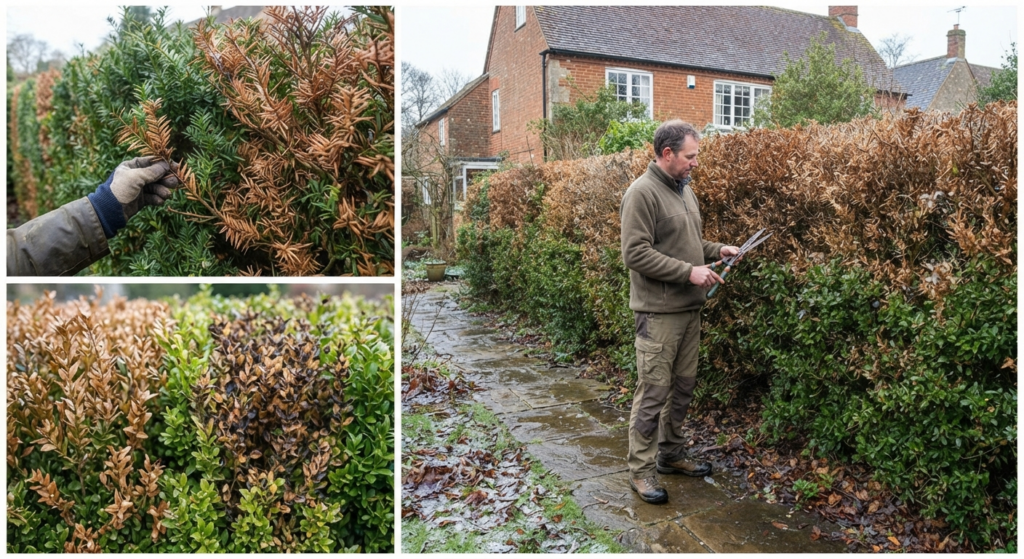
Winter cold leaves a lot of hedges and evergreen shrubs looking terrible by late January. The instinct is to reach for the shears. Usually, that’s the wrong call.
What frost scorch actually looks like
Cold scorch follows exposure. It tends to appear first on the windward face of a hedge or the north-east side of a plant, then at the tips of long unprotected runs. The foliage goes bronze, then rusty brown or papery, and often the change doesn’t become visible until a week or two after the damaging cold event. A hedge that looked fine through December can turn brown in February after a sharp January freeze.
The browning is fairly uniform across the affected zone. Young growth goes first: extension growth pushed out in late autumn is the most vulnerable. Established older stems usually survive even where the leaf cover looks grim.
How to tell cold scorch from disease
Cold scorch has a consistent pattern: it tracks exposure. The face of the hedge that caught the cold wind looks bad; the sheltered side is mostly fine. That asymmetry is the first thing to check.
Box blight, caused by Cylindrocladium fungi (reclassified as Calonectria pseudonaviculata), behaves differently. It spreads as irregular patches within the canopy rather than just at the exposed tips, and in humid conditions you may see white or pinkish fungal growth at the base of dying stems. Box blight can develop at any time of year; a hard frost in January does not cause it.
Phytophthora root rot produces a different pattern. Plants wilt or yellow from the base upwards, sometimes one branch at a time, and the roots show reddish-brown discolouration when examined. Photinia with brown or red blotches after cold weather is often suffering from frost scorch on young growth, but Entomosporium leaf spot, a fungal disease common on Photinia x fraseri, can look similar. The leaf spot tends to have a distinct darker margin and spreads across plants regardless of cold exposure.
If you’re not sure whether a stem is dead, scratch the bark with your fingernail. Green tissue underneath means the stem is still alive, even if the foliage above looks completely gone. Dry, pale tan or cream-coloured tissue means the stem itself has died back.
Why cutting too early makes things worse
Frost-scorched foliage, ugly as it is, insulates the growth buds sitting behind it on the stems. Cut it off in January or February and those buds are exposed to the next hard frost. The tidying-up impulse can set back recovery.
There’s a second problem. Until spring growth starts to push, you can’t tell how far the damage actually goes. Some of what looks entirely dead in February will break from below by April. Cut back to bare stems now and you risk removing viable material, or cutting to a point where there’s no bud left to grow from.
The RHS advises waiting until buds are visibly breaking before cutting frost-damaged plants. For most UK sites that means March at the earliest; on cold or exposed gardens, waiting until April is safer.
When to cut back, and how
Once growth has started to push, use the scratch test to work from the tips inward, cutting to just above the first healthy bud or lateral shoot you find. On heavily damaged plants that might mean cutting quite hard. Most evergreens, including box, yew, laurel and privet, tolerate hard pruning into older wood in spring.
If you’ve confirmed or suspect box blight, bag and bin the clippings rather than composting them. Clean cutting blades with a garden disinfectant between plants, as the fungus enters readily through fresh wounds.
Frost-scorched material with no fungal signs can go on the compost heap. And if a plant still looks beyond saving by April, that’s the right time to make the call, not January.
Frequently asked questions
My box hedge has brown patches after frost. Could it be box blight?
Frost damage on box follows exposure: the side facing the cold wind browns first and the sheltered side stays green. Box blight appears as irregular patches anywhere in the canopy and may show white or pink fungal growth at stem bases in damp conditions. If the damage is clearly one-sided and matches a cold spell, frost scorch is the more likely cause.
When is it safe to cut back frost-damaged box, yew or laurel?
Wait until you can see buds beginning to break in spring. For most UK sites that means March at the earliest, and April on cold or exposed gardens. Cutting in January or February exposes protected buds to further frost and makes it impossible to judge how far the damage actually goes.
Will frost-damaged evergreen leaves grow back?
The scorched leaves themselves will not recover. New growth will push from surviving buds on the stems below, and on most evergreens this new foliage covers the damage by summer, provided the stems themselves are alive. Use the scratch test to check: green tissue under the bark means the stem is live.
How do I know if a frost-damaged stem is dead or just dormant?
Scratch the bark gently with your fingernail. If you see green tissue underneath, the stem is alive. Pale tan or cream-coloured tissue means the stem has died back. Work from the tips inward until you reach live wood before making any cuts.
My photinia has brown or red blotches after the cold. Is that frost damage?
It could be either. Frost scorch on photinia tends to affect the most exposed younger leaves and follows the pattern of cold exposure. Entomosporium leaf spot, a common fungal disease on Photinia x fraseri, produces similar-looking marks but has a distinct darker border and spreads regardless of cold weather. Wait until spring to see how the plant responds before treating.