
How to keep newly planted trees alive through a dry June and July
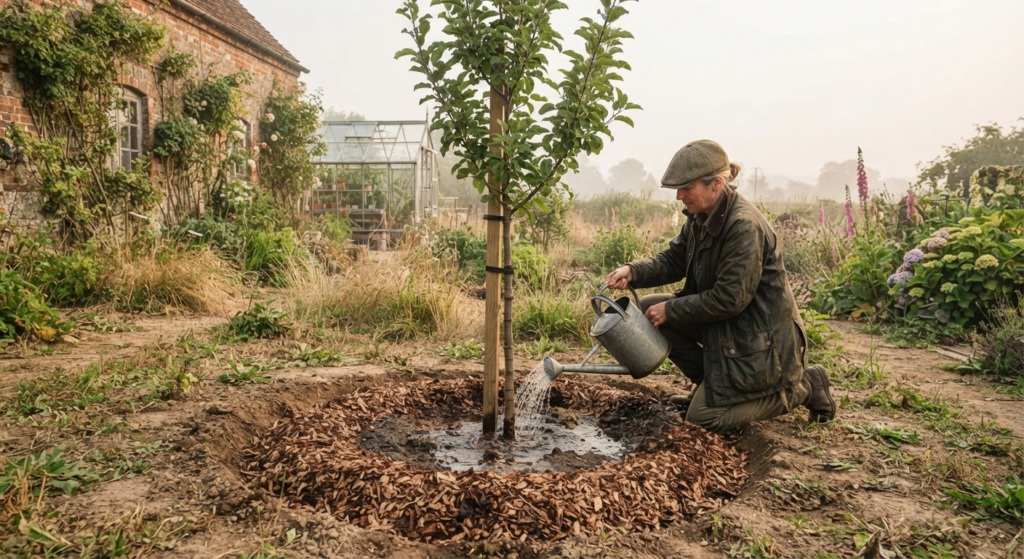
June and July are the months that decide whether a newly planted tree survives its first year. The roots are still confined to the original root ball, the soil around it has started to firm up, and if there’s a dry spell, that compact zone dries out faster than most people expect.
How much water to give
The figure that most arboricultural guidance converges on is 10 to 15 litres per watering, applied slowly enough to soak in rather than run off the surface. In dry weather, that means watering at least two or three times a week for standard and semi-mature stock. A small whip needs considerably less; a larger tree with a substantial root ball needs more.
The temptation is to assume recent rainfall has done the job. It often hasn’t. Twenty millimetres of rain sounds helpful, but if the soil surface has compacted or grass surrounds the tree pit, little of that water reaches the root zone. Water the tree directly over the root ball, slowly, and check soil moisture at 10 to 15 cm depth rather than judging by the surface. Feeling the soil beside the root ball tells you more than anything else.
Mulch rings and why they matter
A proper mulch ring cuts moisture loss from the root zone considerably. Apply composted bark or wood chip 75 to 100 mm deep, in a ring roughly one metre from the stem. Keep the mulch clear of the stem itself by about 100 mm: mulch sitting against the bark traps moisture at the base and can cause collar rot.
Mulch also moderates soil temperature, which in a hot July slows evaporation and keeps roots working longer. If you’re looking after trees on a public green space, housing scheme or estate, topping up mulch rings before mid-July is a practical priority. Existing rings often thin out through winter and spring and need refreshing.
Checking the weak points
Stakes and ties are worth checking every two to three weeks through summer. Trees planted in autumn or the previous spring will have grown since installation, and a tie that was correctly sized at planting can start to cut in. Girdling damage to the vascular tissue is cumulative and usually only noticed once it has already caused real harm.
Signs of drought stress are fairly readable: wilting that hasn’t recovered by morning, leaf scorch starting at the margins, premature leaf drop, or a washed-out colour to the foliage. These symptoms can look similar to waterlogging in heavy soils, so check the root ball directly. Dig down 15 cm beside it and feel the soil. Dry means water; wet means hold off and look at drainage around the pit.
Stock type and first-summer risk
Container-grown trees are generally better buffered in their first summer because the root system came through transplanting intact. Field-lifted or bare-root stock planted the previous winter is more exposed: it had to regenerate its absorbing roots from scratch and may still be building that system well into July.
For contractors and grounds teams managing larger plantings, a simple record of species, girth at planting, and installation date helps prioritise attention during dry spells. Silver birch and rowan tend to establish readily. Larger-girth standards of lime or hornbeam often need more intensive attention through a dry first summer.
When the signs are serious
A tree that looks stressed in early June can usually recover with prompt attention. A tree that has been dry for several weeks, has dropped most of its leaves, and shows no new growth is harder to save. If in doubt, scratch the bark very gently with a thumbnail just below a branch tip. Green beneath the surface means live tissue; brown or dry means that section has gone.
A failed tree on a landscape or amenity project usually carries a replacement obligation. Replacement costs considerably more than the watering time that could have prevented it.
Frequently asked questions
How often should I water a newly planted tree in summer?
In dry weather, water at least two or three times a week, applying 10 to 15 litres each time directly over the root ball. A small whip needs less; a large standard or semi-mature tree needs more. Continue through any dry spell until the end of September.
Can you overwater a newly planted tree?
Yes. Signs include yellowing leaves, soft bark at the base, and soil that stays wet at 15 cm depth for several days after watering. In heavy clay soils with poor drainage, overwatering is a real risk. If the root zone stays waterlogged, ease off and look at drainage around the tree pit.
How thick should the mulch be around a new tree?
Apply 75 to 100 mm of composted bark or wood chip in a ring roughly one metre from the trunk. Keep a clear gap of about 100 mm around the stem itself to prevent collar rot. Top up existing rings if they have thinned below 50 mm.
How long does it take for a newly planted tree to establish?
For most standard-size trees, expect at least one to two full growing seasons before the root system spreads meaningfully beyond the original root ball. Larger-girth specimens take longer. Supplementary watering is usually recommended for at least the first two summers after planting.
The leaves on my new tree are going brown at the edges. What does it mean?
Brown leaf margins most commonly indicate drought stress, though the same symptoms can follow hot dry winds or waterlogged roots. Check soil moisture at 10 to 15 cm beside the root ball. If dry, water slowly and apply mulch. If wet, hold off watering and improve drainage around the tree pit.