
Re-firm frost-lifted plants and check your guards before deep cold sets in
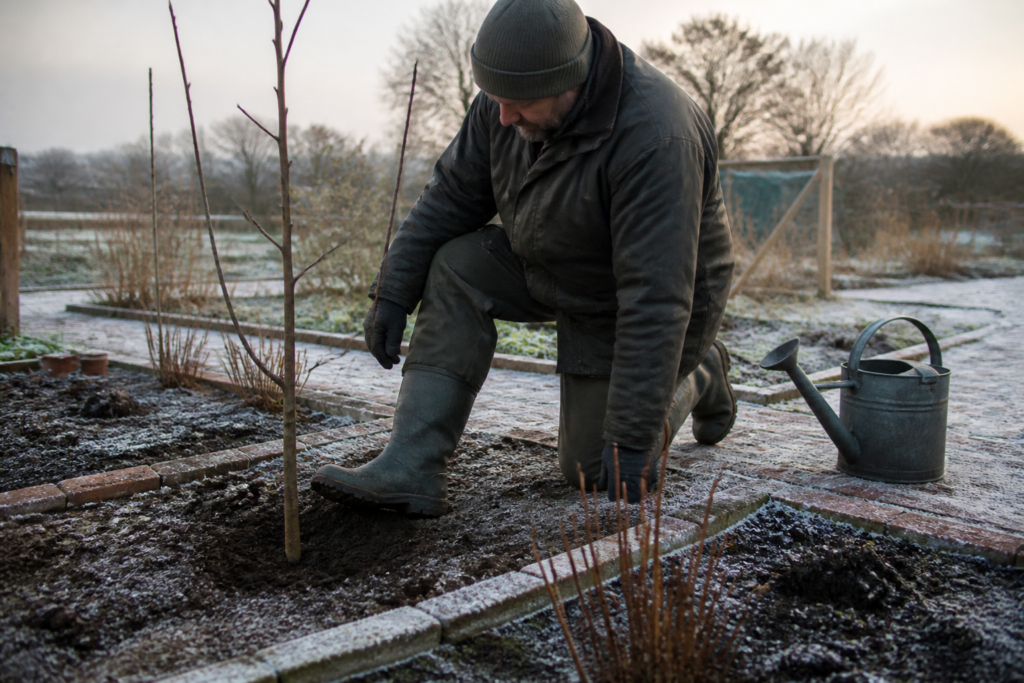
The first proper ground frosts of late November can catch a late planting season in the worst possible way. Stock planted in October or early November hasn’t had time to knit into the surrounding soil. When frost heaves the ground up and then releases it, the roots come with it, leaving a slightly proud, slightly loose plant sitting in a widened hole. It looks fine at a glance but is already in trouble.
The fix is simple. On a milder day after any frost event, go round your new planting, push each plant firmly back with your boot, close any gaps around the stem base with your heel, and water in if the ground is not already wet. That five-minute job per plant can genuinely be the difference between establishment and failure for a lot of trees and shrubs in their first winter.
Why frost heave hits new planting hardest
Established plants grip a wide area of soil with their roots. A tree planted eight weeks ago has roots only in the original rootball and the immediate surrounding zone. When soil water freezes, it expands and pushes upward; when it thaws, it doesn’t always settle back in the same position. The rootball rises and stays risen. That air gap dries the roots out, and in a cold wind the damage moves faster than most people expect.
Heavy clay soils are the worst offenders, especially if the ground was cultivated at planting, since loosened soil contracts and expands more dramatically. Sandy or free-draining soils are slightly less prone because they hold less water to freeze. Sloping ground with natural drainage is less likely to heave badly than flat sites with a high water table.
What to check on your walkaround
A walkround after any frost event, or certainly before the next cold spell, pays for itself in spring. Look for plants that have visibly risen or rocked loose, stakes that have shifted or cracked, and guards that have moved, split, or fallen off entirely.
Run your hand around the stem base of each plant. Soil contact should be firm and consistent all the way round. Any sponginess or visible gap needs sorting immediately. For tree whips and bare-root transplants especially, a loosened plant left through a cold fortnight can be impossible to save by spring.
Where gaps exist, work fine topsoil or a mix of site soil and compost in around the root zone before firming down. For larger standards, work it in by hand in layers rather than trying to do it all with your boot.
Stakes, ties and guards
Stakes shift more than people expect once frost has cycled through the ground. Push each one: it should move no more than a centimetre or two. A wobbling stake transfers movement directly to the root union, which is the opposite of what it is there to do. If a stake has heaved or cracked, replace it.
Tree ties need to be firm but not cutting into the bark. A tie that was correct at planting in September may now be slightly too tight if the stem has thickened, or too loose if the stake has shifted. Check each one and adjust. The stake should carry the load, not the tie.
Tree guards and spiral wraps are worth a proper look. A fallen guard offers almost nothing. Spiral guards can split in hard frost; a cracked guard still gives useful wind protection that reduces bark desiccation, so replace rather than leave it. Mesh guards on park trees should be pegged back down if frost has lifted the base stakes.
Mulch before deep cold sets in
If mulch was applied at planting, top it up to around 75 mm depth now. Mulch buffers the freeze-thaw cycles that cause heaving by slowing temperature change at the soil surface. It won’t stop frost, but reducing the number of freeze-thaw cycles the soil goes through is exactly where the benefit lies.
Keep mulch a hand’s width clear of the stem to avoid collar rot, which in a wet winter can be as damaging as frost. Bark chip and composted wood chip both work well. Avoid piling on fresh un-composted chippings, which can tie up nitrogen in the root zone and in some cases introduce pathogen risk to young stressed plants.
Frequently asked questions
How soon after frost should I check newly planted trees?
Check within a day or two of any thaw while the soil is still workable. A frost-lifted plant left for a week or more is harder to save, particularly if cold dry wind follows.
What is frost heave and why does it affect new planting?
Frost heave is when freezing soil expands and pushes plants upward. Newly planted stock is most at risk because the roots haven't spread into the surrounding soil to resist the movement.
Should I water plants back in after re-firming them?
Only if the soil is dry, which is unusual in late November. If the ground is already wet or recently rained on, firming the soil back with your boot is usually enough. Overwatering in cold weather creates its own problems.
How tight should a tree tie be?
Firm enough to hold the stem against the stake without compressing the bark. You should be able to slide a finger between the tie and the stem. The stake does the work; the tie just stops the stem from separating from it.
Do spiral tree guards protect against frost?
Spiral guards reduce wind exposure and buffer temperature fluctuation around the stem, which limits bark desiccation. They are not a frost barrier in the way horticultural fleece is, but an intact guard is far better than one lying on the ground.