
Matting graded banks in autumn before winter rain does the damage
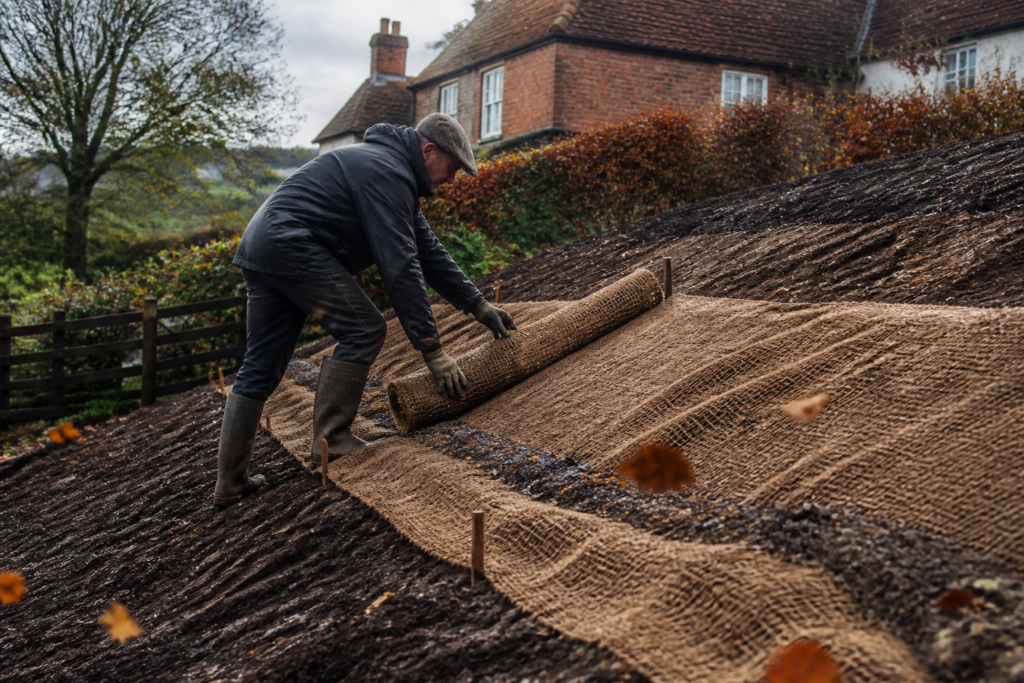
Graded banks are at their most vulnerable in their first winter. The soil is loose, the surface has no root structure, and once October rain sets in, weeks of careful grading can wash towards the drain in a few storms. The practical answer, for autumn earthworks and bank stabilisation, is to get erosion control matting down with a fast-establishing seed mix before the heavy rain arrives. Not perfect establishment. Just enough to hold.
Why autumn is the right window, and why it closes fast
September and early October offer a useful combination: soil still warm enough from summer to support germination, but conditions that are about to change sharply. Daylight hours drop and temperatures follow. Seed sown after late October on an exposed bank is a gamble on whether it establishes before frost.
UK autumn rainfall increases from October across most of England and Wales. Rain landing on bare, unprotected soil on a slope moves material quickly. The combination of matting and seed gives the bank surface a real chance through those first wet months.
Choosing the right matting
Biodegradable erosion control blankets (ECBs) are the standard choice on most amenity and civil sites. They come in coir (coconut fibre), straw, wood fibre and jute. Coir is the most durable, lasting two to three years before breaking down, which covers most grass establishment timescales on UK banks.
On steep slopes or sites with concentrated water flow, a combined biodegradable and synthetic mat may be needed. For the most erosion-prone situations, permanent turf reinforcement mats (TRMs) provide long-term root reinforcement. Most standard ECBs are rated for slopes up to 1:2 (roughly 27 degrees). Steeper than that, check the manufacturer’s specifications before ordering.
Getting seed establishment right
Seed goes down first, then the matting goes over it. That order gets reversed on rushed jobs. Broadcast the seed over the prepared surface, lightly rake it in where the slope allows, and lay the matting immediately on top. Seeding onto the mat after it is pinned in place gives patchy germination and undermines the whole operation.
For most UK amenity banks, a fast-establishing mix with a high proportion of perennial ryegrass (Lolium perenne) is the practical choice. It germinates quickly relative to other species and develops a root system that binds the bank face. On shadier or north-facing slopes, a fescue-dominated mix is more reliable: ryegrass thins significantly in low-light conditions over time.
Use a higher seed rate than you would on flat ground. Thirty to forty grams per square metre is typical on disturbed banks, compensating for the less-than-ideal seedbed conditions on a slope.
Pinning: where most jobs go wrong
Matting that lifts in the first storm has not failed the product. Someone cut corners on pinning. On typical slopes, pins go at 300 to 500 mm centres along the top edge and at 500 to 750 mm intervals through the body of the mat. Steeper banks and wetter regions need the tighter spacings. Biodegradable wire-form pins or wooden stakes are both standard options.
Overlaps matter too. Rolls should overlap by at least 150 mm at the sides, with the upper roll overlapping the lower one, not the other way around. Water channels under a poor join very efficiently, creating exactly the gully the mat was meant to prevent.
What to expect through to spring
A uniform green bank by January is not a realistic target. Germination will be uneven where soil temperatures have dropped, and some areas may stay dormant until February or March. What you should see is the matting sitting flat, minimal surface movement after rain events, and the first patches of establishment appearing at the mat edges.
By April, root development across most of the bank should be enough to hold the surface without the matting doing all the work. If bare patches remain at that point, overseed them before the soil warms properly. A bank with 60% cover going into its second summer is a very different situation from one with 20%.
Frequently asked questions
When is the latest I can lay erosion control matting in autumn?
Early to mid October is the practical cut-off in most of England and Wales. After that, soil temperatures drop enough to delay germination until spring. If you miss the window, pin matting to protect the bank surface over winter and overseed in March when temperatures recover.
Should seed go down before or after the matting?
Before. Broadcast seed over the prepared bank, rake it in lightly where the slope allows, then lay the mat on top. Seeding onto the surface of already-pinned matting produces patchy germination and is not reliable.
Which matting works on steep slopes?
Most standard biodegradable erosion control blankets are rated for slopes up to 1:2 (about 27 degrees). On steeper ground, check manufacturer specifications: you may need a reinforced combination mat or a permanent turf reinforcement mat rather than a standard ECB.
What seed rate should I use on a graded bank?
Higher than on flat ground. Thirty to forty grams per square metre is typical on disturbed banks. Some seed will not establish in the uneven seedbed conditions on a slope, and the higher rate compensates for that loss.
What is the difference between erosion control matting and hydroseeding?
Erosion control matting is a physical blanket pinned to the slope surface. Hydroseeding sprays a slurry of seed, mulch and tackifier directly onto the bank. Hydroseeding suits slopes too steep to walk on safely; physical matting is generally more cost-effective on gentler gradients.