
How the hydroseed slurry gets cover established on slopes that defeat conventional sowing
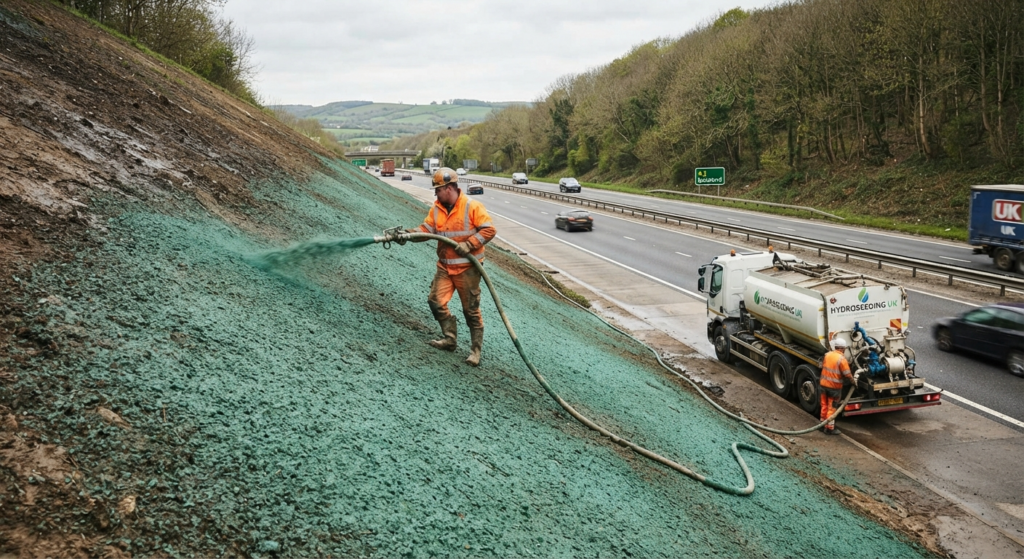
If you are seeding a slope steeper than about 1:3, conventional broadcasting will let you down. The seed dislodges, the exposed soil dries out before the root can anchor, and you end up with bare patches exactly where you need cover most. Hydroseeding gets round that by spraying the seed inside a slurry that clings to the surface and holds the right conditions for germination underneath it. On the right site, it is faster and more reliable than dry sowing, and cheaper at scale than turfing.
What goes into the slurry
The mix running through the hose is more than seed and water. A standard hydroseeding slurry contains wood fibre or cellulose mulch, a tackifier (usually guar gum or a synthetic polymer binder), starter fertiliser, and sometimes a green tracer dye so the operator can see what has been covered.
The fibre mulch is the part that makes it work on slopes. Once it dries against the surface, it forms a lightweight mat that holds moisture around the seed and buffers the temperature swings you get on a bare embankment face. The tackifier bonds that mat to the ground, so even a heavy shower shortly after application does not wash it away. Without it, germination on exposed slopes is a lottery: seeds either dry out before the root establishes or move downhill in the first rain.
Where dry sowing breaks down
Broadcast seeding works well where rain washes seed in rather than off. On gradients steeper than roughly 1:3, surface water takes the path of least resistance down the slope. Unprotected seed goes with it.
The same issue applies on awkward sites that conventional machinery cannot easily reach: narrow road cuttings, flood defence bunds, quarry restoration areas, and ground close to watercourses where disturbing the bank with a tractor is either unsafe or not permitted. A hydroseeder uses a hose, so one operator can treat corners and edges that machinery misses, and can work from a track or road above or below the slope.
Turfing is an alternative on some slopes, but at any real scale it is slow and expensive. On gradients steeper than about 1:2.5, turf can slip before it roots unless you pin it, which adds both material cost and labour. Hydroseeding sidesteps all of that.
Spring timing and soil conditions
Grass seed germinates reliably once soil temperature at 5 cm depth is consistently above around 8 to 10°C. In most of England and Wales that window opens from late April, and May into early June is usually the best combination of warmth and soil moisture before summer dry spells reduce germination rates. Scotland and higher ground will be two to three weeks behind.
South-facing embankments warm quickly and can run 3 to 5°C above flat ground nearby. North-facing slopes take longer. It is worth checking soil temperature before committing to a programme, because a fortnight’s difference can mean germination in two to three weeks instead of four to six.
The mulch layer helps extend the viable window a little. It insulates against overnight cold and slows surface drying during dry days, which is why spring hydroseeding often outperforms a late-April dry seedbed that bakes hard in May.
What to expect from establishment
On a prepared slope with decent soil contact and adequate moisture, hydroseeded grass mixes typically show visible cover in three to four weeks under spring conditions. Full establishment, meaning a sward that can hold the slope without the mulch layer, takes eight to twelve weeks depending on species mix, soil quality, and weather.
Walk the site at three weeks and check for bare patches. These can be spot re-sprayed before they become erosion points. Keep machinery and traffic off the slope for at least six weeks. The mulch mat degrades over the same period, which is intentional: it returns organic matter to the surface and you should not need to remove it.
If the site has steep sections combined with poor topsoil or heavy clay, adding a biodegradable erosion control blanket over the hydroseeded area can improve establishment rates on the most exposed parts. That is an additional cost worth factoring into the project quote early rather than discovering it once germination fails.
Frequently asked questions
How steep a slope can you hydroseed?
Hydroseeding is commonly used on gradients up to 1:1 and sometimes steeper, where the tackifier in the slurry binds the mulch mat to the surface. Beyond 1:1 you may need additional erosion control measures, such as a pinned biodegradable blanket over the hydroseeded area.
How long does hydroseeded grass take to germinate?
Under typical spring conditions in the UK, with soil temperatures consistently above 8 to 10°C, most grass mixes show visible germination within two to three weeks. Full sward cover takes eight to twelve weeks.
Can you hydroseed in dry weather?
The mulch mat improves resilience in dry conditions, but the seed still needs adequate moisture to germinate. If no rain is forecast for more than a week after application, irrigation or a short delay is worth considering on exposed sites.
Does hydroseeding work on clay soil?
It can, but clay presents two issues: poor seed-to-soil contact on a compacted surface, and waterlogging risk in wet spells. Loosening the top few centimetres before spraying and choosing a species mix tolerant of wet-then-dry conditions improves the result considerably.
Is hydroseeding cheaper than turfing a slope?
For areas above roughly half a hectare, hydroseeding is usually significantly cheaper than turf. On steep slopes where turf would need pinning, the cost difference is larger still. The trade-off is time: turf gives near-instant cover, whereas hydroseeding takes eight to twelve weeks to establish.