
How to hold a newly graded bank with matting and nurse grass before summer rains
Bare, freshly graded slopes are most vulnerable in May and June. The soil is loose, there is no root structure to bind it, and British summer rain does not always arrive gently. A 25mm downpour on a 20-degree bank can shift a meaningful amount of topsoil before a single grass plant has taken hold.
The practical fix is to combine erosion-control matting with a fast-germinating nurse species sown into the same seedbed as your main mix. Do both together, in the right order, and you give the bank a realistic chance of surviving the first summer without significant loss.
Choosing matting for the slope
Biodegradable jute netting is the most common choice on UK amenity banks. It lets rainfall infiltrate rather than run across the surface, holds seed in contact with the soil, and breaks down cleanly within one to two growing seasons as the sward establishes. Coir matting is heavier and slower to degrade; it is worth considering on steeper ground or where fine soils are prone to rilling.
On banks steeper than roughly 1:1 (45 degrees), or where the substrate is particularly sandy or silty, a geosynthetic reinforcement layer may be more appropriate. For most local authority or amenity slopes in the 1:2 to 1:3 range, jute works well and is straightforward to source and install.
Pinning matters more than most people expect. Pins at 300 to 500mm intervals across the slope face, with extra pins at the top and bottom edges, prevent the mat lifting in wind or sheet runoff. On soft substrates, go closer to 300mm. A mat that lifts takes the seed with it.
What nurse species actually does
A nurse species is a fast-germinating grass that provides ground cover while slower permanent species establish. It is not meant to stay in the sward long-term. It just needs to come up quickly enough to protect the surface in the six to eight weeks before your main mix shows meaningful coverage.
Westerwolds ryegrass is the standard choice in UK amenity work. It germinates in seven to ten days at typical May soil temperatures and produces visible cover within three weeks. It is an annual or biennial, so it dies back naturally in its first or second year, giving perennial and wildflower species room to establish without much competition. Italian ryegrass can be used for slightly longer nurse cover, though it may need managing if your permanent mix is fine-leaved or species-rich.
Mix the nurse grass into the main seed blend at five to ten grams per square metre. Sowing them in the same pass gives a more even result than treating the nurse as a separate operation and leaves fewer bare patches in the permanent cover.
Sowing sequence on a slope
The order of operations makes a difference. Prepare the seedbed, then sow your seed mix (nurse grass included), then pin the matting over the top. This presses seed into the surface rather than burying it so deep it struggles to emerge. On shallow banks up to about 1:3, a light raking before laying the mat is enough to achieve good seed-to-soil contact.
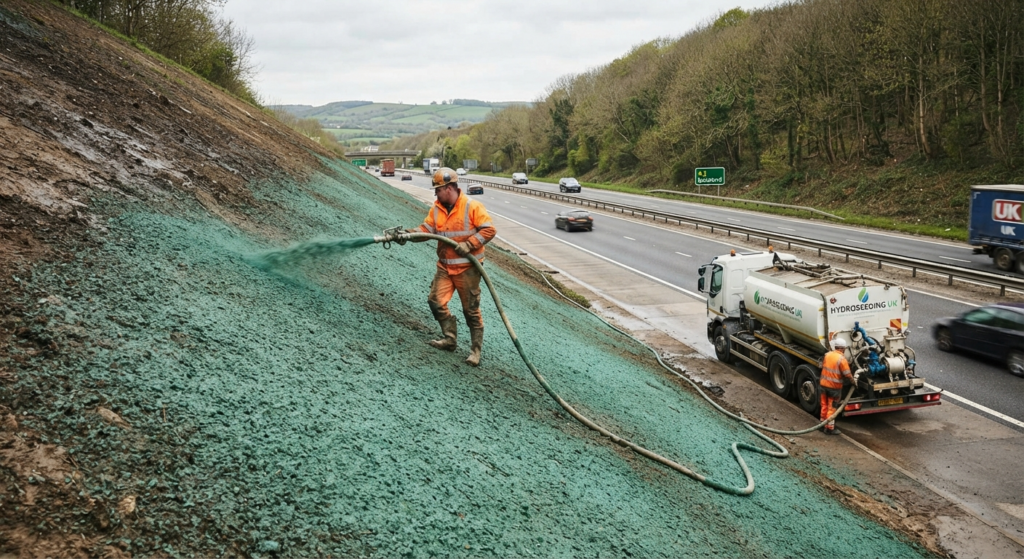
On steeper slopes or longer runs where access is difficult, hydraulic seeding combines seed, fibre mulch and a tackifier in a single application. It is efficient on large or inaccessible banks where hand sowing would be slow and uneven. The setup cost means it tends to make sense on areas above roughly 500 square metres; below that, conventional sowing under pinned matting is usually more cost-effective.
The first six weeks
Water is the first thing to check after sowing. Slopes drain and dry out faster than flat ground, and May and June can bring dry spells as easily as storms. If the top 20mm of soil is dry to the touch, irrigate. South-facing banks dry particularly quickly.
Check the mat edges after any significant rainfall. If pinning has lifted, re-pin straight away. Small repairs in the first two weeks take minutes; waiting until the mat has shifted enough to expose bare soil often means resowing a section.
Hold off on any herbicide until the sward is properly established, which is typically later in the first season or into the second year. If aggressive weed species appear early, hand removal is the sensible approach.
Frequently asked questions
Does every new bank need erosion-control matting?
Not always. On gentle slopes of 1:5 or shallower, a well-prepared seedbed, dense sowing rate and adequate watering programme may be sufficient. On anything steeper, or where the soil is sandy or silty, matting reduces the risk of surface wash before the sward establishes.
Can I use ordinary perennial ryegrass as a nurse species?
It will germinate, but perennial ryegrass establishes aggressively and can outcompete fine-leaved or wildflower species in the permanent mix. Westerwolds ryegrass is a better choice: it is an annual, germinates fast, and dies back without suppressing what follows.
When is the best time to sow on a newly graded bank?
April to mid-June is the most reliable window in the UK. Soil temperatures above 8 to 10 degrees Celsius support reliable germination, and there is still time before summer dry spells for the sward to root down properly. Autumn sowing in September and October also works, though the bank carries more risk over winter without an established cover.
How do I stop seed washing off a steep slope before it germinates?
Pin the matting over the seed rather than underneath it. On very steep ground or long runs of cut slope, hydraulic seeding with a fibre mulch and tackifier is more reliable than hand sowing under matting, as it bonds the seed to the surface in one operation.
How long before a sown bank is safe from erosion?
A nurse grass cover provides some protection within three to four weeks. Full erosion resistance from the permanent sward usually takes six to twelve months, depending on species mix, soil type and aftercare. Matting provides the bridge through the critical establishment period.