
How to choose an urban non-native wildflower mixture
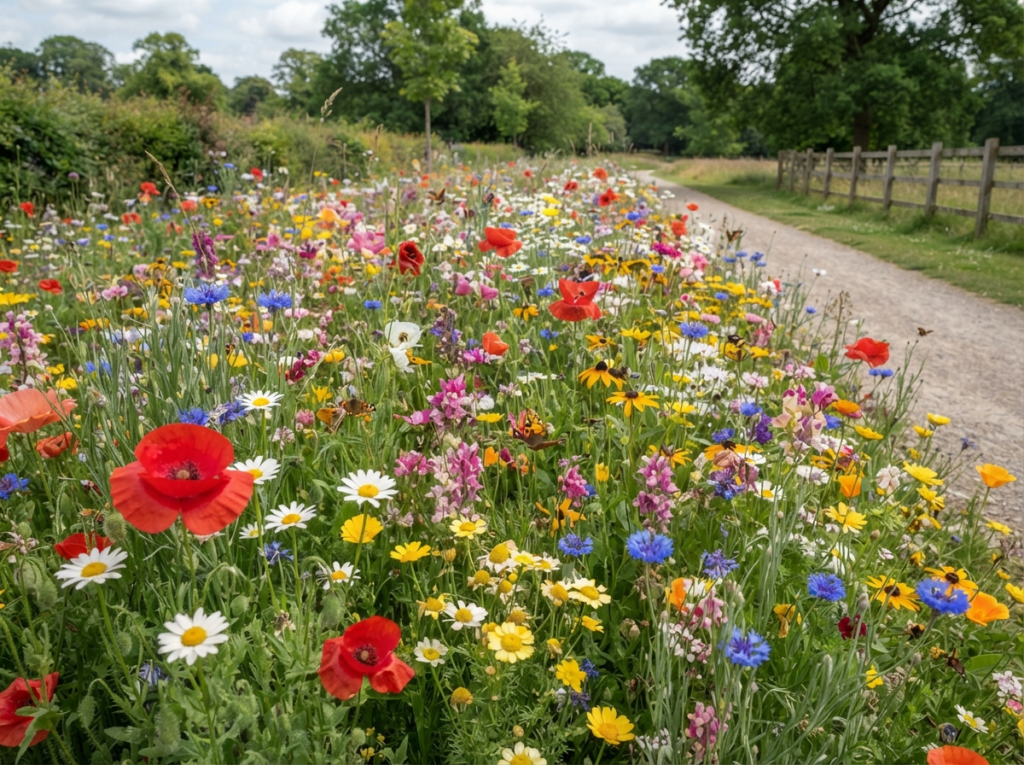
These mixes are chosen for visual impact rather than native provenance, so the first decision is whether you want one bold season of colour or a display that keeps coming back, and the second is whether your ground is ordinary fertile soil or something more difficult.
One bold season, or colour that comes back
Several mixes in the range are 100% annual: they germinate, flower and set seed within a single growing season, sown from spring for the quickest colour. That covers UM4 Contrasting, UM5 Golden Summer Annual, UM7 Hardy Annuals, UM8 Jubilee and UM3 Candy Floss. They’re the right call for an event site, a one-off display or a bed you’re happy to resow.
Others are perennial, so the display returns and builds over subsequent years rather than needing resowing: UM6 Golden Summer Perennial, UM12 Purple Glade, UM9 Nice & Easy and UM2 Brick Yard, which combines perennial species specifically to suit tough, built-up ground. That’s a better fit for a permanent scheme where you don’t want to be back with a seed drill every spring.
Matching the mix to your ground
Most of the palette-led mixes are bred for normal fertility soil and don’t need special preparation. Three are bred for harder conditions instead. UM2 Brick Yard is built for rubble, demolition spoil and stone-filled soil rather than open beds. UM11 Patchwork suits free-draining, low-nutrient soil where vigorous grasses would otherwise crowd out smaller wildflowers within a season or two. UM7 Hardy Annuals copes with a wider range of soils than most annual blends, including cooler sites and light shade. If your site is any of those rather than ordinary bed or verge soil, start there before choosing on colour.
Most packs share a 2g/m² sowing rate, with pack sizes from 100g, covering around 50m², up to 1kg for 500m², so coverage scales predictably once you know the area.
Choosing by colour
Once soil and season are settled, the rest comes down to palette. UM1 Blue Harbour runs deep cornflower and echium blue fading to paler linum and nigella, lifted with white. UM3 Candy Floss mixes purples, reds and yellows against pastel blue and white. UM10 Pastel Colours takes a softer pink, red and white ‘Strawberries and Cream’ tone. UM4 Contrasting gives a striking red, yellow, orange and blue clash, while UM5 and UM6 Golden Summer run gold, yellow and orange in annual and perennial forms respectively. UM12 Purple Glade is mauve and blue with white drifts. UM9 Nice & Easy combines yellow, white and purple perennials for borders and verges. UM8 Jubilee is the patriotic red, white and blue, first blended for the Queen’s Diamond Jubilee in 2012. UM13 Treasure Trove combines fourteen species for a changing display across a long season, with a midsummer cut encouraging a second flush into autumn.
Which product for which job
Quick, bold colour for a season: UM3, UM4, UM5, UM7, UM8 or UM10. A permanent display that returns: UM6, UM9, UM12 or UM13. Difficult ground: UM2 for rubble and demolition sites, UM11 for free-draining, low-nutrient soil. A calm blue palette for a border or event bed: UM1.
If none of the fourteen fit the brief, whether that’s a specific colour palette, a particular soil, or a mix that needs to carry a client’s own branding, the Create Your Own Seed Mix service builds a bespoke grass, wildflower meadow or combined blend around your site and brief, with advice on species selection and sowing rates. Get in touch with your site details to talk through species options, coverage and lead times.
Frequently asked questions
Are these mixes suitable for a Biodiversity Net Gain scheme?
These are colour-led mixes that combine some true wildflowers with cultivated garden species, chosen for visual impact rather than native provenance. If your scheme needs a native wildflower meadow to meet a BNG or ecological target, ask about a bespoke native mix through the Create Your Own Seed Mix service and check requirements with your project ecologist first.
When should I sow an urban non-native wildflower mix?
It varies by mix. Most of the annual mixes are recommended for spring sowing, while several of the perennial and tough-ground mixes can go in during autumn or at any time of year. Check the sowing window on the individual product page before ordering.
How much seed do I need for my area?
Most packs in the range use a 2g/m² sowing rate, with pack sizes running from 100g, covering roughly 50m², up to 1kg for around 500m². Measure your area first and the pack size follows directly from that.