
How to choose a spring and summer turf fertiliser
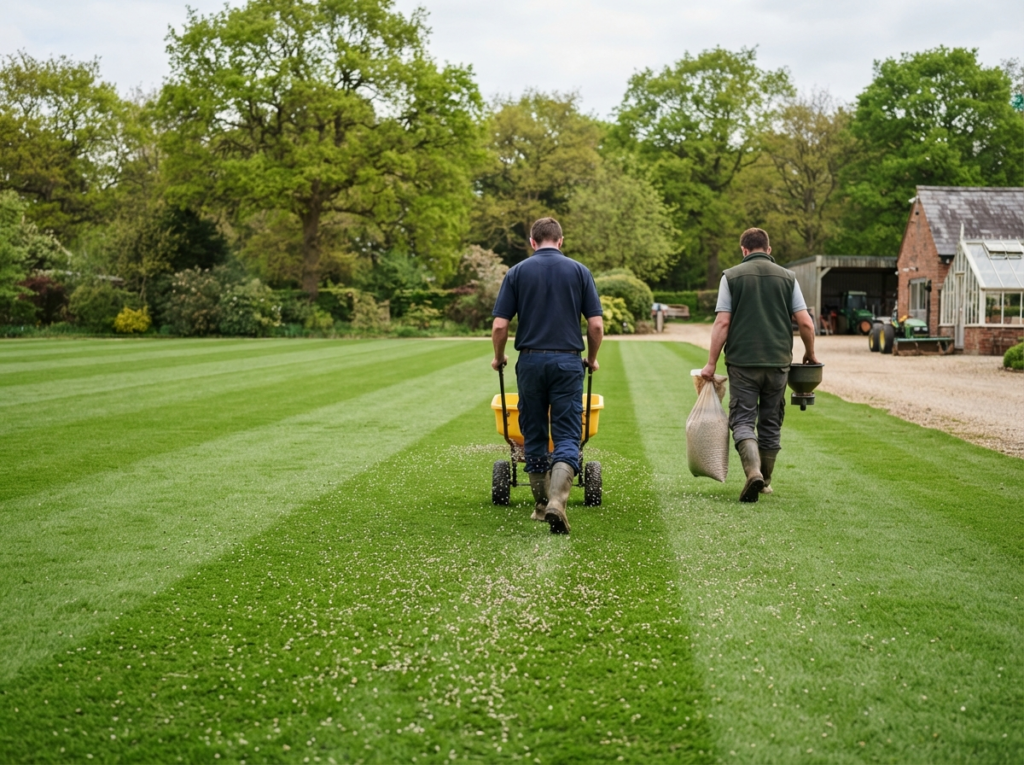
Spring and summer is when turf does most of its growing, so the feed matters more than at any other point in the year. The first real decision is quick or slow release nitrogen, since that determines how many times you need to visit the site across the season. The second is whether the product matches your cutting height, because a granule sized for a 3mm green will behave differently on a 10mm lawn.
Quick release or slow release
Standard-release products such as Command Complete NPK (12-10-20) and Command Spring & Summer Fine Turf (14-3-8) feed for 4 to 6 weeks: fast to respond, but you are back out spreading again within a month or two. Slow-release options stretch that out considerably. Command Slow Release All Season (13-0-26) and Command Balanced Spring & Summer (15-6-15) use methylene urea for around half their nitrogen, feeding over roughly 12 weeks. Nutrilong V90 Lite (17-3-8) carries 40% slow-release nitrogen over a similar 12-week window, and Nutrilong V180 (29-4-9) goes further still, at 76% slow release over roughly 5 to 6 months. The honest trade-off: V180 costs more per bag, but you are spreading twice a season instead of four or five times, which is where the saving in labour and site visits comes back.
Match the granule to the cutting height
Command’s 1-2mm granules are built for close-cut, high-value turf: 3mm and above for the standard-release grades, 6mm and above once you move to the slow-release ones. Velvit Essential (14-3-6) and the Velscape range use a larger 2-3mm granule intended for lawns, parks and general turf cut to 10mm or above, where spreading consistency matters more than fine-tuned release timing. Putting a fine-turf product on a park pitch, or a park-grade granule on a green, generally means paying for precision you don’t need, or not getting the coverage consistency you do.
Extra jobs: thatch and moss
If moss and thatch are part of the problem alongside feeding, two products handle that without the black staining a straight iron treatment leaves on paths and patios. MO Bacter (5-5-20 + 3% MgO) uses live Bacillus bacteria and a high potash content that overfeeds moss until it collapses, working over about 100 days. Phoenix Pro-Bacter goes further again, combining Bacillus with Trichoderma fungus to break down thatch as well as moss while feeding the sward, at a high 20% K2O for stronger cell walls through dry spells. Neither is suitable for turf cut below 10mm.
Which product for which job
- Command Complete / Fine Turf: fast response on high-value, close-cut turf, standard release.
- Command Slow Release / Balanced: same close-cut turf, fewer visits per season.
- Nutrilong V90 Lite: mid-range slow release for turf cut 6mm and above.
- Nutrilong V180: longest release window, fewest applications, for turf cut 10mm and above.
- Velvit Essential / Velscape: general lawns, parks and less technical turf cut 10mm and above.
- MO Bacter / Phoenix Pro-Bacter: feed plus moss and thatch control, no staining, not for turf under 10mm.
Next step
Check your cutting height and how often you can realistically get back to the site before choosing a release rate: that combination narrows the range down to two or three products fast. For anything more site-specific, see the individual product pages for exact application rates, or speak to the technical sales team.
Frequently asked questions
What's the difference between standard release and slow release fertiliser?
Standard-release granules feed for around 4 to 6 weeks, giving a fast response but needing more frequent applications. Slow-release products, such as the Command Slow Release range or Nutrilong V90 and V180, release nitrogen gradually over 12 weeks up to around 6 months, so fewer visits are needed across the season.
Can I use a fine turf fertiliser on a general lawn?
You can, but the smaller 1-2mm Command granules are built for close-cut turf down to 3mm, and the cost per bag is usually higher than a general lawn product. For lawns and parks cut to 10mm or above, Velvit Essential or the Velscape range are the better-matched, more cost-effective option.
Will MO Bacter or Phoenix Pro-Bacter stain my paths?
No. Both are organic-based and do not contain sulphate of iron, so neither leaves the black staining associated with conventional iron moss treatments. Phoenix Pro-Bacter also breaks down thatch as well as moss, using Bacillus and Trichoderma.