
How to choose a herbicide for amenity and grounds work
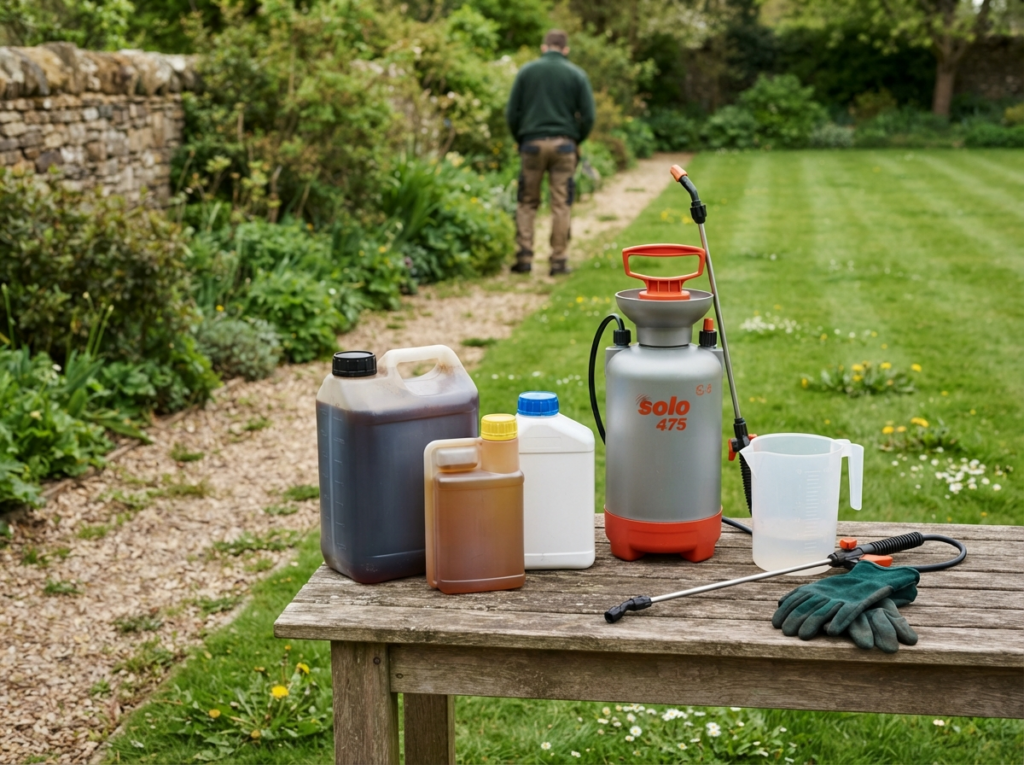
Two questions decide the choice here. First: do you need to kill everything green, or remove broadleaf weeds while keeping the grass? Second: are you after a one-off knockdown, or months of residual control that stops weeds coming back at all? All of the products below are professional-use plant protection products. Always read and follow the label and safety data sheet before use, and check that anyone applying them is trained and certificated, as UK approval conditions require.
Total weedkiller, or selective control that keeps the grass?
For hard surfaces, non-crop ground and grassland destruction before reseeding, a total glyphosate herbicide clears everything green: Gallup Biograde 360, Roundup ProVantage 480 and Roundup ProActive 360 all work this way, absorbed through the leaf and moved through the plant’s vascular system.
Where the grass itself needs to stay, Grazon Pro and Depitox Selective Herbicide control broadleaf weeds such as docks, thistles, nettles and ragwort in permanent pasture and amenity turf without taking the grass with them. Both will kill clover, so check whether clover is doing a job in the sward before you spray.
Which glyphosate, and where can it go?
Gallup Biograde 360 and Roundup ProActive 360 are both 360g/L glyphosate, the standard industry concentration, each covering up to 10,000m² per 5 litre pack. Roundup ProVantage 480 is a stronger 480g/L formulation covering up to 14,000m² per pack, rainfast within an hour on annual weeds and within 4 hours on perennials, and it is the one approved for aquatic areas and for Japanese Knotweed. That higher concentration and aquatic approval cost more per litre, and most ordinary non-aquatic sites are well served by a standard 360g/L product; keep the 480 for sites near water or where Japanese Knotweed is the target.
Broadleaf weeds in grassland: Grazon Pro or Depitox?
Grazon Pro acts fast once weeds are in active growth and reaches nettles, docks, thistles, brambles, broom and gorse, including some woody species Depitox’s label does not cover. It needs livestock off treated ground for at least 7 days, and the grass should not be cut for 28 days so the herbicide can translocate fully to the roots.
Depitox covers a similarly wide list, including ragwort while it is still in the rosette stage, and its 2,4-D active gives an alternative mode of action to ALS-based herbicides, useful where resistance management is part of the programme. A 5 litre pack also covers double the area of Grazon Pro, up to 20,000m² against 10,000m², which matters on larger sites. Livestock generally need to be off the field for 7 to 14 days before treatment and at least 14 days after.
Residual control for hard and permeable surfaces
Chikara works differently again: applied to gravel drives, paths, patios, kerb lines and fence lines, it forms a barrier in the soil that stops weeds germinating for up to 5 months from a single application. It is a professional-use product (MAPP 20185, LERAP B) for trained operators, and it is commonly tank-mixed with a glyphosate herbicide such as Roundup ProActive 360 where established weeds need clearing at the same time as the residual barrier goes down.
Which product for which job
Clearing a gravel drive or patio and keeping it clear for months: Chikara, alone or tank-mixed with glyphosate. Knocking back everything on a hard surface or before reseeding: Gallup Biograde 360 or Roundup ProActive 360. Working near water or on Japanese Knotweed: Roundup ProVantage 480. Docks, thistles and nettles in a paddock without losing the grass: Grazon Pro or Depitox, depending on area and whether resistance management matters on that site.
Site conditions, weed pressure and what is grazing the ground all change which product is right. Talk to the technical sales team about the site before you order, and always check the current label and safety data sheet, since application rates and approvals can change.
Frequently asked questions
Do I need training or certification to use these?
Yes. Every product in this guide is a professional-use plant protection product, and the purchaser and end user are responsible for using it in line with industry Approved Codes of Practice. Operators must be trained and certificated to use and apply any Ministry-approved professional product. Read the label and safety data sheet fully before use, regardless of experience.
How long do I need to keep livestock or the public off treated grassland?
This varies by product and is stated on the label, not from memory. Grazon Pro asks for a minimum 7 day withdrawal and no cutting for 28 days to let the herbicide translocate to the roots; Depitox asks for roughly 7 to 14 days before treatment, to encourage lush growth, and at least 14 days after. In both cases, keep livestock off until any poisonous weeds such as ragwort have died back and become unpalatable, not just until the withdrawal period has passed.
Can I tank-mix these products?
Some combinations are specifically supported: Chikara is often tank-mixed with a glyphosate herbicide to add pre-emergent residual control to a knockdown treatment, and Roundup ProActive 360 can be mixed with Chikara for the same reason. Do not mix products outside what the labels specifically permit; check both labels and, if in doubt, ask the technical sales team before spraying.