
How to choose grass and turf reinforcement mesh
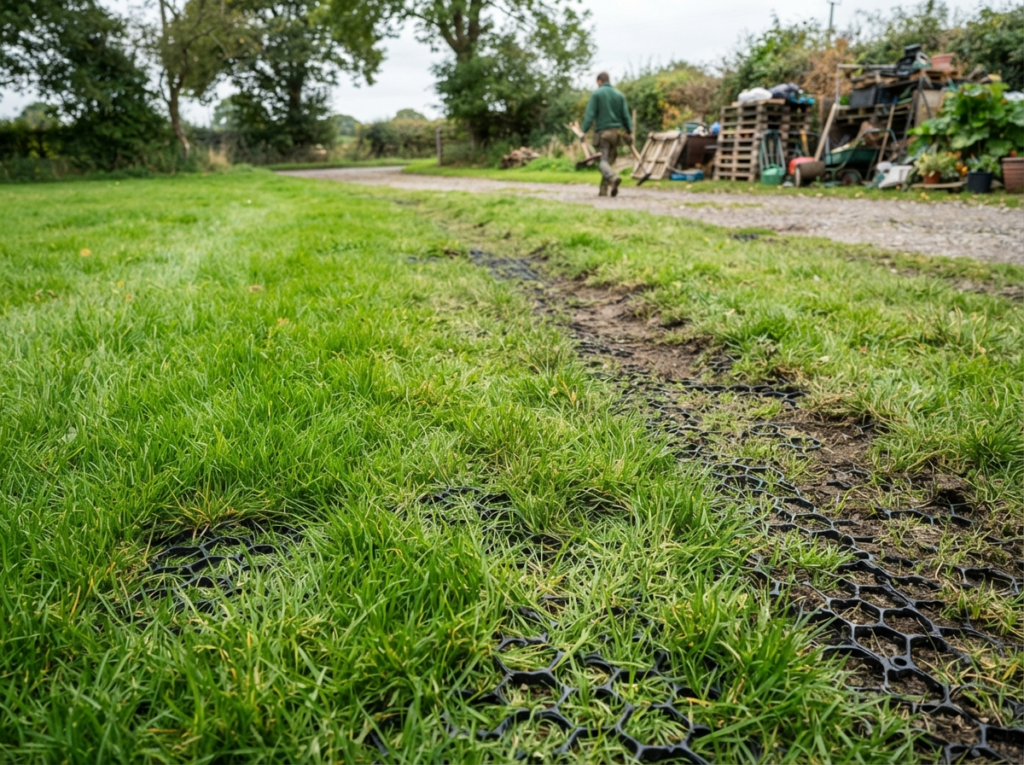
Two questions decide almost everything here: how much weight is going to cross the grass, and whether you want the reinforcement to vanish into the sward or sit as a visible, removable surface. Get those two answers first and the product list narrows itself fast.
What is actually going to cross the grass?
Pedestrians and wheelchairs need very little: a permeable mat that grips underfoot and lets water through, such as BodMat, or the lightest 1000g grade of GP-Flex.
Cars, light vans and caravans call for a step up. The 1400g grade of GP-Flex is built for this, and so is GridLok, an interlocking HDPE grid filled with gravel or grass that takes loads over 170 tonnes per square metre once it beds in.
Occasional HGVs, fire engines or refuse trucks need the heaviest options: GP-Flex at 1800g, Trackguard panels rated to 20 tonnes, or BodPave 85, a British-made recycled HDPE grid load-bearing to 400 tonnes per square metre.
Should the reinforcement disappear into the grass, or stay a visible surface?
Turf reinforcement mesh is meant to knit into the sward: grass grows up through the apertures until the mesh is reinforcing the root zone rather than sitting on top of it. Turfprotecta suits occasional light traffic, sown through or laid over existing turf. TR-Flex does the same job for lawn protection, embankment stabilisation and golf range anti-ball plugging, and can go down on new or established turf. GrassProtecta is the one to reach for when slip resistance matters most: it improves traction by up to 97% compared with standard mesh, which is why it turns up on disabled access routes and light aircraft taxiways as well as grass car parks.
If you need a surface you can lift again, Trackguard panels lay straight onto the ground and lift out afterwards, useful for a one-off event or a construction access route. GridLok and BodPave 85 sit at the other end: cellular grids meant to stay in place permanently, forming a permeable urban drainage system that generally does not need planning permission.
Fixing it down
Mesh and matting are only as good as the pins holding them flat. Steel U-pins and J-pins suit most sites; where you would rather not leave metal in the ground, GreenStake biodegradable stakes hold as well as a metal staple and break down completely within about 18 months.
Ground preparation matters more than the spec sheet
Every mesh and grid in this range performs best on ground that is firm and well drained before you start. A mesh laid over soft, waterlogged soil will still flex and rut under vehicle weight, whatever grade you choose, since the failure happens beneath the mesh rather than in it. Where drainage is genuinely poor, sort that out first, or expect to reinforce a smaller area than the budget suggests. Turf reinforcement mesh such as TR-Flex also works best installed when grass growth is quick, so the blades push through the filaments and root into the mesh before the area sees serious traffic.
Which product for which job
Overflow car park on decent ground: GP-Flex 1000g or 1400g, depending on the vehicles using it. Permanent grass car park or access route that needs to look like grass, not hardstanding: GrassProtecta or, for higher loads, BodPave 85 or GridLok. Wheelchair ramp, play area or slippery walkway: rubber matting. Site access for construction traffic that needs to come out again: Trackguard. Lawn or embankment protection under light foot traffic: Turfprotecta or TR-Flex.
Ground conditions vary enough between sites that the grade or product that worked on the last job is not always right for this one. Send the team a rough idea of traffic type, frequency and ground drainage and they will confirm the right grade before you order.
Frequently asked questions
Will grass really grow through turf reinforcement mesh, or does it just sit on top?
Products described as turf reinforcement mesh, such as TR-Flex, Turfprotecta and GrassProtecta, are designed for grass to grow up through the apertures until the mesh reinforces the root zone from within the sward. Ground grids such as GridLok and BodPave 85 work differently: they are cellular units filled with grass or gravel, so the grass grows in the cells rather than through a mesh layer.
How many pins does a roll of mesh need?
As a rough guide, allow 25 U-pins for a 1m x 10m roll and 100 for a 2m x 20m roll, though ground conditions change this. Trackguard panels take around 12 fixing pins each. Check the individual product page or ask the team before ordering pins separately.
Can any of these take HGV or fire engine weight?
Yes, with the right product. GP-Flex at 1800g is rated for occasional HGV and fire engine access, Trackguard panels are built for vehicles up to 20 tonnes, and BodPave 85 is load-bearing to 400 tonnes per square metre. Ground preparation and drainage still matter, so tell the sales team what is driving over the surface and how often, and they will confirm the right product.