
How to choose brushwood for bank stabilisation
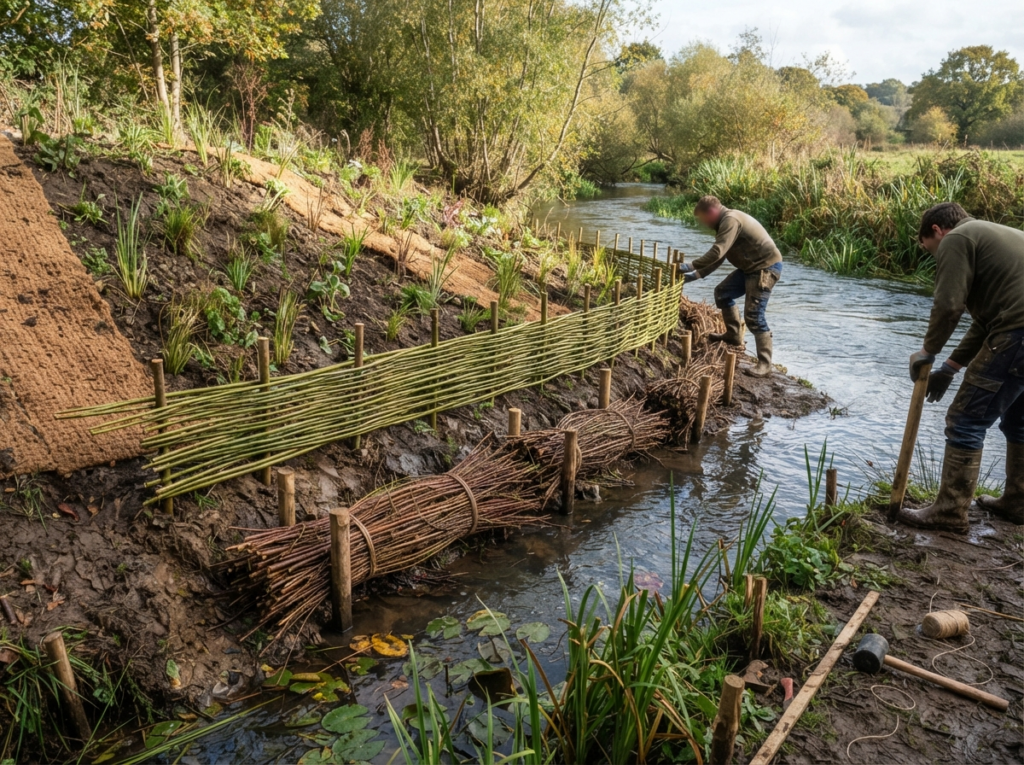
Brushwood erosion products come down to one real choice. Do you need a barrier that blunts moving water and fills a scour pocket, or do you want the bank itself to end up alive, holding its own soil with roots rather than dead wood? Flow energy and how much you want left to chance decide which one is right.
A barrier, or a living bank?
Brushwood Faggots are bundles of native UK brushwood in ash, hazel or willow, bound tight and staked or laid in as a revetment along the toe of a bank, a ditch or a pond edge. They do a physical job: blunt the force of moving water, let silt settle out, and give new bankside vegetation somewhere to root. Left in place, they do eventually become part of a naturalised bank too, as settled silt and whatever vegetation colonises binds in with the brushwood. What they do not do is plant that vegetation on purpose.
Willow Spiling & Brush Mattress takes that idea and builds the planting in from the start. Willow spiles are live willow stakes driven into the bank in a staggered pattern; chosen for fast rooting, they grow into a living root matrix instead of concrete or rock armour. The brush mattress goes over the bank surface, sometimes woven through the spiling, using bundles of dead or live willow branches or similar material, and gives immediate scour protection while the willow underneath establishes. The bank ends up held by roots someone actually put there.
What decides it on site
Flow energy is the first thing to check. Faggots dissipate hydraulic energy and reduce scour, which suits ditches, pond margins and lower-energy stretches, or toe support alongside other bank work. A stretch that takes a real battering after heavy rain, or a bank that has to look after itself for years without anyone going back to it, is where a deliberate living root structure earns its place.
Bank height and exposure are the second thing. Faggots work as a standalone revetment or as toe support under something else, so they suit a modest fix at the waterline. Spiling and mattress wants a full bank face, because the roots need room and time to establish before the next flood tests them.
Both fit a natural flood management scheme or a habitat restoration brief. Faggots trap silt and give cover for fish, amphibians, invertebrates and small mammals. Spiling and mattress does the same, plus a root system that keeps working long after the brushwood itself has rotted away.
Neither product has a fixed online price, since species, sizes and delivery all depend on the site. Get in touch through the product page for Willow Spiling & Brush Mattress or Brushwood Faggots with your bank length, flow conditions and whether you want a straightforward fix or a bank that plants itself, and Phoenix will quote from there.
Frequently asked questions
What is the actual difference between brushwood faggots and willow spiling?
Faggots are a physical barrier: bundled brushwood that blunts water flow, traps silt and gives vegetation somewhere to root, whatever happens to colonise it. Willow spiling puts live willow stakes into the bank on purpose, so the root system holding the bank together is deliberate rather than left to chance.
Can faggots and willow spiling be used on the same bank?
Yes. A brush mattress is often built from bundles of willow branches laid or woven over the bank, so the two are frequently specified together on one stretch, faggots at the toe, spiling and matting up the bank face.
There is no price shown on the product page, how do I find out the cost?
Both products are supplied to a specification rather than off a shelf, so price depends on species, quantity and delivery. Use the enquiry form on either product page with your site details and Phoenix will come back with a quote.