
How to choose a sprayer or spreader
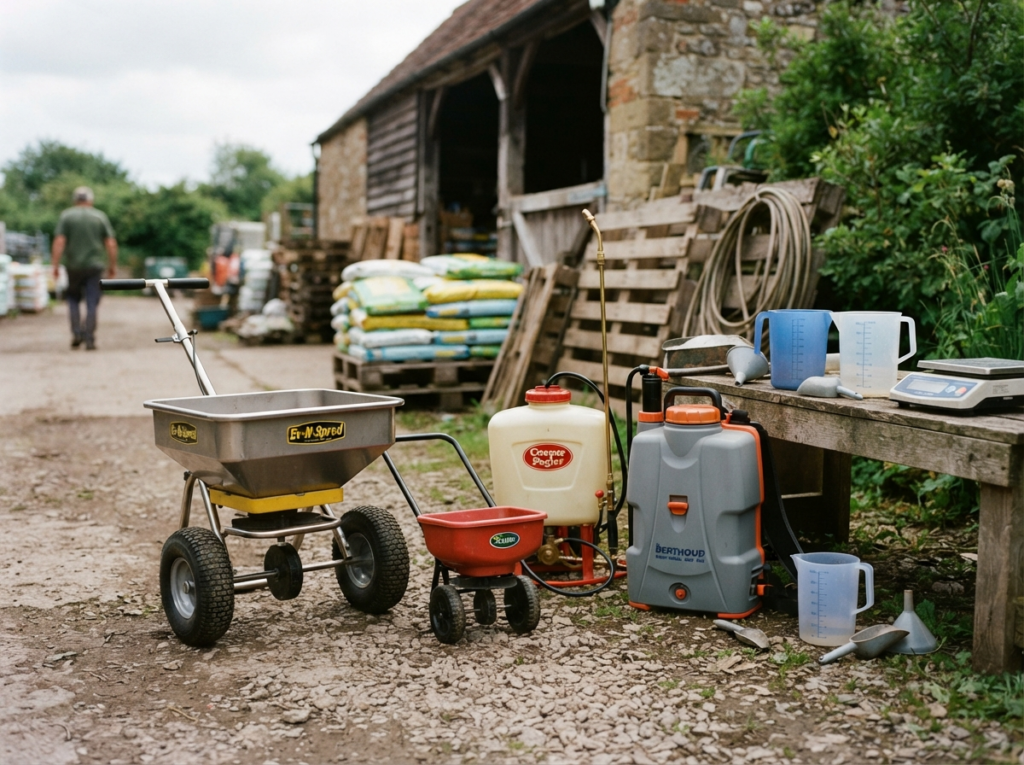
Application equipment splits into two decisions before it splits into brands: are you putting down a liquid or a granular product, and how much ground do you need to cover between refills. Answer those two and the rest of the choice is mostly about comfort and build quality.
Liquid or granular: sprayer or spreader?
If the product being applied is a liquid, a diluted concentrate, a wettable powder or a liquid feed, it needs a knapsack sprayer. If it is a granular fertiliser, grass seed or de-icing salt, it needs a spreader. The two are not interchangeable, and running granules through a sprayer, or a liquid through a spreader hopper, will damage the equipment rather than save you buying a second machine.
Chemical products carry their own rule regardless of which sprayer you buy: always read and follow the product label, and where a product is restricted to qualified users, only a qualified user should apply it.
Choosing a knapsack sprayer: pressure, pump type and capacity
Pump type affects how much work a spray run takes. The Cooper Pegler CP15 Classic uses a diaphragm pump with no moving parts exposed to friction, so it keeps working after piston sprayers wear out, and gives dual 1 bar and 3 bar settings to suit fungicides, insecticides and herbicides. For more tank between refills, the Cooper Pegler CP3 Classic shares the same pump and dual pressure settings in a 20 litre tank rather than 15.
Where the priority is working pressure rather than tank size, the Berthoud Vermorel 1800 holds pressure at just 8 to 10 strokes per minute against 30 to 40 on a conventional pump, which matters over a long spray run. The Berthoud Cosmos 18 Pro goes further still, reaching 6 bar from a piston pump with a built-in agitator that keeps wettable powders and suspension concentrates properly mixed throughout treatment rather than settling in the tank. Both Berthoud models use Viton seals, which resist chemical wear far longer than standard rubber, and come with a five-year guarantee.
Choosing a spreader: capacity, spread width and control
For small lawns and patching work rather than whole sites, the Hand Held Fertiliser and Seed Spreader has five settings that adjust the rate for fertiliser, grass seed or wildflower seed from the same machine, though it is not built for large areas.
Once the job is bigger than a hand spreader can cover, the choice is between a drop spreader and a broadcast spreader. The Fertiliser and Seed Drop Spreader places material in a precise 22 inch band directly beneath the hopper, which gives more even coverage than broadcasting, at the cost of more passes to cover the same ground. The Professional Fertiliser and Seed Spreader throws material up to 3 metres wide instead, covering ground faster in exchange for a less exact edge. For the largest amenity areas, the Extra Large Professional Spreader takes two 25kg bags at once and spreads 3 to 3.5 metres wide, with a rain cover included so a shower does not end the job early.
Which product for which job
Chemical spraying, daily contractor use: Cooper Pegler CP15 Classic.
Chemical spraying, more tank between refills: Cooper Pegler CP3 Classic.
Wettable powders that need to stay mixed: Berthoud Cosmos 18 Pro.
Long spray runs, less pumping effort: Berthoud Vermorel 1800.
Small lawns and patch repairs: Hand Held Fertiliser and Seed Spreader.
An accurate edge on a domestic or contract lawn: Fertiliser and Seed Drop Spreader.
Large amenity areas, speed over precision: Extra Large Professional Spreader.
If in doubt between two sizes, buy for the biggest job the machine will regularly do, not the smallest; a sprayer or spreader that is slightly too big for an occasional small job costs less in wasted capacity than one that is too small for the regular one. For spreader-specific detail, including hopper capacity and spread width side by side, see the fertiliser spreaders buying guide.
Frequently asked questions
Can the same knapsack sprayer be used for herbicides, fungicides and insecticides?
Yes, provided the product label allows it and the sprayer is cleaned thoroughly between different chemical types. The Cooper Pegler and Berthoud ranges are built to handle professional herbicides, fungicides and insecticides, but always read and follow the label of whatever product is going into the tank.
How much ground does a broadcast spreader cover compared with a drop spreader?
A broadcast spreader such as the Professional Fertiliser and Seed Spreader throws material up to 3 metres wide, so it covers ground in fewer passes than a drop spreader, which places material only as wide as its wheelbase, 22 inches on the Fertiliser and Seed Drop Spreader. The trade-off is that broadcasting is less precise at the edges of a bed or path.
Do spreaders need cleaning between fertiliser and grass seed?
It is worth rinsing and drying the hopper between products, particularly after fertiliser, since residue left in a damp hopper can corrode metal parts and clump before the next use. It also stops seed and fertiliser cross-contaminating a mixed load.