
How to choose tree root protection
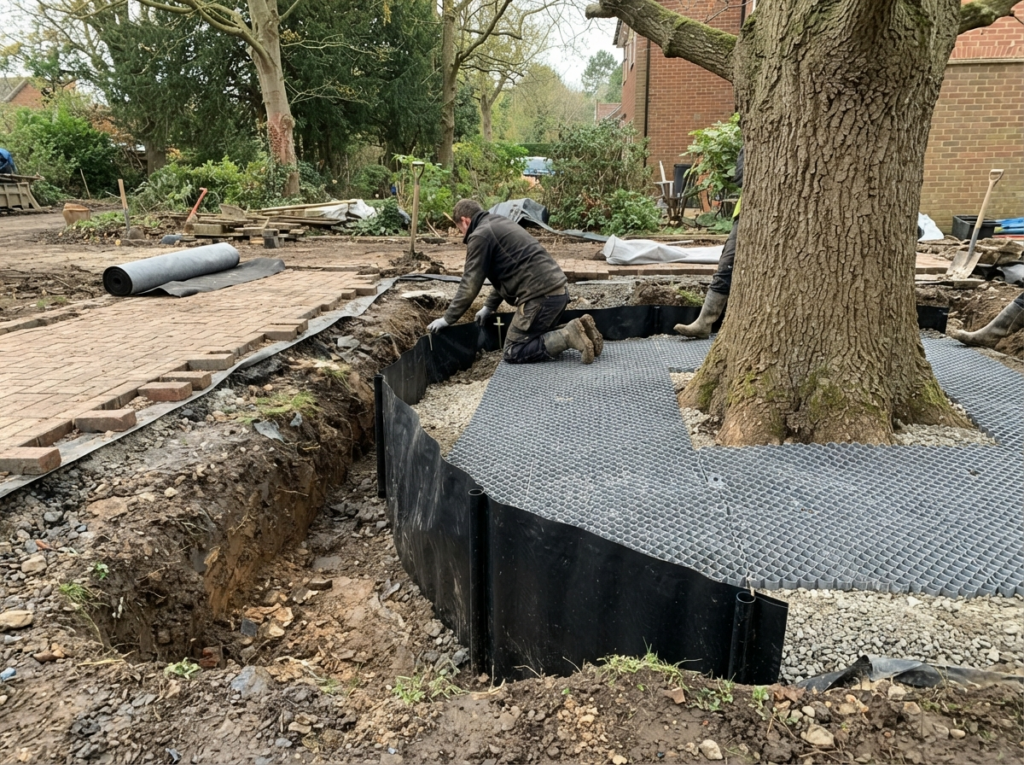
These two products solve opposite ends of the same problem. One redirects a young tree’s roots before they become an issue. The other protects an established tree’s roots from damage that’s about to happen nearby. Working out which situation you’re in decides which product you need.
Planting a new tree near hardstanding, or building hardstanding near an existing one
If you’re planting a tree that will sit near paving, a driveway, drains or foundations, the risk is roots spreading outwards along the surface and disrupting whatever’s nearby as they grow. ReRoot Root Barriers deflect the roots downwards instead, so the tree establishes deep rather than along the surface. That prevents the disruption later on, and deeper rooting also anchors the tree more securely and helps it cope with drought, so it’s worth fitting at planting time even where hardstanding is only planned for the future.
If the tree is already established and the new work is happening around it, the risk runs the other way: vehicles or plant compacting the soil over the root zone, or crushing roots outright, while building a road, access route or driveway nearby. Bodcell Tree Root Protection is a cellular ground stabilisation system that spreads heavy vehicle loading across the surface, so the ground stays firm enough to drive on without compressing the soil or damaging the roots beneath. The panels are supplied flat-packed, unfold into the cell structure on site, and fix down with metal pins, which makes it practical to install around an existing tree without disturbing the root zone to do it.
Which product for which job
New planting near future hardstanding, drains or foundations: fit a ReRoot Root Barrier at planting time, sized to the depth your site needs. A road, access route or driveway going in close to a tree that’s already there: use Bodcell Tree Root Protection to carry the vehicle loading without compacting the roots.
Root Barrier is available in four sizes, so it’s worth telling the team the tree species, soil type and how close the hardstanding will run before ordering, so they can confirm the depth that actually suits the site. If neither job applies, for instance a mature tree well clear of any hardstanding, there’s usually no need to buy root protection at all; it earns its cost on sites where roots and hard surfaces genuinely compete for the same ground. Get in touch for advice on sizing, or to check current pricing on either product.
Frequently asked questions
Do I need root protection if hardstanding won't be built for years?
Yes, it's worth fitting a root barrier at planting time even if paving or a driveway is only planned for later. Roots that have already spread outwards along the surface are far harder to redirect than roots that were deflected downwards from the start.
Can Bodcell be installed around a tree that's already established without harming the roots?
The panels are designed to be laid over the ground and pinned down rather than dug in, which is why it suits protecting an established tree's root zone during nearby construction. Site conditions vary, so check the installation method against your specific tree and ground before starting work.
Which Root Barrier size do I need?
It's supplied in four sizes, and the right one depends on tree species, soil type and how close the hardstanding will be. Rather than guess, tell the team your site details and they'll confirm the depth that suits the job.