
How to choose a tree anchoring system
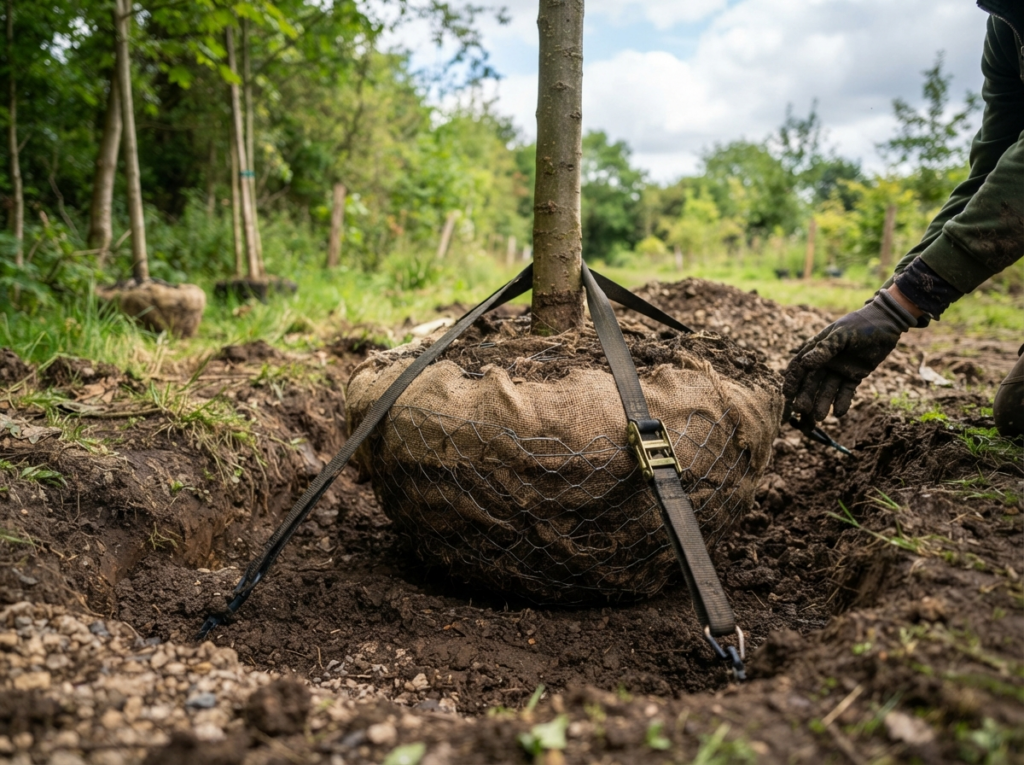
For a rootballed or containerised semi-mature tree, the real decision usually isn’t which stake to buy. It’s whether to stake above ground at all, or anchor the rootball below it instead. Below-ground anchoring lets the stem move and flex in the wind while the roots knit into the surrounding soil, and on anything past whip size that’s normally the better outcome.
When above-ground staking stops making sense
A cane and a tie work fine for a young whip. Once you’re planting a semi-mature standard with a heavy rootball, the equation changes. Traditional staking on a tree that size usually means guy wires run out to ground anchors around the base, which is a tripping hazard on a public site, awkward around mowing and pedestrian routes, and it restricts the exact trunk movement that helps a tree develop taper and strength as it establishes.
The Platipus Tree Anchoring System is the alternative: an anchor and cable set below ground that secures the rootball instead of the trunk. There’s nothing visible above the surface, so there are no guy wires to strim around, trip over or vandalise, and the stem is free to move naturally.
Getting the anchor size right
Platipus is supplied in four standard sizes, matched to rootball weight and tree size rather than a one-size-fits-all fitting. Because it’s a specified product rather than an off-the-shelf pack, the sensible route is to give the team your rootball diameter, tree size and planting method and let them confirm which size and quantity the job needs, rather than guessing from a size chart.
The same range includes the Plati-Mat, which holds a newly transplanted rootball in position while it establishes. It comes in four sizes to match most rootball dimensions and is worth asking about alongside the anchor itself, particularly on exposed sites or heavier soils where the rootball is more likely to shift before the roots take hold.
Which product for which job
For securing a rootballed or containerised semi-mature tree with no above-ground hardware, the Platipus Tree Anchoring System is the one product in this category, and it covers that job well. If the rootball itself needs holding steady in the planting pit while the anchor does its work, ask about the Plati-Mat option on the same product line.
If you’re planting whips or smaller standards where a stake and tie will do the job perfectly well, there’s no need to reach for below-ground anchoring. It earns its keep on the trees where guy wires would otherwise be the only option.
This is a quote-based product, so the next step is to get in touch with the team with your tree sizes and site conditions. They’ll confirm the right anchor size, whether a Plati-Mat is worth adding, and current pricing.
Frequently asked questions
Do I still need a stake above ground if I use the Platipus system?
No. Platipus secures the rootball below ground with anchors and cable, so there's no above-ground stake or guy wire needed. That's the main reason landscapers choose it over traditional staking for semi-mature trees on public or high-footfall sites.
What size of tree can be anchored with the Platipus system?
It's supplied in four standard sizes covering rootballed and containerised semi-mature trees. Sizing depends on rootball weight and tree size rather than trunk diameter alone, so it's best to contact the team with your tree details and let them confirm the right size and quantity.
What does the Plati-Mat do that the anchor doesn't?
The anchor and cable stop the rootball moving in the wind once it's in the ground. The Plati-Mat sits under the rootball itself and holds it in position while the tree establishes, which is worth asking about on exposed sites or where the ground is soft.