
How to choose a fertiliser and seed spreader
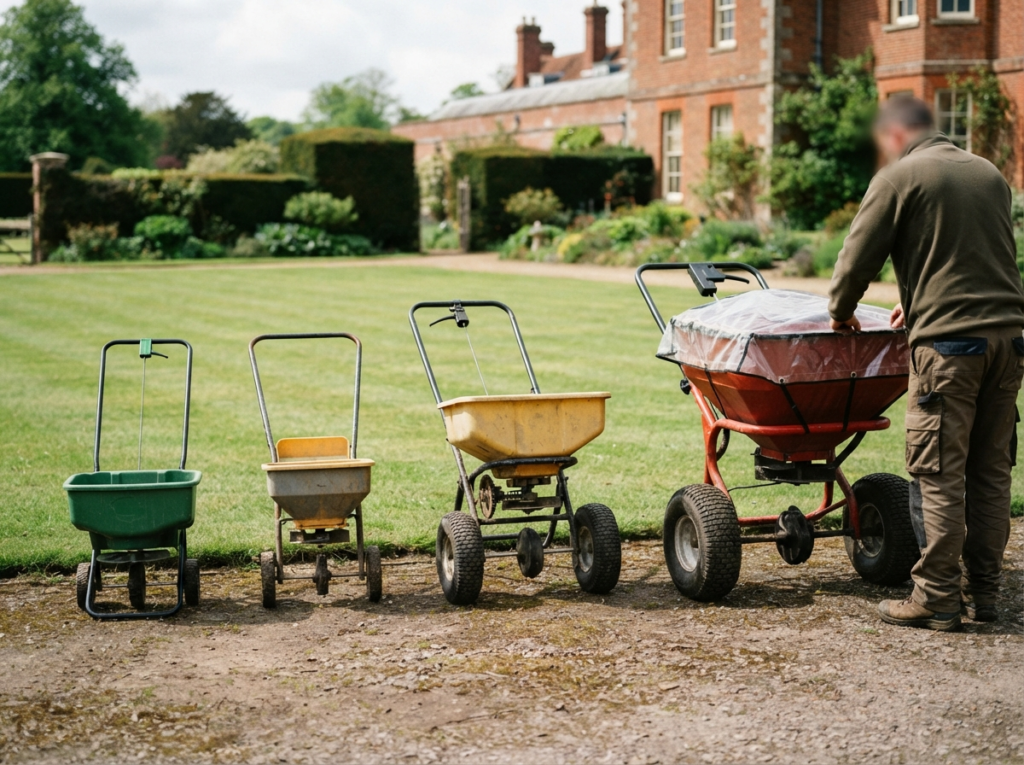
Four spreaders cover almost every job a grounds team or gardener needs: filling gaps by hand, laying an accurate band, broadcasting quickly over a lawn, or clearing a large amenity area in a morning. Match the machine to the size of the job, not the size of the budget.
How big is the area, really?
The Hand Held Fertiliser and Seed Spreader is built for small lawns and patching work, not large areas, and its five settings cover fertiliser, grass seed and wildflower seed from a single machine. It is the right size for topping up bare patches or feeding a modest domestic lawn, and the wrong size for anything measured in hundreds of square metres, where the walking time between refills starts to outweigh the saving on the machine.
Past that point, the two walk-behind spreaders differ mainly in hopper size. The Professional Fertiliser and Seed Spreader takes a 20kg bag in its 23kg hopper, while the Extra Large Professional Spreader takes two 25kg bags at once. For a single domestic lawn, the extra capacity of the large spreader is rarely worth the price; for a grounds contract covering several sites in a day, fewer refills means fewer stops. Storage is worth a thought too: the Professional Fertiliser and Seed Spreader has a foldable handle, so it does not take up a full shed bay, while the 57kg spreader is a bigger machine to manoeuvre and store, better suited to a van or trailer than a domestic shed.
Timing affects the result as much as the machine. Most lawn fertilisers go down between March and September, with overseeding usually following in early autumn once the ground has cooled and rainfall has picked back up. Whatever the season, avoid spreading right before heavy rain, since a downpour can wash granular fertiliser into drains and paths rather than into the soil where it is needed.
Accuracy or speed: drop or broadcast?
The Fertiliser and Seed Drop Spreader places material in a 22 inch band directly under the hopper. Because nothing is thrown sideways, there is no risk of fertiliser or seed landing on a path, border or neighbour’s lawn, which matters on tight domestic plots or anywhere with a hard edge nearby. The trade-off is coverage speed: a drop spreader needs more passes to cover the same ground as a broadcast machine.
Both the Professional Fertiliser and Seed Spreader and the Extra Large Professional Spreader broadcast instead, throwing material 3 to 3.5 metres wide depending on the model. That covers open ground faster, but broadcasting is the wrong choice next to water, paving that stains, or beds where scattered fertiliser is unwanted. On an open sports pitch or amenity field with no sensitive edges, broadcasting is almost always the faster, cheaper option per hectare.
What are you spreading, and does it matter?
All four spreaders in the range handle both fertiliser and grass seed, and the hand held model also copes with wildflower seed, since its adjustable settings can be brought right down for small, light seed as well as up for denser granular fertiliser. Getting the rate wrong matters more with fertiliser than with seed: over-applying a high nitrogen feed can scorch turf, while a light seed sown too thickly mostly just wastes product. Check the bag rate for the specific fertiliser or seed being used and set the spreader to that rate rather than a default guess, since NPK ratios and seed sizes vary between products.
Which product for which job
Patching and small domestic lawns: Hand Held Fertiliser and Seed Spreader.
Precision next to paths, beds or borders: Fertiliser and Seed Drop Spreader.
Faster coverage on an open domestic or light professional lawn: Professional Fertiliser and Seed Spreader.
Large amenity areas and multi-site contract work: Extra Large Professional Spreader.
Whichever spreader you land on, calibrate it against the product bag rate before the first full run rather than trusting the dial setting alone, since spread rate depends on walking speed as well as the machine. If a project also needs a knapsack sprayer for liquid products, the equipment buying guide covers that decision alongside this one.
Frequently asked questions
What area will a 23kg or 57kg spreader cover before refilling?
It depends on the application rate of the product being spread rather than a fixed figure, since a light grass seed goes further per hopper than a dense granular fertiliser. Check the coverage rate stated on the fertiliser or seed bag and use the spreader's hopper capacity to work out roughly how many refills a given area will need.
Can one spreader do both fertiliser and grass seed without cleaning in between?
All four spreaders in the range are built to handle both, and a quick tip-out and brush of the hopper between products is normally enough. It is still worth rinsing and drying the hopper occasionally, particularly after fertiliser, since residue left in a damp hopper can corrode metal parts over time.
Is a broadcast spreader safe to use next to a path or flower bed?
Broadcast spreaders such as the Professional Fertiliser and Seed Spreader throw material 3 metres or more wide, so granules will land past the edge of the lawn if you spread right up to a path or bed. For anywhere with a hard edge nearby, the Fertiliser and Seed Drop Spreader keeps everything within its 22 inch band instead.