
Silene dioica (L.) Clairv.
Red Campion
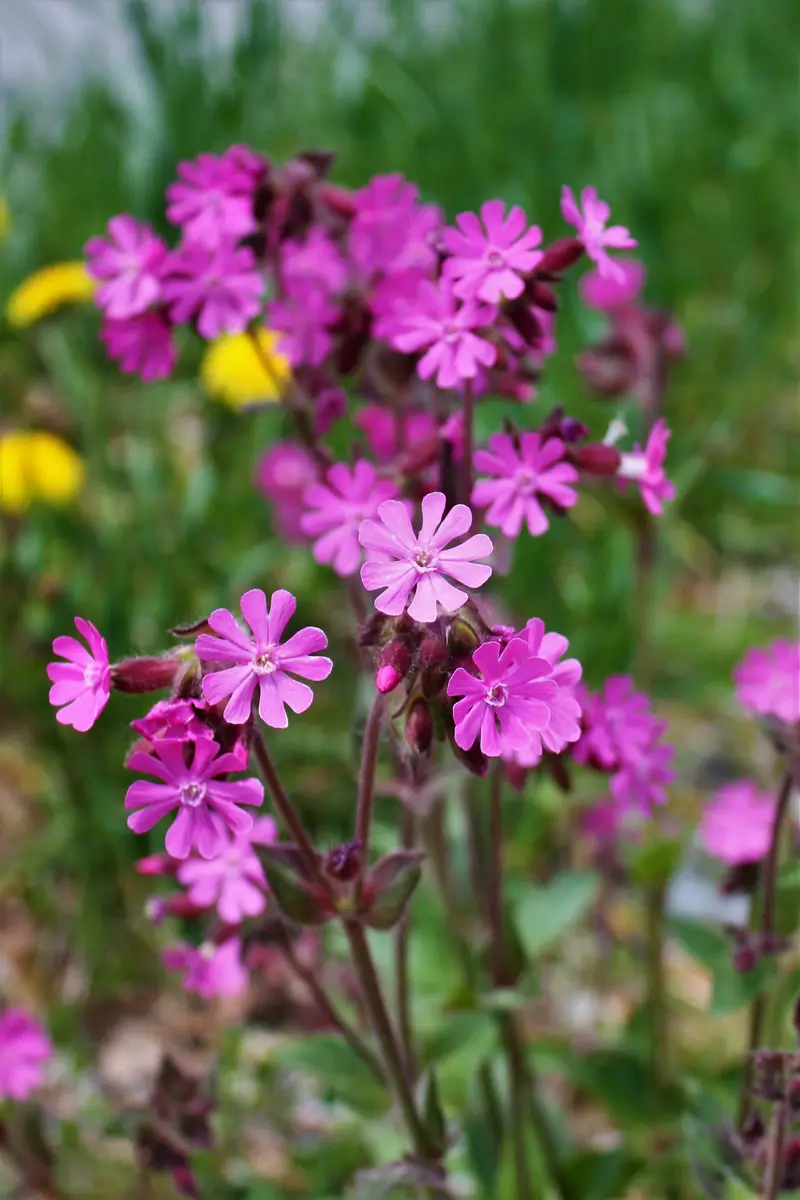
Red campion is a familiar native wildflower of woodland edges, shady hedge banks and damp roadside verges across Britain. It forms clumps of soft, hairy oval leaves and sends up branching stems carrying rose-pink to deep magenta flowers, each with five notched petals.
About
Red campion is a familiar native wildflower of woodland edges, shady hedge banks and damp roadside verges across Britain. It forms clumps of soft, hairy oval leaves and sends up branching stems carrying rose-pink to deep magenta flowers, each with five notched petals. As the species name suggests, it is dioecious, so male and female blooms appear on separate plants. It favours moist, fertile soils and copes happily with dappled or partial shade, which makes it a useful choice for the cooler, greener corners of a garden.
Flowering generously from late spring through summer, it provides nectar and pollen for bumblebees, long-tongued hoverflies and butterflies, while several moths use it as a larval food plant. Where it grows alongside white campion the two readily cross to produce intermediate pale pink forms. A reliable performer in woodland-edge seed mixes and naturalistic borders, red campion is short-lived but self-seeds freely, knitting in among bluebells, cow parsley and other spring flora.
Also known as
Red Catchfly · red cockle
Synonyms
Agrostemma dioica · Agrostemma sylvestris · Lychnis sylvestris · Lychnis sylvestris pygmaea · Melandrium dioicum · Melandrium pratense crassifolium · Melandrium sylvestre glabrescens · Melandrium sylvestre lactea · Melandrium sylvestre stenophyllum · Silene dioica crassifolia · Silene dioica foetida · Silene hornemannii
In our seed mixes
- BFS 120 – Wildlife Wildflower Seed Mix for Bees, Birds and Butterflies- 100% Flora
- BFS 13 – Tussocky Grassland Wildflower Meadow Mix
- BFS 140 – Bat Friendly Wildflower Seed Mix – 100% Flora
- BFS 6 – Hedgerow & Shade Wildflower Seed Mix
- BFS 8 – High Nutrient Initial Establishment Wildflower Grassland Mix – 50% Flora
- BFS6(F)- Hedgerow & Shade 100% Wildflower Seed Mix
- BFS8(F) – High Nutrient Initial Establishment 100% Wildflower Mix
- UM11 – Patchwork Wildflower Mix
- UM6 – Golden Summer Perennial Wildflower Mix
Beta — under active development. This catalogue is still being built and accuracy-checked. The information here (including plant identifications, British native status, soil and sun/shade preferences) is provided in good faith for general guidance only and may contain errors or omissions. It must not be relied upon on its own — please confirm details with us before making planting, specification, foraging or purchasing decisions, and never eat or medicinally use any plant based on this catalogue alone, as some species are toxic. To the extent permitted by law, Phoenix Amenity Supplies accepts no liability for any loss arising from use of this information.