
Pulicaria dysenterica (L.) Bernh.
Common Fleabane
Common fleabane is a native perennial of the daisy family that spreads by creeping underground roots to form dense, weed-suppressing patches. Its woolly, grey-green stems carry soft, wavy-edged leaves that clasp the stem, and reach roughly 60 cm in height.
About
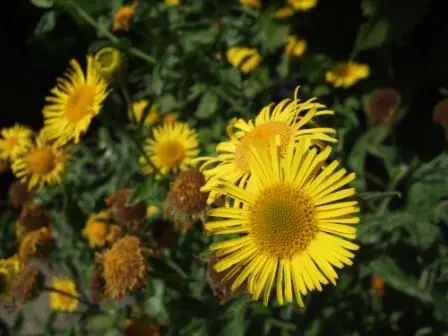
Common fleabane is a native perennial of the daisy family that spreads by creeping underground roots to form dense, weed-suppressing patches. Its woolly, grey-green stems carry soft, wavy-edged leaves that clasp the stem, and reach roughly 60 cm in height. The flat-topped golden-yellow flowerheads have a broad central disc ringed by many narrow ray florets, and the heads curve back as the seed ripens.
It is a plant of damp ground, thriving in wet meadows, marshes, fens, ditches and the margins of ponds and streams on heavier, moisture-retentive soils in full sun. Flowering from midsummer into early autumn, it provides an abundant late source of nectar that is especially valued by bees, butterflies and hoverflies. Its spreading habit and tolerance of wet conditions make it a useful choice for damp meadow mixes, pond edges and rain gardens where a long-lasting splash of yellow is wanted.
Also known as
Fleabane · Meadow false fleabane
Synonyms
Inula conyzae · Inula conyzoea · Pulicaria dysenterica dysenterica · Pulicaria repens
In our seed mixes
Beta — under active development. This catalogue is still being built and accuracy-checked. The information here (including plant identifications, British native status, soil and sun/shade preferences) is provided in good faith for general guidance only and may contain errors or omissions. It must not be relied upon on its own — please confirm details with us before making planting, specification, foraging or purchasing decisions, and never eat or medicinally use any plant based on this catalogue alone, as some species are toxic. To the extent permitted by law, Phoenix Amenity Supplies accepts no liability for any loss arising from use of this information.