
Centaurium erythraea Rafn
Centaury
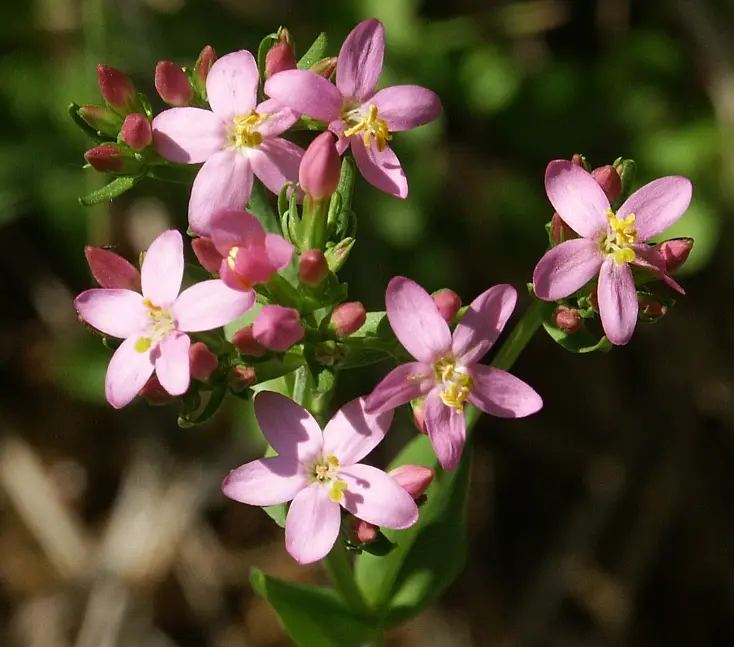
Common centaury is a small, hairless native of the gentian family, usually behaving as a biennial and occasionally as an annual. It forms a neat basal rosette of oval, veined leaves in its first year and then sends up slender, upright stems that branch towards the top into flat-topped clusters of flowers.
About
Common centaury is a small, hairless native of the gentian family, usually behaving as a biennial and occasionally as an annual. It forms a neat basal rosette of oval, veined leaves in its first year and then sends up slender, upright stems that branch towards the top into flat-topped clusters of flowers. The blooms are bright pink with five spreading petals and, like other gentians, they tend to close up in dull weather and during the afternoon.
Flowering through the summer months, it grows on dry, open, often disturbed ground: short calcareous and sandy grassland, heathland, woodland rides, quarries, dune slacks and road verges. It is found across much of Britain and Ireland but becomes scarcer in Scotland. The flowers draw in butterflies and other insects for nectar. Being low and undemanding, it works well in short-turf wildflower areas and free-draining grassland mixes, though it dislikes lush, competitive swards.
Also known as
Common Centaury · Common centaury · Dumpy Centaury · European Centaury · forking centaury
Synonyms
Centaurium capitum · Centaurium erythraea austriacum
In our seed mixes
Beta — under active development. This catalogue is still being built and accuracy-checked. The information here (including plant identifications, British native status, soil and sun/shade preferences) is provided in good faith for general guidance only and may contain errors or omissions. It must not be relied upon on its own — please confirm details with us before making planting, specification, foraging or purchasing decisions, and never eat or medicinally use any plant based on this catalogue alone, as some species are toxic. To the extent permitted by law, Phoenix Amenity Supplies accepts no liability for any loss arising from use of this information.