
Bellis perennis L.
Common Daisy
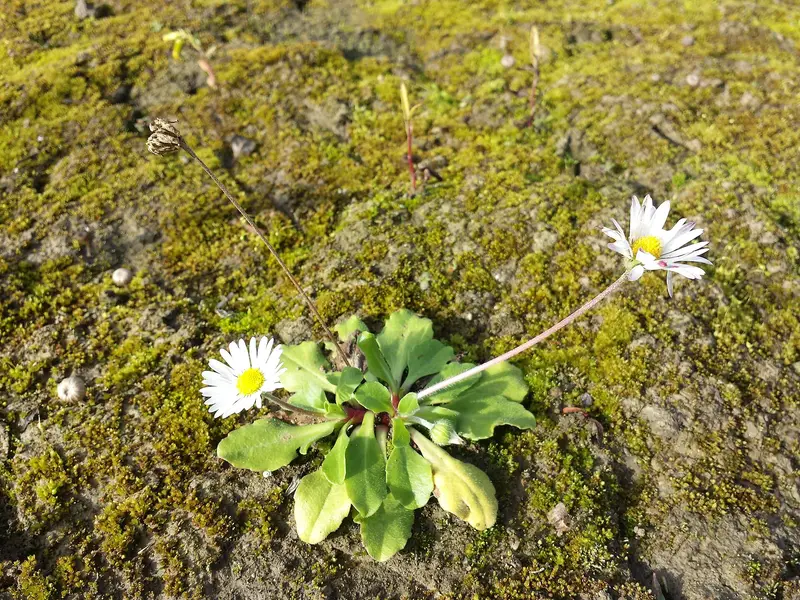
The common daisy is one of the most familiar native wildflowers, a low-growing perennial that forms a flat rosette of small, spoon-shaped leaves pressed against the ground. From this rise single flower heads on short, leafless stalks, each a composite of many white ray florets, often tipped or backed with pink, surrounding a bright yellow central disc.
About
The common daisy is one of the most familiar native wildflowers, a low-growing perennial that forms a flat rosette of small, spoon-shaped leaves pressed against the ground. From this rise single flower heads on short, leafless stalks, each a composite of many white ray florets, often tipped or backed with pink, surrounding a bright yellow central disc. The heads close at night and in dull weather and reopen with the light.
It is a plant of short, regularly cut or grazed turf, thriving in lawns, meadows, pastures and verges on most reasonably moist soils in sun. Remarkably, it can be found in flower almost throughout the year, with a strong flush from spring into summer, providing accessible early and late nectar and pollen for bees, flies and beetles. Tolerant of mowing and trampling, it is a natural choice for flowering lawns and short-grass wildflower areas.
Also known as
Daisy · English Daisy · Lawndaisy · Perennial Daisy · lawn daisy
Synonyms
Aster bellis · Bellis alpina · Bellis armena · Bellis croatica · Bellis hortensis · Bellis hybrida · Bellis integrifolia · Bellis minor · Bellis perennis disciformis · Bellis perennis discoidea
In our seed mixes
Beta — under active development. This catalogue is still being built and accuracy-checked. The information here (including plant identifications, British native status, soil and sun/shade preferences) is provided in good faith for general guidance only and may contain errors or omissions. It must not be relied upon on its own — please confirm details with us before making planting, specification, foraging or purchasing decisions, and never eat or medicinally use any plant based on this catalogue alone, as some species are toxic. To the extent permitted by law, Phoenix Amenity Supplies accepts no liability for any loss arising from use of this information.