
Veronica persica Poir.
Bird's Eye Speedwell
Common Field-speedwell is a low, sprawling annual that has become one of the most familiar weeds of cultivated and disturbed ground across lowland Britain. Originally from western Asia, it was introduced in the early nineteenth century and is now thoroughly naturalised rather than a true native.
About
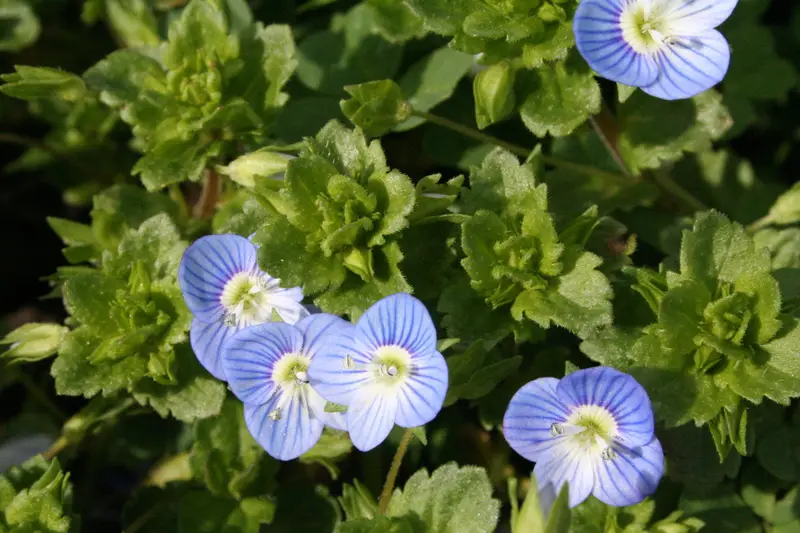
Common Field-speedwell is a low, sprawling annual that has become one of the most familiar weeds of cultivated and disturbed ground across lowland Britain. Originally from western Asia, it was introduced in the early nineteenth century and is now thoroughly naturalised rather than a true native. Its trailing, slightly hairy stems carry pairs of small, bluntly toothed leaves, and from the leaf axils rise long-stalked flowers, each a clear sky-blue with a notably paler, often whitish, lower petal that gives it the country name bird's-eye. The flat seed pods are broad and two-lobed.
Thanks to its long flowering season, which can run almost year-round but peaks from spring into autumn, it is a useful early nectar source for hoverflies and small bees. You will find it self-seeding freely in gardens, allotments, field margins and rough ground on most fertile soils in sun or light shade. It is a colonist of bare earth rather than a meadow or border plant, and is not usually sown deliberately.
Also known as
Bird's-eye · Bird-eye Speedwell · Birdeye Speedwell · Birds-eye Speedwell · Common Field-speedwell
Synonyms
Cardia filiformis · Pocilla persica · Veronica agrestis byzantina · Veronica alpiphila · Veronica areolata · Veronica buxbaumii · Veronica buxbaumii kochiana · Veronica byzantina · Veronica cymbalariaefolia · Veronica cymbalariifolia
Beta — under active development. This catalogue is still being built and accuracy-checked. The information here (including plant identifications, British native status, soil and sun/shade preferences) is provided in good faith for general guidance only and may contain errors or omissions. It must not be relied upon on its own — please confirm details with us before making planting, specification, foraging or purchasing decisions, and never eat or medicinally use any plant based on this catalogue alone, as some species are toxic. To the extent permitted by law, Phoenix Amenity Supplies accepts no liability for any loss arising from use of this information.