
Sisymbrium officinale (L.) Scop.
Crambling Mustard
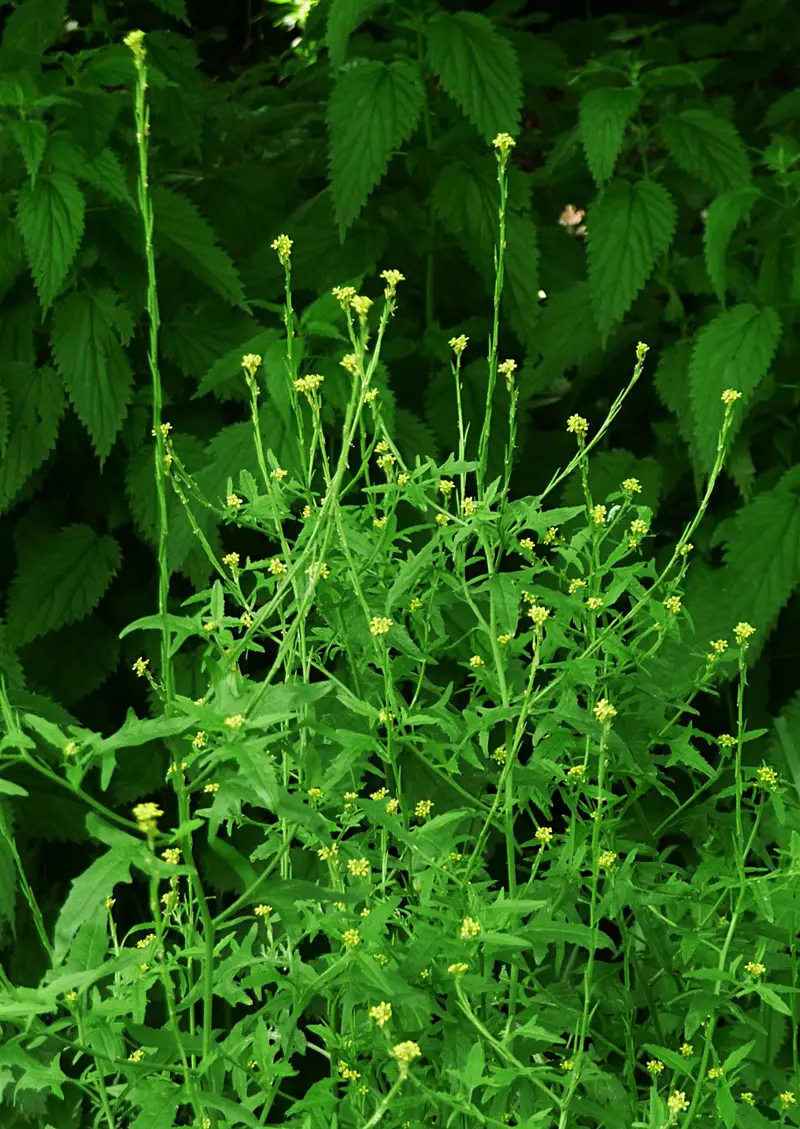
Hedge mustard is a wiry crucifer, growing either as a small rosette-forming annual or, more usually, as a tall, stiffly branched biennial reaching 60 to 90cm. Its branches are held out at sharp, almost right angles, giving the plant a gaunt, gallows-like silhouette, and the tiny lemon-yellow flowers are crowded at the stem tips.
About
Hedge mustard is a wiry crucifer, growing either as a small rosette-forming annual or, more usually, as a tall, stiffly branched biennial reaching 60 to 90cm. Its branches are held out at sharp, almost right angles, giving the plant a gaunt, gallows-like silhouette, and the tiny lemon-yellow flowers are crowded at the stem tips. Flowering runs from spring to autumn, with the main flush around midsummer. A distinctive feature is the slender seed pods, which lie pressed flat against the stem. In Britain it is now regarded as an archaeophyte, an ancient introduction rather than a true native.
It is almost always found near habitation, colonising roadsides, hedge banks, field edges, waste ground and disturbed soil in full sun. The flowers offer forage for bees, and it serves as a foodplant for some white butterflies. Long valued in herbal tradition as a soother of the throat, it is a tough, weedy ruderal of open ground.
Also known as
Crambling Rocket · European hedge mustard · Hairypod Hedgemustard · Hedge Mustard · Hedge Tumblemustard
Synonyms
Chamaeplium officinale · Crucifera sisymbrium · Erysimum officinale · Erysimum officinale leiocarpum · Erysimum runcinatum · Erysimum vulgare · Hesperis niagarensis · Hesperis officinalis · Hesperis ruderalis · Kibera officinalis · Klukia officinalis
Beta — under active development. This catalogue is still being built and accuracy-checked. The information here (including plant identifications, British native status, soil and sun/shade preferences) is provided in good faith for general guidance only and may contain errors or omissions. It must not be relied upon on its own — please confirm details with us before making planting, specification, foraging or purchasing decisions, and never eat or medicinally use any plant based on this catalogue alone, as some species are toxic. To the extent permitted by law, Phoenix Amenity Supplies accepts no liability for any loss arising from use of this information.