
Polemonium caeruleum L.
Blue Jacob's Ladder
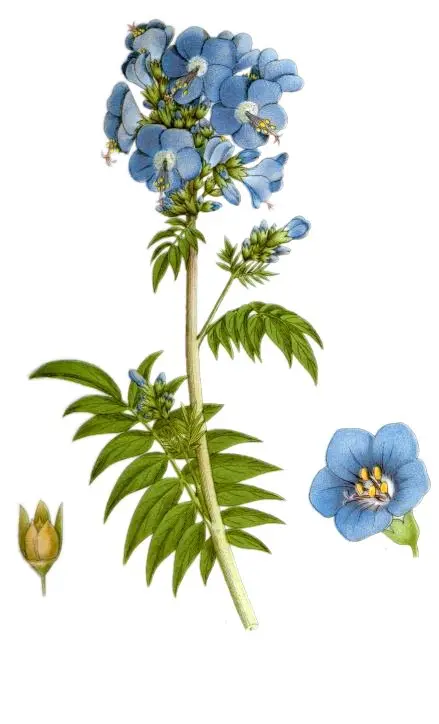
Jacob's-ladder is a clump-forming perennial named for its elegant pinnate leaves, whose paired leaflets climb the stalk like the rungs of a ladder. Above the foliage it lifts loose clusters of open, bell- to saucer-shaped flowers in soft violet-blue, occasionally white, each set off by bright orange stamens, typically from early to midsummer.
About
Jacob's-ladder is a clump-forming perennial named for its elegant pinnate leaves, whose paired leaflets climb the stalk like the rungs of a ladder. Above the foliage it lifts loose clusters of open, bell- to saucer-shaped flowers in soft violet-blue, occasionally white, each set off by bright orange stamens, typically from early to midsummer. Plants usually reach around 45 to 90cm tall. It is a genuine British native, but a very local and scarce one: its wild strongholds are cool, north-facing limestone slopes and flushed grassland in the Pennine dales of Derbyshire and Yorkshire, where it was voted Derbyshire's county flower.
Much more widely it is grown in gardens and naturalised from cultivation. It thrives on moist but well-drained, fertile, base-rich soils in sun or light shade. The nectar- and pollen-rich flowers are very attractive to bumblebees and other long-tongued bees, making it a fine choice for damp meadow plantings, wildlife borders and pollinator mixes.
Also known as
Charity · Greek valerian · Greek-valerian · Jacob's Ladder · Jacob's-ladder
Synonyms
Polemonium caeruleum caeruleum · Polemonium caeruleum hidakanum · Polemonium caeruleum insulare · Polemonium caeruleum laxiflorum · Polemonium caeruleum vulgare · Polemonium coeruleum · Polemonium himalayense · Polemonium humile
Beta — under active development. This catalogue is still being built and accuracy-checked. The information here (including plant identifications, British native status, soil and sun/shade preferences) is provided in good faith for general guidance only and may contain errors or omissions. It must not be relied upon on its own — please confirm details with us before making planting, specification, foraging or purchasing decisions, and never eat or medicinally use any plant based on this catalogue alone, as some species are toxic. To the extent permitted by law, Phoenix Amenity Supplies accepts no liability for any loss arising from use of this information.