
Orobanche minor Sm.
Common Broomrape
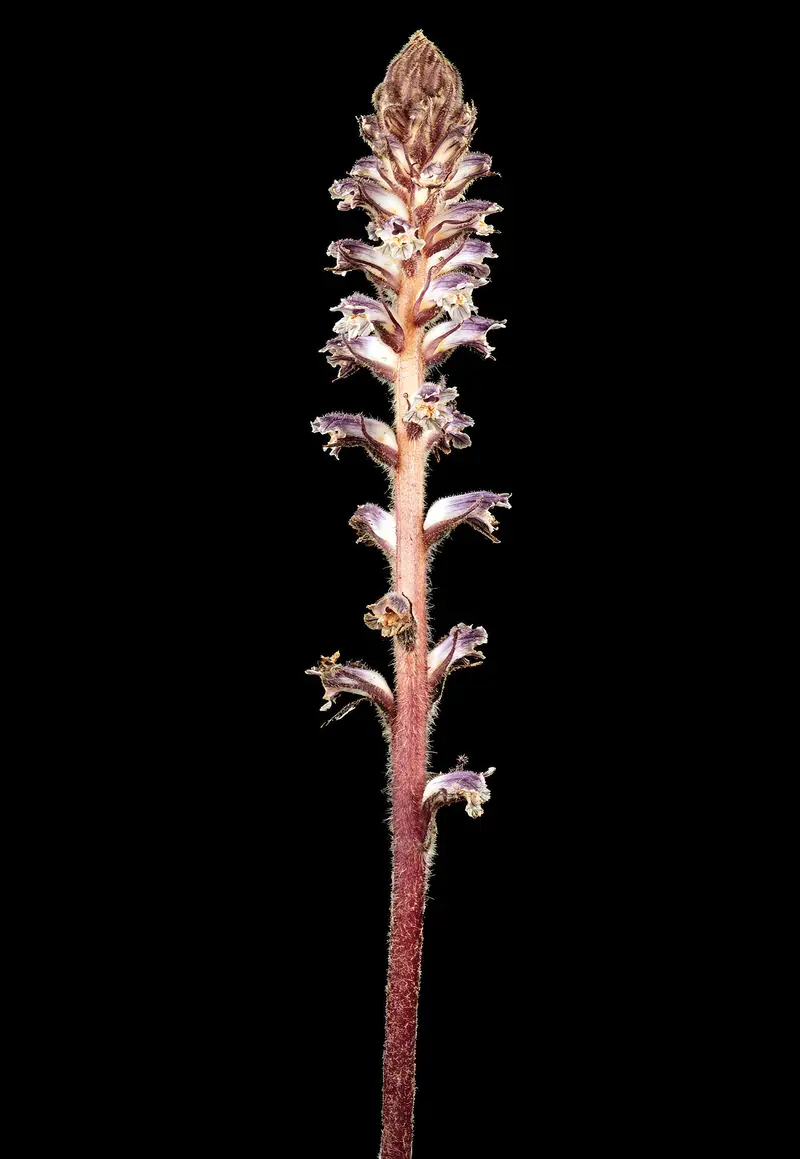
Common broomrape is a native parasitic plant that lives entirely off the roots of other species, lacking chlorophyll and any green leaves of its own. It pushes up as a solitary, leafless flowering stem, typically 10-50cm tall, in shades of straw, honey-brown and dull purple, clothed in scale-like bracts and bearing a spike of tubular, two-lipped flowers, usually creamy or yellowish and veined or flushed with purple.
About
Common broomrape is a native parasitic plant that lives entirely off the roots of other species, lacking chlorophyll and any green leaves of its own. It pushes up as a solitary, leafless flowering stem, typically 10-50cm tall, in shades of straw, honey-brown and dull purple, clothed in scale-like bracts and bearing a spike of tubular, two-lipped flowers, usually creamy or yellowish and veined or flushed with purple. Its commonest host is clover, but it parasitises a wide range of plants in the pea and daisy families.
It flowers from June through to September in grassland, rough and disturbed ground, verges and sometimes gardens and cultivated land, mainly across southern Britain on a variety of soils in sun or light shade. Because it must connect to a living host, it appears wherever suitable host plants grow and cannot be cultivated independently. Intriguing rather than showy, it is a curiosity of meadows and waste places rather than a plant for deliberate sowing.
Also known as
Hellroot · clover broomrape · lesser broomrape · small broomrape
Synonyms
Orobanche ambigua · Orobanche angela · Orobanche apiculata · Orobanche arvensis · Orobanche arvensis rubiginosa · Orobanche barbata · Orobanche barbata crithmi-maritimi · Orobanche barbata violacea · Orobanche boissieri · Orobanche bovei · Orobanche columbariae
Beta — under active development. This catalogue is still being built and accuracy-checked. The information here (including plant identifications, British native status, soil and sun/shade preferences) is provided in good faith for general guidance only and may contain errors or omissions. It must not be relied upon on its own — please confirm details with us before making planting, specification, foraging or purchasing decisions, and never eat or medicinally use any plant based on this catalogue alone, as some species are toxic. To the extent permitted by law, Phoenix Amenity Supplies accepts no liability for any loss arising from use of this information.