
Orobanche elatior Sutton
Knapweed Broomrape
Knapweed broomrape is an unusual native parasitic plant that contains no chlorophyll and makes no food of its own, instead drawing all its nourishment from the roots of a host. It is found chiefly on greater knapweed and other knapweeds, appearing as stiff, leafless flowering spikes rather than a typical leafy plant.
About
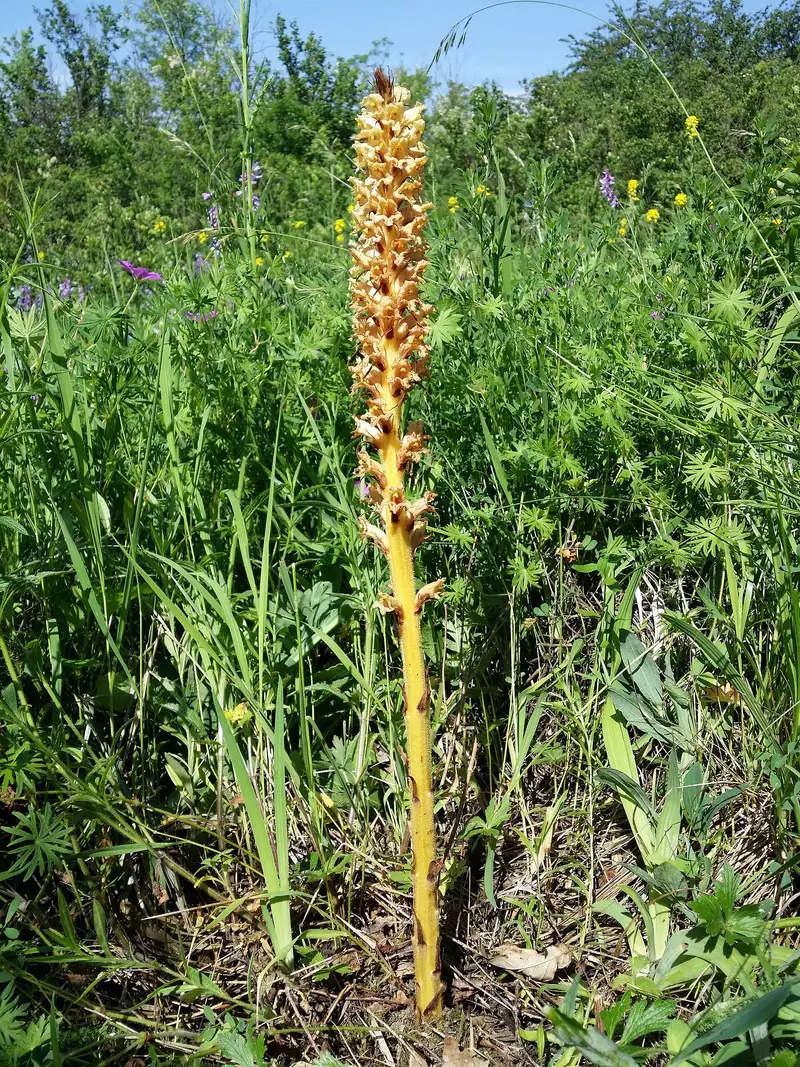
Knapweed broomrape is an unusual native parasitic plant that contains no chlorophyll and makes no food of its own, instead drawing all its nourishment from the roots of a host. It is found chiefly on greater knapweed and other knapweeds, appearing as stiff, leafless flowering spikes rather than a typical leafy plant. Reaching roughly 30-70cm, the whole stem is honey-coloured to yellowish- or reddish-brown, clothed in scale-like bracts and topped by a dense column of tubular, two-lipped flowers in soft amber and brown tones.
It flowers from June into July on dry, lime-rich grassland, favouring chalk and limestone downland and banks largely in southern England, wherever its knapweed hosts grow. Because it depends entirely on the host, it occurs only in established, undisturbed grassland and cannot be grown like an ordinary wildflower. The flowers are visited by bees. As a parasite of species-rich calcareous turf, it is best regarded as an indicator of good-quality grassland rather than something to be sown.
Also known as
tall broomrape
Synonyms
Orobanche caudata · Orobanche centauriophya · Orobanche echinopis · Orobanche echinopophyta · Orobanche elatior mierophyia · Orobanche elatior moraviea · Orobanche ritro · Orobanche stigmatodes
Beta — under active development. This catalogue is still being built and accuracy-checked. The information here (including plant identifications, British native status, soil and sun/shade preferences) is provided in good faith for general guidance only and may contain errors or omissions. It must not be relied upon on its own — please confirm details with us before making planting, specification, foraging or purchasing decisions, and never eat or medicinally use any plant based on this catalogue alone, as some species are toxic. To the extent permitted by law, Phoenix Amenity Supplies accepts no liability for any loss arising from use of this information.