
Ophrys apifera Huds.
Bee Orchid
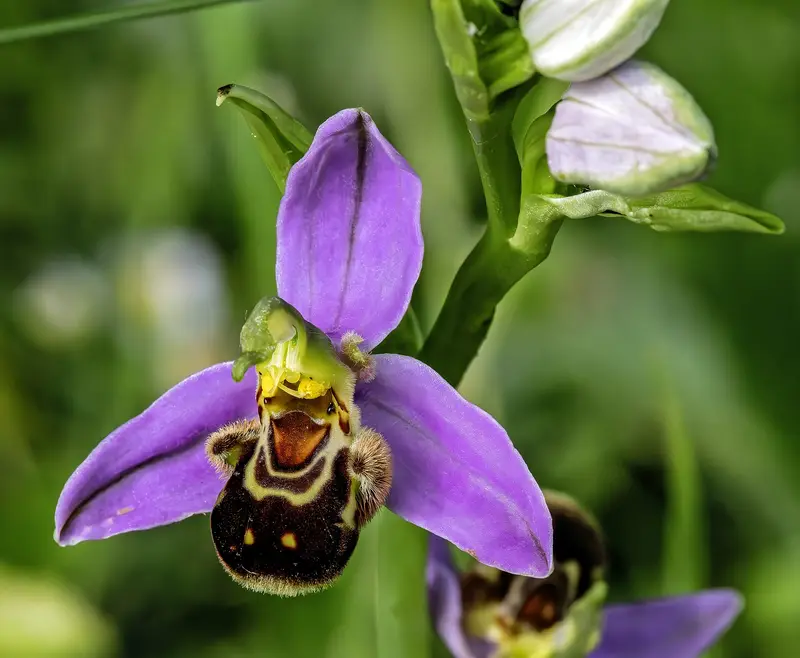
The bee orchid is a native perennial orchid famous for its extraordinary flowers, which mimic a female bee resting on a bloom. Rising from tubers to around 15-40cm, it forms a basal rosette of greyish-green leaves and a slender spike of a few well-spaced flowers.
About
The bee orchid is a native perennial orchid famous for its extraordinary flowers, which mimic a female bee resting on a bloom. Rising from tubers to around 15-40cm, it forms a basal rosette of greyish-green leaves and a slender spike of a few well-spaced flowers. Each has three spreading pink sepals and a plump, velvety, maroon-and-yellow lip patterned to resemble a bee's furry body, an evolved lure for would-be insect suitors.
It flowers in June and July on dry, lime-rich grassland, downland, dunes, verges and old quarries, mainly across central and southern England and scarcer to the north and west. In the Mediterranean these flowers are pollinated by male bees deceived into attempting to mate with them, but the right bee is absent in Britain, so here the plant is almost always self-pollinated. A much-loved indicator of unimproved calcareous grassland, it can appear unpredictably on undisturbed lime-rich ground.
Synonyms
Arachnites apifer · Arachnites apiferus · Ophrys albiflora · Ophrys apifera almaracensis · Ophrys apifera aurita · Ophrys apifera badensis · Ophrys apifera basiliensis · Ophrys apifera belgarum · Ophrys apifera bicolor · Ophrys apifera botteronii · Ophrys apifera brevilabellata
Beta — under active development. This catalogue is still being built and accuracy-checked. The information here (including plant identifications, British native status, soil and sun/shade preferences) is provided in good faith for general guidance only and may contain errors or omissions. It must not be relied upon on its own — please confirm details with us before making planting, specification, foraging or purchasing decisions, and never eat or medicinally use any plant based on this catalogue alone, as some species are toxic. To the extent permitted by law, Phoenix Amenity Supplies accepts no liability for any loss arising from use of this information.