
Odontites vernus (Bellardi) Dumort.
Red Bartsia
Red bartsia is a native annual that is partly parasitic, attaching its roots to those of grasses to draw off some of their resources while keeping its own green, photosynthesising leaves. Wiry and freely branched, it grows to around 30-50cm with four-angled stems and narrow, opposite, slightly toothed leaves, the whole plant often flushed with a dull reddish or bronzed tone.
About
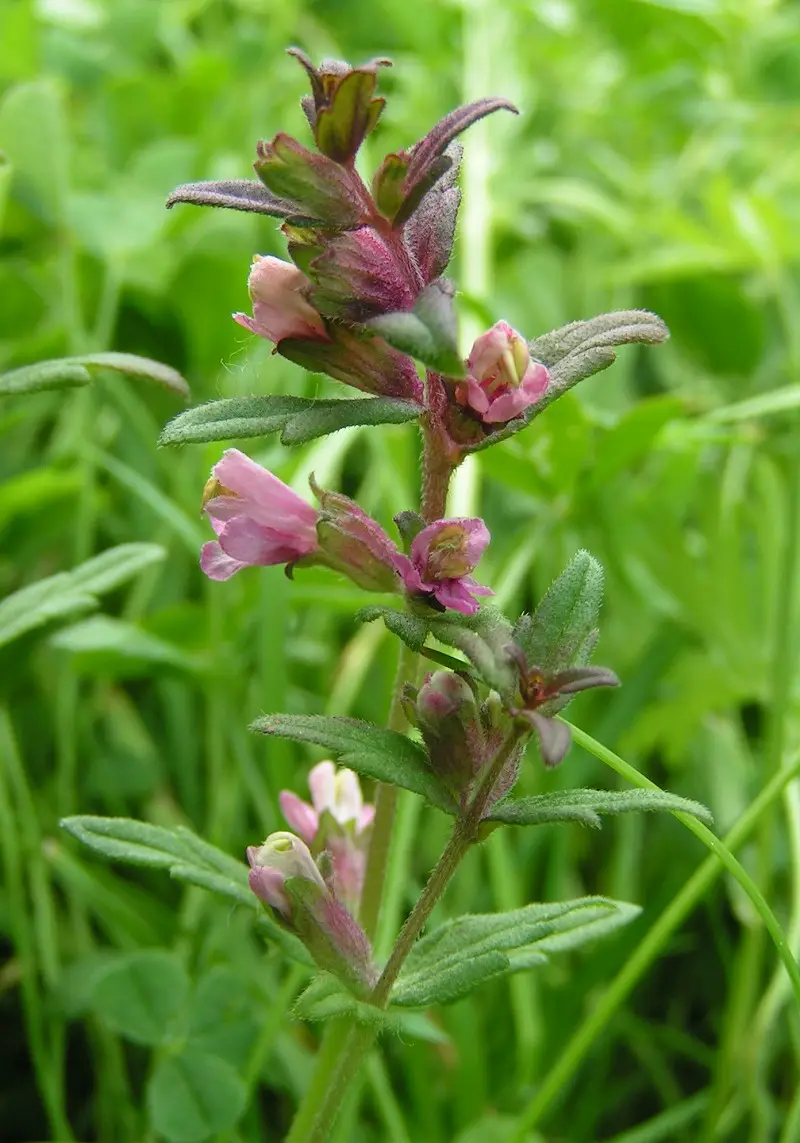
Red bartsia is a native annual that is partly parasitic, attaching its roots to those of grasses to draw off some of their resources while keeping its own green, photosynthesising leaves. Wiry and freely branched, it grows to around 30-50cm with four-angled stems and narrow, opposite, slightly toothed leaves, the whole plant often flushed with a dull reddish or bronzed tone. From summer into early autumn it carries one-sided spikes of small, dusky pinkish-purple, two-lipped flowers.
It favours short, open, low-fertility grassland and bare or compacted ground, doing well on track edges, field margins, verges and disturbed places across much of Britain. The flowers are a useful late-season nectar source, particularly for bees, including some specialist solitary bees. As a grass-weakening hemiparasite it can help create gaps for other wildflowers, so it has a place in meadow creation and conservation grassland on poor soils, though as an annual it relies on some open ground to regenerate from seed.
Synonyms
Odontites jaubertianus roseiflorus · Odontites ruber vernus · Odontites rubra verna · Odontites verna verna
Beta — under active development. This catalogue is still being built and accuracy-checked. The information here (including plant identifications, British native status, soil and sun/shade preferences) is provided in good faith for general guidance only and may contain errors or omissions. It must not be relied upon on its own — please confirm details with us before making planting, specification, foraging or purchasing decisions, and never eat or medicinally use any plant based on this catalogue alone, as some species are toxic. To the extent permitted by law, Phoenix Amenity Supplies accepts no liability for any loss arising from use of this information.