
Cruciata laevipes Opiz
Crosswort
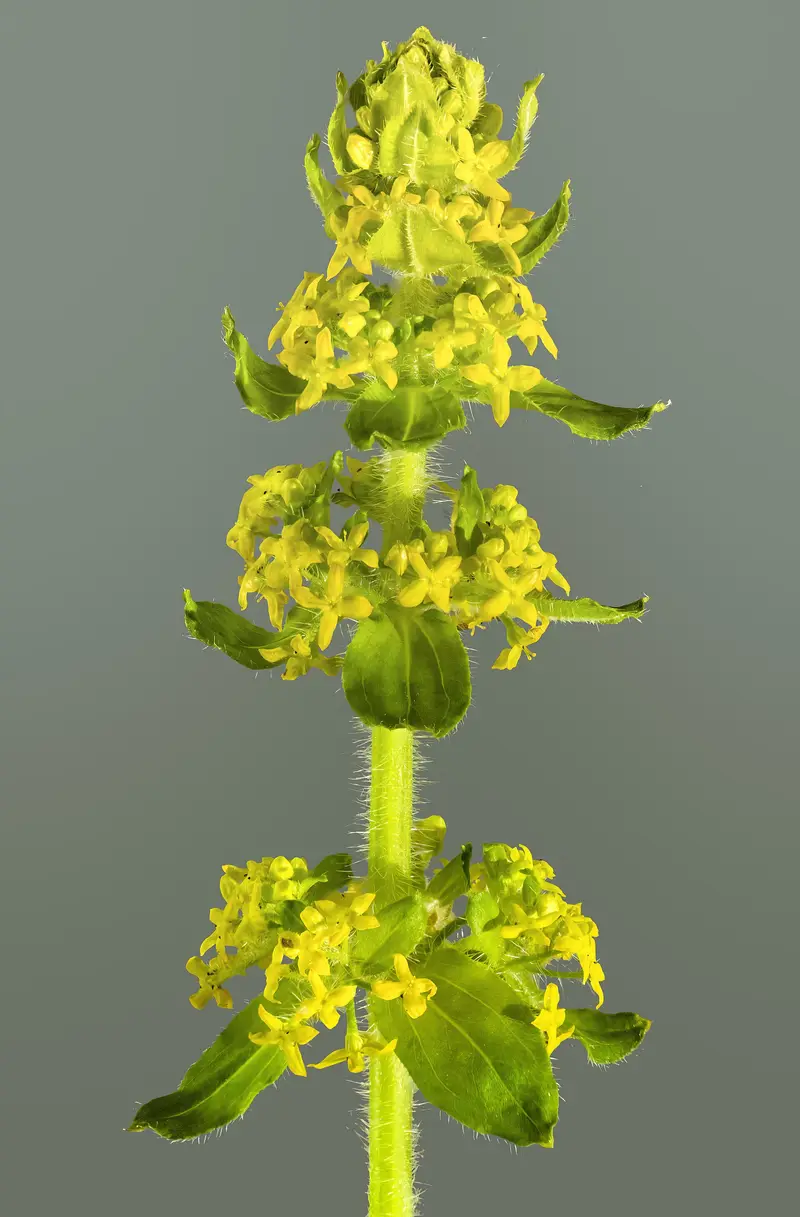
Crosswort is a softly hairy native perennial in the bedstraw family, fairly common across much of Britain and Ireland but increasingly scarce towards northern Scotland and generally absent from strongly acid soils. Its name comes from the neat arrangement of leaves: pale yellow-green, oval leaves are held in whorls of four, forming a series of little crosses up the square, weak stems.
About
Crosswort is a softly hairy native perennial in the bedstraw family, fairly common across much of Britain and Ireland but increasingly scarce towards northern Scotland and generally absent from strongly acid soils. Its name comes from the neat arrangement of leaves: pale yellow-green, oval leaves are held in whorls of four, forming a series of little crosses up the square, weak stems. Clustered in the leaf axils are tiny, four-petalled yellow flowers, just a few millimetres across, that carry a soft scent of honey.
It grows on well-drained neutral to calcareous ground, and is a good plant to look for on chalk downland, sunny woodland edges, hedge banks, scrub and ungrazed grassy verges. Peak flowering runs from April to June, early in the season, providing nectar for bees, hoverflies and other insects when many meadow flowers are still to come. A pretty, low-key choice for grassland mixes and hedge-bottom planting on lime-rich soils.
Also known as
Maywort · Smooth bedstraw
Synonyms
Aparine latifolia · Cruciata ciliata · Cruciata ciliata glabrifolia · Cruciata ciliata hirsutissima · Cruciata ciliata laevicaulis · Cruciata ciliata laxa · Cruciata ciliata mucronata · Cruciata ciliata nana · Cruciata hirsuta · Cruciata laevipes brutia · Galium chersonense hispanicum · Galium ciliatum laevicaulis
Beta — under active development. This catalogue is still being built and accuracy-checked. The information here (including plant identifications, British native status, soil and sun/shade preferences) is provided in good faith for general guidance only and may contain errors or omissions. It must not be relied upon on its own — please confirm details with us before making planting, specification, foraging or purchasing decisions, and never eat or medicinally use any plant based on this catalogue alone, as some species are toxic. To the extent permitted by law, Phoenix Amenity Supplies accepts no liability for any loss arising from use of this information.